• HOME
  • NEWS
  • EXPLORE
    • CAREER
      • Companies
      • Jobs
    • EVENTS
    • iGEM
      • News
      • Team
    • PHOTOS
    • VIDEO
    • WIKI
  • BLOG
  • COMMUNITY
    • FACEBOOK
    • INSTAGRAM
    • TWITTER
Sunday, August 9, 2026
BIOENGINEER.ORG
No Result
View All Result
  • Login
  • HOME
  • NEWS
  • EXPLORE
    • CAREER
      • Companies
      • Jobs
        • Lecturer
        • PhD Studentship
        • Postdoc
        • Research Assistant
    • EVENTS
    • iGEM
      • News
      • Team
    • PHOTOS
    • VIDEO
    • WIKI
  • BLOG
  • COMMUNITY
    • FACEBOOK
    • INSTAGRAM
    • TWITTER
  • HOME
  • NEWS
  • EXPLORE
    • CAREER
      • Companies
      • Jobs
        • Lecturer
        • PhD Studentship
        • Postdoc
        • Research Assistant
    • EVENTS
    • iGEM
      • News
      • Team
    • PHOTOS
    • VIDEO
    • WIKI
  • BLOG
  • COMMUNITY
    • FACEBOOK
    • INSTAGRAM
    • TWITTER
No Result
View All Result
Bioengineer.org
No Result
View All Result
Home NEWS Science News Chemistry

Shock-dissipating fractal cubes could forge high-tech armor

Bioengineer by Bioengineer
July 7, 2020
in Chemistry
Reading Time: 2 mins read
0
IMAGE
Share on FacebookShare on TwitterShare on LinkedinShare on RedditShare on Telegram

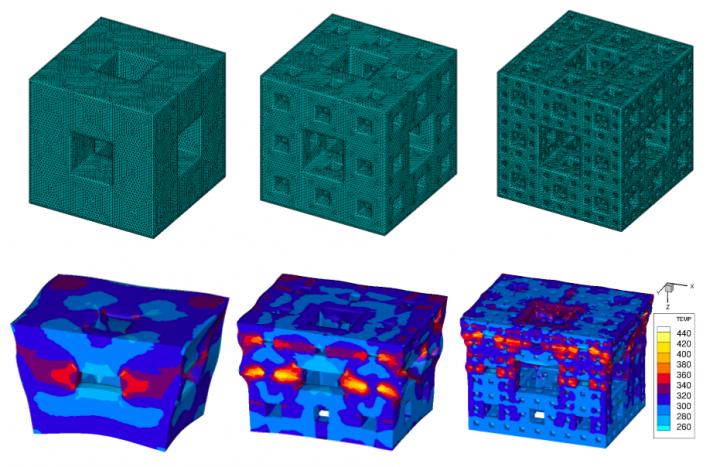
3D printed fractal structures with closely spaced voids dissipate shockwaves five times better than solid cubes
IMAGE

Credit: Los Alamos National Laboratory

Tiny, 3D printed cubes of plastic, with intricate fractal voids built into them, have proven to be effective at dissipating shockwaves, potentially leading to new types of lightweight armor and structural materials effective against explosions and impacts.

“The goal of the work is to manipulate the wave interactions resulting from a shockwave,” said Dana Dattelbaum, a scientist at Los Alamos National Laboratory and lead author on a paper to appear in the journal AIP Advances. “The guiding principles for how to do so have not been well defined, certainly less so compared to mechanical deformation of additively manufactured materials. We’re defining those principles, due to advanced, mesoscale manufacturing and design.”

Shockwave dispersing materials that take advantage of voids have been developed in the past, but they typically involved random distributions discovered through trial and error. Others have used layers to reverberate shock and release waves. Precisely controlling the location of holes in a material allows the researchers to design, model and test structures that perform as designed, in a reproducible way.

The researchers tested their fractal structures by firing an impactor into them at approximately 670 miles per hour. The structured cubes dissipated the shocks five times better than solid cubes of the same material.

Although effective, it’s not clear that the fractal structure is the best shock-dissipating design. The researchers are investigating other void- or interface-based patterns in search of ideal structures to dissipate shocks. New optimization algorithms will guide their work to structures outside of those that consist of regular, repeating structures. Potential applications might include structural supports and protective layers for vehicles, helmets, or other human-wearable protection.

###

The research will be published in the July 2020 issue of AIP Advances, in the article “Shockwave dissipation by interface-dominated porous structures,” by D.M. Dattelbaum et al.

About Los Alamos National Laboratory

Los Alamos National Laboratory, a multidisciplinary research institution engaged in strategic science on behalf of national security, is managed by Triad, a public service oriented, national security science organization equally owned by its three founding members: Battelle Memorial Institute (Battelle), the Texas A&M University System (TAMUS), and the Regents of the University of California (UC) for the Department of Energy’s National Nuclear Security Administration.

Los Alamos enhances national security by ensuring the safety and reliability of the U.S. nuclear stockpile, developing technologies to reduce threats from weapons of mass destruction, and solving problems related to energy, environment, infrastructure, health, and global security concerns.

Media Contact
James Riordon
[email protected]

Tags: Chemistry/Physics/Materials SciencesCivil EngineeringMaterialsMechanical EngineeringResearch/DevelopmentSatellite Missions/ShuttlesTechnology TransferTechnology/Engineering/Computer ScienceVehiclesWeaponry
Share12Tweet8Share2ShareShareShare2

Related Posts

Hebrew University Congratulates Haim Sompolinsky on Receiving 2026 Dirac Medal

Hebrew University Congratulates Haim Sompolinsky on Receiving 2026 Dirac Medal

August 8, 2026
New brain model reveals how regional chemistry shapes large-scale neural activity

New brain model reveals how regional chemistry shapes large-scale neural activity

August 8, 2026

Topological coupler breaks bandwidth tradeoff in broadband coupled resonator waveguides

August 8, 2026

Radical Chemistry Selectively Cleaves Strong Bonds While Preserving Weaker Ones

August 7, 2026
Please login to join discussion

POPULAR NEWS

  • Short-Term Animal-Product Restriction Rapidly Alters Human Proteogenomic Profiles

    29 shares
    Share 12 Tweet 7
  • UVA-Induced Hyperploidization Causes Fibrosis in Post-Mitotic Fuchs Dystrophy Corneal Cells

    29 shares
    Share 12 Tweet 7
  • Study Explores PDLIM2 as Prognostic Biomarker and Treatment Target in Lung Adenocarcinoma

    29 shares
    Share 12 Tweet 7
  • Healthy Vaccinee Effect Shapes Evaluation of Updated COVID-19 Vaccines in Older Adults

    29 shares
    Share 12 Tweet 7

About

We bring you the latest biotechnology news from best research centers and universities around the world. Check our website.

Follow us

Recent News

Short-Term Animal-Product Restriction Rapidly Alters Human Proteogenomic Profiles

UVA-Induced Hyperploidization Causes Fibrosis in Post-Mitotic Fuchs Dystrophy Corneal Cells

Study Explores PDLIM2 as Prognostic Biomarker and Treatment Target in Lung Adenocarcinoma

Subscribe to Blog via Email

Enter your email address to subscribe to this blog and receive notifications of new posts by email.

Join 86 other subscribers
  • Contact Us

Bioengineer.org © Copyright 2023 All Rights Reserved.

Welcome Back!

Login to your account below

Forgotten Password?

Retrieve your password

Please enter your username or email address to reset your password.

Log In
No Result
View All Result
  • Homepages
    • Home Page 1
    • Home Page 2
  • News
  • National
  • Business
  • Health
  • Lifestyle
  • Science

Bioengineer.org © Copyright 2023 All Rights Reserved.