Combined blue and red illumination enhances growth, biosynthesis of D. Salina microalgae
Credit: Xiaojian Zhou/Yangzhou University
WASHINGTON, March 30, 2021 — As ethanol, biodiesel, and other biofuels continue to present challenges, such as competing with food security or lacking the technology for more efficient and low-cost production, microalgae are gaining momentum as a biofuel energy crop.
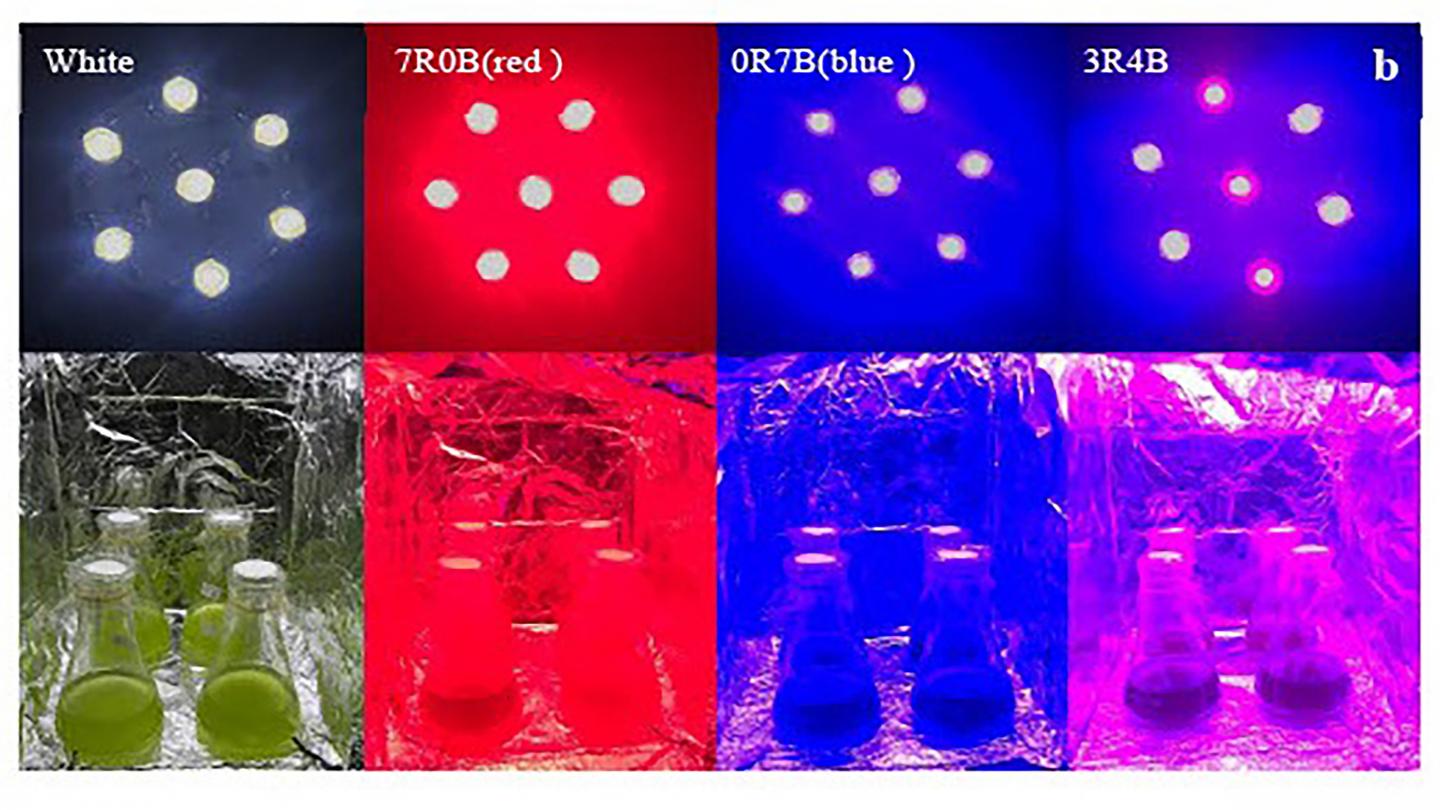
In their paper, published in the Journal of Renewable and Sustainable Energy, by AIP Publishing, Yangzhou University researchers in China show how a combination of monochromatic red and blue LED illumination on one type of microalga can enhance its growth and increase the biosynthesis of critical components, such as lipids, for microalgae feedstock development.
The researchers focused on Dunaliella salina (D. salina), typically extracted from sea salt fields and found in salt lakes. Easily cultivated and known for its bright pink color because of its high levels of carotenoid, D. salina is widely used in foods and cosmetics.
Microalgae tend to accumulate higher amounts of lipids (fatty acids that make up natural oils and waxes) than other biomass feedstocks do, which means a much higher percentage of the organisms can be turned into usable biofuel. In the case of D. salina, the lack of a cell wall could make algae biofuel production easier to pursue.
LEDs, as tunable single-color light sources, are already used to optimize plant growth, particularly in greenhouse cultivation. All parts of the visible spectrum are used in photosynthesis, but light also influences plant development. Adding more blue or red light, for instance, affects different plants in different ways. Optimal illumination conditions for microalgae growth and lipid production yield remain unknown.
In their study, the researchers applied red, blue, or combined red-blue illumination to D. salina culture. They found different intensities of blue light did not significantly enhance microalgae growth but boosted the lipid, protein, and carbohydrate levels. Red light, on the other hand, reduced algae growth and lipid formation, compared to blue and white light.
However, when red and blue lights were simultaneously applied in various ratios, the microalgae showed a major boost in growth and lipid productivity. The optimal 4-to-3 ratio of red and blue light significantly improved lipid productivity by more than 35% and increased dry biomass yield by more than 10% compared to the white light control.
The researchers are planning to analyze the composition of fatty acids synthesized in the algae under the favorable combined lighting for increased lipid production.
“Biodiesel performance is dependent on the composition of fatty acids, so we want to determine how the combined monochromatic lights would affect the quality of microalgae biodiesel,” author Xiaojian Zhou said.
###
The article “Impact of combined monochromatic light on the bio-component productivity of Dunaliella salina” is authored by Cuili Jin, Binqi Yu, Shouyuan Qian, Qing Liu, and Xiaojian Zhou. The article will appear in Journal of Renewable and Sustainable Energy on March 30, 2021 (DOI: 10.1063/5.0041330). After that date, it can be accessed at https:/
ABOUT THE JOURNAL
Journal of Renewable and Sustainable Energy is an interdisciplinary journal that publishes across all areas of renewable and sustainable energy relevant to the physical science and engineering communities. Topics covered include solar, wind, biofuels and more, as well as renewable energy integration, energy meteorology and climatology, and renewable resourcing and forecasting. See https:/
Media Contact
Larry Frum
[email protected]
Related Journal Article
http://dx.