Novel separation method accelerates SHINE’s path to market for cancer treatment isotopes
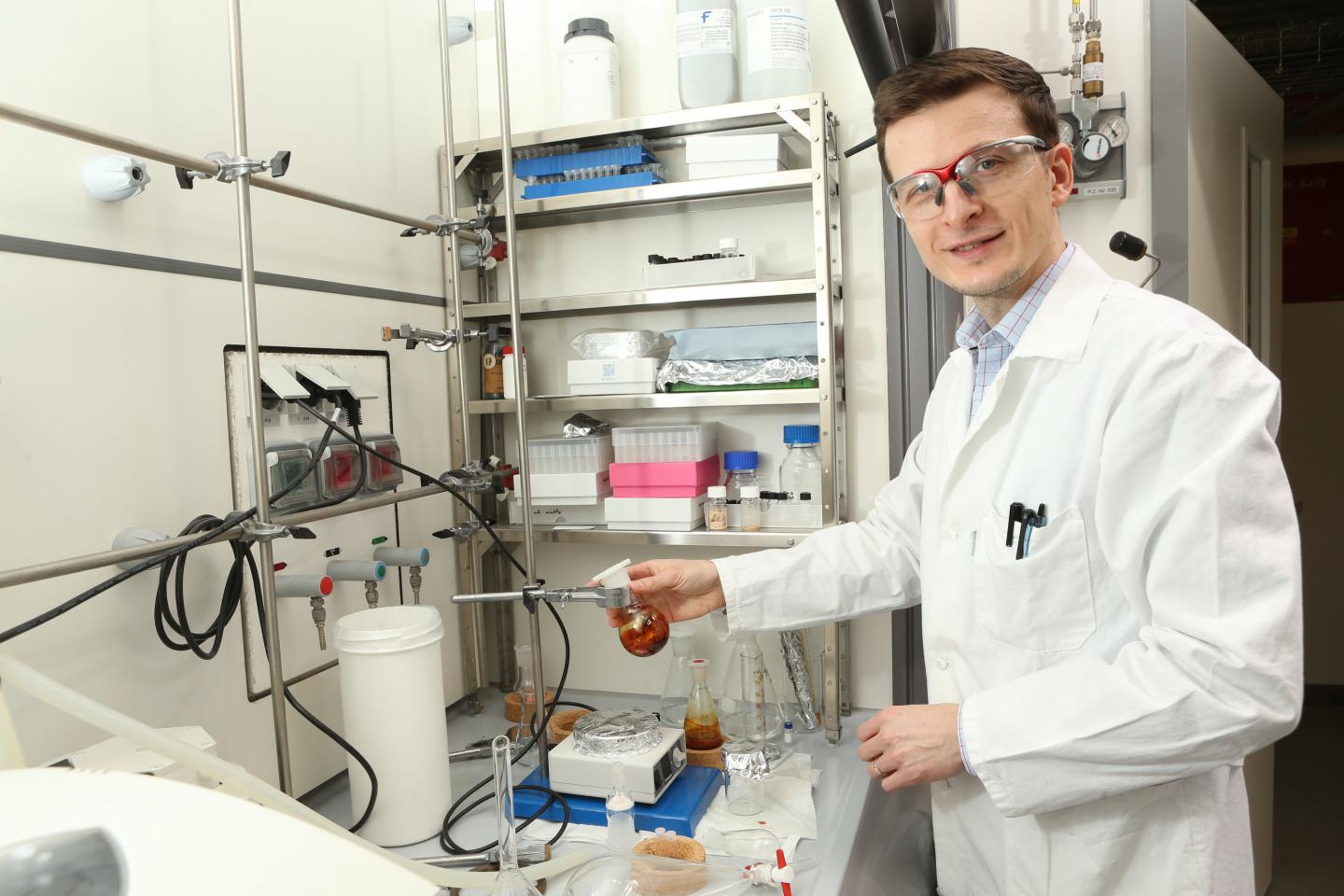
Credit: IOCB Prague
Prague, Czechia – SHINE Medical Technologies, Inc. (SHINE), a Wisconsin company dedicated to being the world leader in the safe, clean, affordable production of medical isotopes, and the Institute of Organic Chemistry and Biochemistry of the CAS (IOCB Prague) have entered into an intellectual property license agreement providing SHINE with a global, exclusive license to a novel method for separating rare earth elements. SHINE will use the innovation to produce lutetium-177 (Lu-177) for the treatment of cancer. The separation technique was developed by the team of Dr. Miloslav Polášek, Head of IOCB Prague’s Coordination Chemistry Research Group, which is devoted to advancing the fields of nuclear medicine and molecular imaging by providing new chemical tools.
“Separation of rare earth elements is notoriously difficult, particularly if they are radioactive and must be extremely pure. Our technology was developed specifically for this purpose and has a potential to improve speed and scale of Lu-177 production. As a scientist, I am thrilled that the years in the lab may bring a real-world application, especially if it helps cancer patients,” said Miloslav Polášek of IOCB Prague.
The announcement comes one week after SHINE broke ground on their US medical isotope production facility in Janesville, Wisconsin. This facility will use SHINE’s platform technology to produce a variety of medical isotopes, including Lu-177. The IOCB separation method will allow SHINE to rapidly and efficiently separate Lu-177 from irradiated ytterbium-176 targets, producing a highly concentrated Lu-177 product known as “non-carrier-added” or “high-specific-activity” Lu-177. In addition to irradiation and separation capabilities, SHINE is also pursuing the ability to create its own ytterbium-176 starting material.
“The Lu-177-based cancer therapeutics under development now show tremendous promise for doing a huge amount of good in the world,” said Greg Piefer, SHINE founder and CEO. “SHINE is committed to ensuring there is enough Lu-177 to meet demand as more and more patients benefit from these products. The IOCB technology is a key element of our strategy to get to market quickly.”
“We are very excited about this cooperation and we believe it will result in helping all patients who could benefit from Lu-177 therapy,” said Martin Fusek, Deputy Director for Strategic Development at IOCB Prague.
“The work Dr. Polášek is doing in this space is phenomenal. I hope that this is only the beginning of a long, mutually beneficial relationship between the IOCB Prague and SHINE,” said SHINE VP of Business Development, Katrina Pitas.
###
About IOCB Prague
The Institute of Organic Chemistry and Biochemistry of the Czech Academy of Sciences / IOCB Prague (http://www.
About SHINE Medical Technologies, Inc.
Founded in 2010, SHINE is a development-stage company working toward becoming a manufacturer of radioisotopes for nuclear medicine. The SHINE system uses a patented, proprietary manufacturing process that offers major advantages over existing and proposed production technologies, as it does not require a nuclear reactor, uses less electricity, generates less waste and is compatible with the nation’s existing supply chain for molybdenum-99. In 2014, SHINE announced the execution of molybdenum-99 supply agreements with GE Healthcare and Lantheus Medical Imaging. In 2015, with the help of Argonne National Laboratory, GE Healthcare demonstrated SHINE molybdenum-99 can act as a drop-in replacement for reactor-based moly-99. In 2016, SHINE received regulatory approval to construct its facility from the Nuclear Regulatory Commission and signed a moly-99 supply agreement with HTA Co., Ltd., the largest Chinese distributor of radiopharmaceuticals. In 2017, SHINE built the first building on its Janesville campus: SHINE Building One. Learn more at http://shinemed.
About Medical Isotopes
Medical isotopes are radioisotopes that are used in the diagnosis and treatment of disease. Molybdenum-99 (Mo-99) is a radioisotope that decays into the diagnostic imaging agent technetium 99m (Tc-99m). The workhorse of nuclear medicine, Tc-99m is used in more than 40 million medical imaging procedures each year, primarily in stress tests to diagnose heart disease and bone scans to stage cancer. SHINE was founded to deploy a safe, cost-effective and environmentally friendly technology to produce a variety of medical isotopes, including Mo?99. Roughly 1% of all Mo-99 in the world decays every hour, meaning it must be continuously produced. Current production is limited to only a handful of government-owned nuclear research reactors, the majority of which are overseas.
Media Contact
Dusan Brinzanik
[email protected]