


Mirror therapy has long been used to help stroke patients recover movement, but its protocols vary so widely that results have been difficult to compare. A new case-control study from Marmara University, published in the Bulletin of Faculty of Physical Therapy, tested a way to standardize the approach: combining the mirror’s visual illusion with the shaping method, a behavioral technique that breaks complex motor tasks into small, progressively harder steps reinforced by feedback. In 60 healthy young adults, the combined training improved unilateral dexterity and reaction time of the non-dominant hand compared with controls, although it did not produce a measurable advantage on a test of motor learning.
The study enrolled healthy volunteers aged 18 to 30 with right-side dominance, excluding anyone with a history of orthopedic or neurological disease or upper limb surgery. Thirty participants were assigned to the mirror therapy group and 30 age- and gender-matched volunteers served as controls who simply maintained their usual daily routines. The mean age was 23.4 years in both groups, and 56.7 percent of participants were female. One additional participant in the intervention group dropped out after experiencing nausea during the hand exercises, leaving 30 completers per side. The study was non-randomized, retrospectively registered, and reported according to the STROBE guidelines for observational studies.
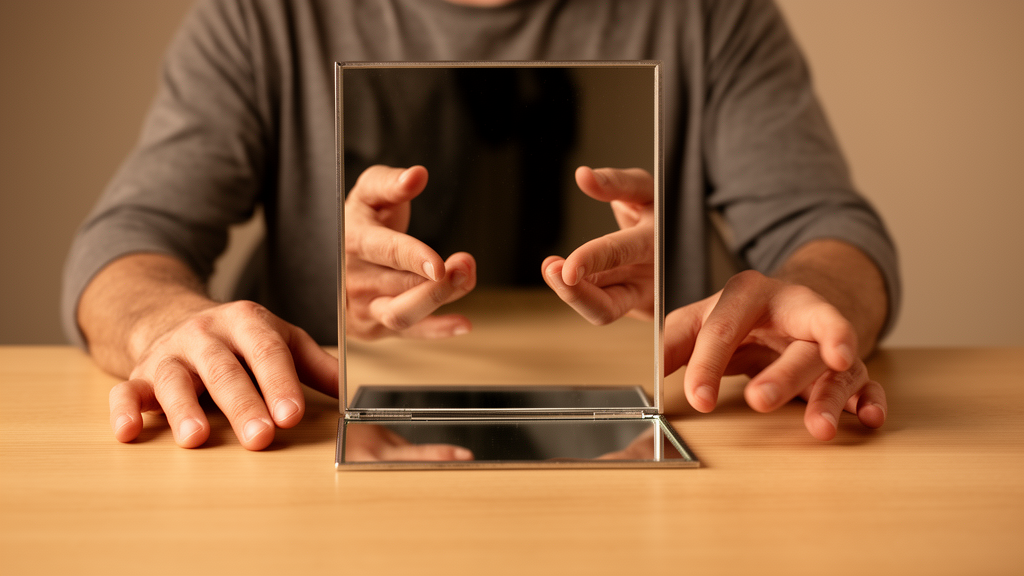
The intervention itself was deliberately compact. Participants trained twice a week for four weeks, with each session lasting 20 minutes, a dosage drawn from published mirror therapy reports in stroke populations where half of studies used a four-week period. Seated at a table with a 26 by 35 centimeter mirror on the body’s midline, each participant placed the dominant hand in front of the mirror and the non-dominant hand hidden behind it. The dominant hand then performed ten repetitions of a series of fine motor shaping activities, including clothespin attachment, ring threading on a rod, connecting dots, placing pencils in a glass, Velcro board tasks, dipping a fork in play dough, sorting cubes, inserting balls into perforated plates, and geometric jigsaw puzzles. Difficulty was progressed by adjusting parameters such as reaching distance, completion time, and repetition number according to each participant’s ability.
The researchers assessed three domains before and after the four weeks. Motor learning, the primary outcome, was measured with a Finger Tapping Test administered on the PsyToolkit platform, in which participants keyed a fixed four-digit sequence as quickly and accurately as possible across nine ten-second trials. Dexterity was assessed with the Roeder Manipulative Aptitude Test, which yields unilateral, bilateral, and total scores by timing the insertion of rods, caps, washers, and nuts into a perforated board, first with one hand and then with both. Reaction time was measured with the Nelson Hand Reaction Time Test, a ruler-catch procedure in which the falling distance is converted into milliseconds.
At baseline, the groups were not equivalent. The mirror therapy group started with significantly poorer bilateral and total Roeder scores but faster Nelson reaction times than controls, which the authors addressed by using analysis of covariance with baseline scores as covariates in all between-group comparisons. After adjustment, the intervention group showed significantly better unilateral dexterity (Roeder unilateral, p = 0.013), total Roeder score (p = 0.006), and reaction time (p < 0.001) than controls. No significant between-group differences emerged for bilateral dexterity (p = 0.552) or the Finger Tapping Test (p = 0.063).
The finger tapping result deserves careful reading. Both groups improved significantly within their own pre-post comparisons on this measure, and the control group’s improvement despite receiving no intervention suggests that much of the change reflects a test-retest or practice effect on a simple, repetitive task rather than a treatment effect. The authors also note that the shaping activities emphasized object-directed, precision-based unimanual tasks with graded difficulty, which may simply not target the fast, ballistic movement pattern the tapping test demands. With a partial eta squared of 0.059 and observed power of 0.461, the study may also have been underpowered to detect a difference of this size, so the null result should not be read as definitive evidence that the training leaves motor learning untouched.
The dissociation between unilateral and bilateral dexterity has a plausible mechanistic explanation rooted in how mirror therapy works. The technique creates a visual illusion in which the movement of one hand appears to be the movement of the other, engaging visual feedback pathways thought to drive cortical reorganization. But in this paradigm only one hand is physically active at any time, and the two hands never need to coordinate with each other. Bilateral dexterity depends on interlimb coordination and temporal coupling between both hands acting simultaneously, a demand that mirror-illusion training targeting a single moving limb is not designed to address. Gains transferring to unilateral but not bilateral performance of the hidden hand are therefore consistent with the proposed mechanism.
The reaction time improvement may partly reflect the structure of the training itself. Speed was used as a progression parameter, with participants encouraged to perform each activity faster on every trial, and the authors suggest this emphasis encouraged faster responses on the ruler-catch task. The authors frame the combination as a potential standardized protocol for mirror therapy, addressing the long-standing inconsistency in how the intervention is delivered, and note that shaping is a core component of constraint-induced movement therapy, which carries Level A evidence in stroke rehabilitation.
Important limitations temper the findings. The control group received no intervention at all, meaning the mirror therapy group also received regular therapist contact, structured task engagement, and the expectation of benefit from a novel treatment; the authors recommend sham or active control conditions, such as the same exercises with a covered mirror, to isolate the specific contribution of the mirror illusion. Assessors were not blinded. The study included only healthy young adults, so nothing here demonstrates efficacy in stroke or other clinical populations, and the authors explicitly call for future trials in patient groups. They also acknowledge that the Roeder test, despite its established normative data, lacks formally published psychometric validation studies, and that the optimal dosage of repetitions, duration, and intensity for building motor learning remains unclear.
Whether the same protocol translates into therapeutic benefit for patients, and whether longer or more intensive training would finally move the needle on motor learning itself, remains for future research to determine.
Subject of Research: Shaping-enhanced mirror therapy and motor function of the non-dominant hand in healthy adults
Article Title: Effects of shaping-enhanced mirror therapy on motor function in healthy adults: a case-control study
Article References: Öztürk, S., Doğan, Ö., Kara, A. N., & Huseyinsinoglu, B. E. (2026). Effects of shaping-enhanced mirror therapy on motor function in healthy adults: a case-control study. Bulletin of Faculty of Physical Therapy, 31(1), Article 37. https://doi.org/10.1186/s43161-026-00373-8
Image Credits: AI Generated
DOI: 10.1186/s43161-026-00373-8
Keywords: mirror therapy, shaping method, motor learning, dexterity, reaction time, healthy adults, non-dominant hand, case-control study, motor rehabilitation, constraint-induced movement therapy, Finger Tapping Test, Roeder Manipulative Aptitude Test
News Source: Ophelia Keating. (October 29, 2026). Shaping-Enhanced Mirror Therapy Boosts Unilateral Dexterity and Reaction Time in Healthy Adults. Scienmag.



