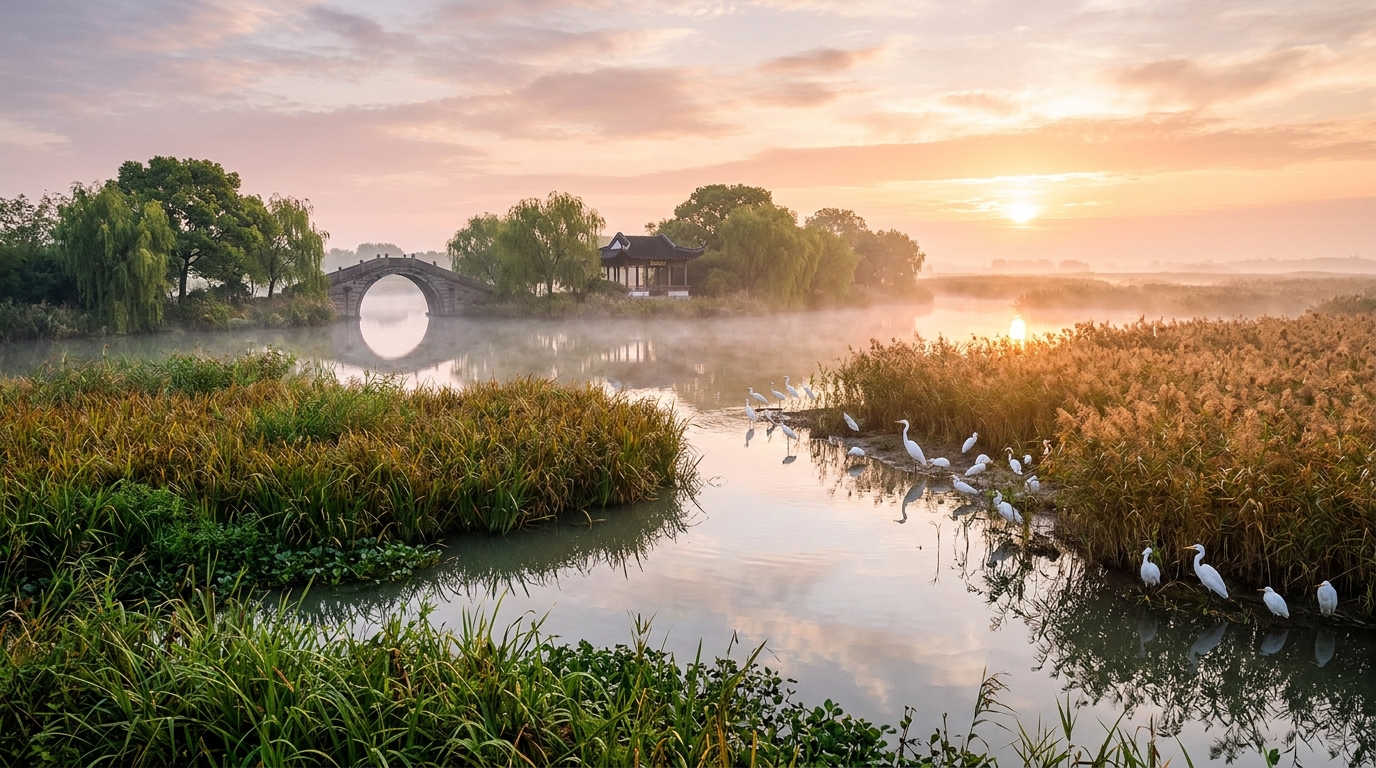
A new research article published in the journal Built Heritage proposes a theoretical framework for ‘nature-culture holistic conservation’ to address the growing disconnection between natural environments and cultural heritage in Chinese megacities. The study, led by Yong Shao and colleagues, uses Shanghai as a primary case study to explore how the city’s unique urban character, deeply rooted in the Jiangnan water land, can be preserved and integrated into modern metropolitan planning. By drawing on the Historic Urban Landscape (HUL) approach and traditional Eastern philosophies, the authors argue that current conservation efforts in Shanghai are fragmented across administrative and planning sectors, limiting the realization of holistic urban value.
The research is situated within a broader policy context where China has committed to integrating ‘ecological civilisation’ into all aspects of development. This shift raises urgent questions about how urban culture, the natural environment, and society can be understood holistically. The authors identify a critical gap in existing literature and practice: while Shanghai has established separate systems for cultural heritage and ecological conservation, there is no systematic framework that interweaves these two domains across administrative boundaries and multiple spatial scales. This study aims to fill that empirical and theoretical gap by refining cognitive and planning approaches towards the ‘nature-culture system’ in Shanghai.
The methodology adopts the HUL approach proposed by UNESCO as a conceptual and methodological framework, operationalized through three analytical dimensions: cognition, planning practices, and governance strategies. At the cognitive level, the team conducted historical document research and spatial interpretation to analyze the economic, political, and geographical characteristics of ancient Shanghai. This analysis revealed that the development of the Shanghai region exhibits holistic characteristics of close interaction and mutual reinforcement between nature and culture, a pattern that has persisted from prehistoric times to the modern era.
Historical analysis indicates that Shanghai’s urban genes are deeply rooted in the unique ‘nature-culture system’ of the Yangtze River Delta. The formation of the city is described as a history of continuous human adaptation within the Jiangnan water network and coastal environment. Natural geographical elements, such as the Gangshen shell-sand ridge, created a differentiated foundation of western lakes and marshes versus eastern coastal areas. To the west, humans transformed the low-lying plain into a ‘land of fish and rice,’ while to the east, sediment deposition from the Yangtze River gradually formed new land over the past 4,000 years, supporting salt and cotton industries.
The study highlights the evolution of Shanghai’s town system, which shifted from inland lake areas towards river-sea corridors driven by navigational and ecological advantages. The establishment of the Huangpu River as a stable outlet for Taihu Lake in 1403, following the ‘Huangpu Captures Wusong’ hydraulic project, established Shanghai’s status as a pivotal port. This hydrological structure allowed the city to become a hub for river-sea transhipment, earning it the reputation of ‘the gateway of rivers and seas.’ The modern era saw the port opening in 1843, which led to a fragmented urban space under the concession system, yet the spatial morphology of expansion remained fundamentally guided by the natural hydrological framework of the Huangpu River and Suzhou Creek.
Contemporary analysis identifies five distinct ‘Geographical-Cultural Units’ in Greater Shanghai, including the urban centre, the Gangshen-Songjiang unit, the Songbei-Pingjiang unit, the coastal emerging unit, and the sand-island unit. Each unit possesses a stable structure formed through long-term human-environment interaction. The ‘One River and One Creek’ framework, comprising the Huangpu River and Suzhou Creek, is identified as the core axis traversing Shanghai’s natural evolution, spatial organisation, and social development. This axis represents the Jiangnan water land structure at the megacity scale, integrating different historical periods and functional types into an organic whole.
Despite these historical foundations, the study identifies significant challenges in current conservation practices. Shanghai has established comprehensive systems for cultural heritage, natural protected areas, and rural landscapes, but fundamental fragmentation persists. At the planning level, conservation plans for natural and cultural domains have historically been formulated independently, creating a gap in cross-sectoral integration. While recent plans like the Shanghai Historic Cultural City Conservation Plan (2024–2035) have embraced a holistic perspective, they remain parallel to existing natural conservation frameworks, such as the Shanghai Ecological Space Plan. This separation means that unique cultural landscapes with composite values, such as ancient river polders and salt-reclamation landscapes, remain incompletely identified or protected.
At the management level, fragmented governance leads to insufficient synergy. Natural and cultural conservation fall under different sectors, with planning and resource departments coordinating historic cities, while forestry and water authorities manage protected areas and river systems. This fragmentation increases coordination costs and weakens spatial continuity in areas where culture and nature are highly superimposed, such as water towns and waterfronts. For example, on Chongming Island, vernacular resources are not integrated into the world-class ecological benchmark, and in the Dianshan Lake area, the symbiotic relationship between ancient town culture and wetlands is weakened by separate departmental strategies.
The authors propose a three-dimensional action framework to address these challenges. At the cognitive level, they advocate for a shift from object-based classification to a holistic cognitive framework centred on the ‘nature-culture system.’ Natural elements should be recognized as the foundational conditions for cultural continuity, while cultural landscapes should be understood as the products of long-term human-environment interaction. This cognitive shift aims to transform holistic conservation into a rational tool guiding development rather than a passive constraint.
At the planning level, the study recommends integrating nature-culture conservation into territorial spatial planning at all levels. This involves superimposing hydrological structures, ecological networks, and historical resources to identify high-composite-value areas, such as water-town clusters and coastal-estuarine eco-cultural zones. The authors suggest conceptualising the ancient Gangshen boundary as a territory-wide ‘natural-cultural heritage corridor’ to guide greenbelts and heritage trails. In suburban and rural areas, maintaining the spatial grain of ‘Shanghai-style Jiangnan’ by controlling settlement scales and protecting polders and field landscapes is key to preserving the ‘mountain-water-settlement-field’ structure.
At the governance level, the framework calls for integrated and regionally coordinated mechanisms. Shanghai should participate in regional synergy within the Yangtze River Delta Eco-Green Integrated Development Demonstration Zone, embedding itself within cross-regional water governance and ecological corridors. The study emphasizes the need to shift governance focus from protecting single elements to maintaining holistic relationships, using water town cultural landscape clusters as operational units. This requires cultural, water, and forestry authorities to pool funding and share responsibilities to overcome conflicts between architectural restoration and environmental remediation.
The research concludes that Shanghai’s international status should not come at the cost of sacrificing its regional cultural and ecological foundations. By treating the cultural genes and natural foundations of the Jiangnan water town as core strategic resources, the city can achieve cultural continuity and ecological resilience. The proposed framework offers a reference for the sustainable development of comparable metropolises, demonstrating how traditional Chinese planning philosophy can be adapted to the context of a modern international metropolis. This approach seeks to ensure that the modern built environment harmonises with the underlying water-town ecosystem, fostering a distinctive Shanghai-style Jiangnan character on the global stage.
The study’s theoretical framework draws on the UNESCO Recommendation on the Historic Urban Landscape (HUL), adopted in 2011, which defines the historic urban landscape as the result of historic layering of cultural and natural values extending beyond the historic centre to the broader urban context. The authors integrate this with the traditional Chinese concept of ‘harmony between heaven and humans,’ which posits that nature and culture are deeply intertwined rather than separate domains. This philosophical underpinning supports the argument that conservation should not aim to restore a static historical moment but to sustain key structures and cultural genes through adaptive transformation. The framework emphasizes interconnectedness, systematicity, and living dynamics, viewing river systems and landforms as core elements of a regional cultural ecosystem rather than mere background environments.
Shanghai’s contemporary conservation efforts are structured around specific spatial plans that reflect this holistic intent. The Special Plan for the Protection and Inheritance of Characteristic Village Landscapes in Shanghai (2023–2035) identifies 148 rural character units across 12 typologies, covering 1,556 administrative villages. This plan mandates the preservation of blue-green substrata, including shallows, water, forests, fields, lakes, grasses, and marshes, ensuring that traditional settlements remain within polders and wetlands. It establishes a hierarchical framework with 20 pilot units for detailed strategies and institutes horizontal coordination across transport, water, agriculture, and ecology departments. This operationalizes the shift from protecting single elements to maintaining holistic relationships, translating conservation discourse into a multiscalar governance tool.
The Yangtze River Delta Eco-Green Integrated Development Demonstration Zone, launched in November 2019, provides a national strategic platform for regional coordination. Spanning 2,300 square kilometers around Dianshan Lake across two provinces and Shanghai, this zone enables regional holistic governance by coordinating ecological security, cultural heritage, and high-quality development. For Shanghai, this strategy redefines the Jiangnan water land as a vital spatial unit carrying cultural-ecological functions rather than merely an urban hinterland. Cross-regional water system governance and the construction of ecological corridors within this zone offer the policy space to reconstruct a regional nature-culture system, allowing Shanghai to demonstrate its natural substrata and cultural characteristics on a larger scale.
The study notes that Shanghai’s architectural evolution reflects its nature-culture integration, characterized by high inclusivity and continuous innovation. From traditional Jiangnan courtyards to Shikumen housing and modern Art Deco buildings, the city’s architecture serves as a material carrier of its adaptive construction logic. The ‘One River and One Creek’ project, which has opened the 45-km Huangpu River core shoreline since 2017, exemplifies this integration by transforming closed industrial waterfronts into public life-oriented spaces. This initiative links natural foundations with humanistic functions, providing critical structural support for rebuilding nature-culture connections in high-density urban environments. The research concludes that such integrated approaches are essential for shaping Shanghai into an international metropolis with distinct Jiangnan characteristics, offering a reference for comparable megacities seeking to balance globalisation with local heritage conservation.
Subject of Research: Theoretical framework for nature-culture holistic conservation in Shanghai
Article Title: From Jiangnan water land to Greater Shanghai: exploring ‘nature-culture holistic conservation’ in an international metropolis
Article References: Shao, Y., Geng, Q., Zhang, K., & Hu, L. (2026). From Jiangnan water land to Greater Shanghai: exploring ‘nature-culture holistic conservation’ in an international metropolis. Built Heritage, 10(1), 80. https://doi.org/10.1186/s43238-026-00317-0
Image Credits: AI Generated
DOI: 10.1186/s43238-026-00317-0
Keywords: urban planning, heritage conservation, Shanghai, Jiangnan culture, sustainable development, historic urban landscape, ecological civilisation, spatial planning, Jiangnan, water, land, Greater
News Source: Margaret Porter. (November 9, 2026). Shanghai study proposes holistic nature-culture conservation framework. Scienmag.