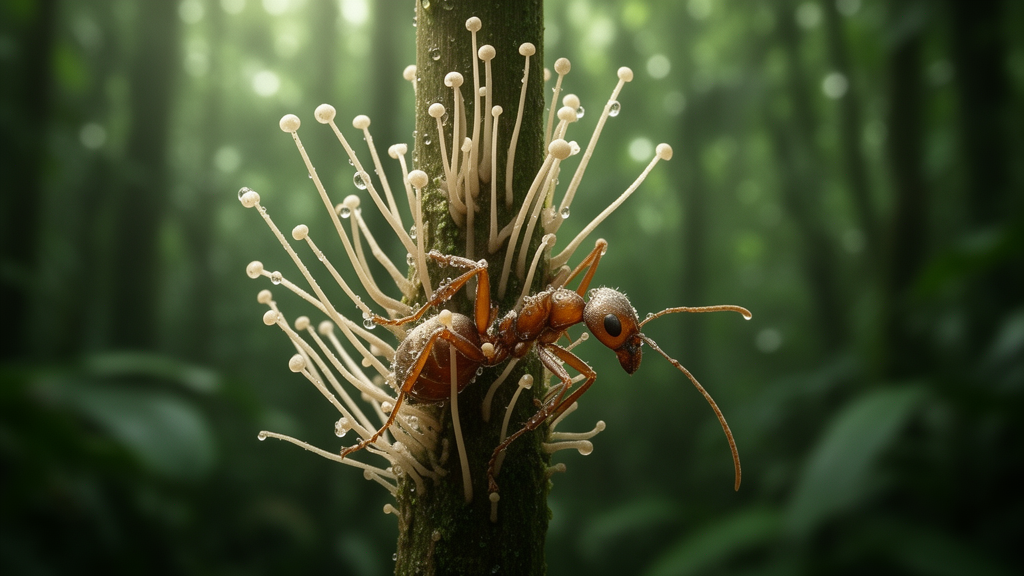
Deep in the forests of southwestern China and northern Thailand, an international team of mycologists has been hunting for one of nature’s most sinister parasites: fungi that invade insects, hijack their bodies, and erupt from their corpses in strange, branching stalks. That hunt has now paid off in spectacular fashion. In a study published in IMA Fungus, researchers describe seven brand-new species of entomopathogenic fungi — parasites that kill insects — and, in the process, untangle one of the most confusing branches of the fungal tree of life.
The newly described species belong to a group of fungi famous for their macabre lifestyle. Entomopathogenic fungi infect their hosts, consume them from the inside, and then push fruiting structures through the insect’s exterior to spread their spores. The most celebrated member of this group is Ophiocordyceps unilateralis, the so-called zombie-ant fungus that manipulates its ant hosts before killing them. But the broader family these parasites belong to, the order Hypocreales, includes hundreds of species that prey on beetles, moths, cicadas, spiders, and even other fungi — and many of them remain formally unknown to science.
The research team, led by Xian Zhang and colleagues, collected eight fungal species from Guizhou, Yunnan, and Liaoning Provinces in China and from Chiang Rai Province in Thailand. The specimens were found growing from insect larvae and adults on the surfaces of leaves, in leaf litter, and even buried in soil. Some of the fungi emerged as delicate white or yellowish stalks called synnemata, while others formed dark, wiry structures characteristic of the genus Ophiocordyceps. Each specimen was photographed in the field, brought back to the laboratory, and examined under both stereomicroscopes and compound microscopes to document every diagnostic detail.
To determine whether these fungi were genuinely new, the team turned to DNA. They sequenced six genetic markers — the ITS region, the nuclear small and large ribosomal subunits (nrSSU and nrLSU), and the protein-coding genes tef1-α, rpb1, and rpb2 — building a dataset of 5,072 characters covering 303 taxa. Using maximum likelihood and Bayesian inference, they reconstructed an evolutionary tree showing exactly where each new fungus belonged. The result was unambiguous: seven of the eight species had never been described before, and the eighth turned out to be a known species, Ophiocordyceps formicarum, recovered from a new locality.
The seven new species span three genera. Two belong to Ophiocordyceps itself: O. jinguangensis, found in Yunnan’s Jinguang Temple Nature Reserve parasitizing a beetle larva, and O. northeastensis, collected in Jilin Province in northeast China from click beetle larvae. Four more belong to the family Polycephalomycetaceae: Polycephalomyces bannaensis from Xishuangbanna, Polycephalomyces chiangraiensis from northern Thailand, and two species of Pleurocordyceps, P. shibingensis from Guizhou and P. tengchongensis from Yunnan. The seventh, Dingleyomyces yunnanensis, is particularly intriguing because it does not infect insects directly — instead, it parasitizes the fruiting bodies of other Ophiocordyceps species, making it a fungal parasite of a fungal parasite.
Each new species had to be distinguished not only genetically but also morphologically. Ophiocordyceps jinguangensis, for example, sits as a sister lineage to O. formosana and O. spicatus with maximum statistical support, but it lacks the vivid orange pigmentation of its relatives and has measurably shorter asci and longer secondary ascospores. Ophiocordyceps northeastensis differs from its closest relative, O. stylophora, by six percent of its ITS sequence — a substantial genetic gap. For Polycephalomyces bannaensis, the team went further, applying a pairwise homoplasy index (PHI) test to check for genetic recombination with its closest relatives. The test found no evidence of gene flow (Φw = 0.2105, above the significance threshold), confirming that the new species is reproductively isolated and genuinely distinct.
Beyond describing new species, the study tackles a long-standing taxonomic headache: the hirsutella-like fungi. These fungi share a distinctive asexual form in which flask-shaped cells called phialides, with swollen bases tapering into slender necks, produce conidia often coated in slime. This morphology, first defined in the genus Hirsutella more than a century ago, has proven remarkably slippery for taxonomists. Because similar phialide shapes evolved independently in unrelated lineages, fungi with hirsutella-like forms have been shuffled between genera repeatedly, and recent classifications have become increasingly inconsistent as new species accumulate.
To bring order to the chaos, the researchers produced the first comprehensive map of hirsutella-like species across the two relevant families, Ophiocordycipitaceae and Polycephalomycetaceae. By plotting phialide shapes, conidial features, and host associations onto their phylogenetic tree, they identified 17 distinct clades carrying this morphology — including the O. sinensis clade, home of the caterpillar fungus prized in traditional medicine; the O. unilateralis clade of zombie-ant fungi; and clades containing nematode-trapping Drechmeria, sickle-spored Harposporium, and the cyclosporin-producing Tolypocladium. The analysis revealed that some traits, such as warty phialide ornamentation and mucous-sheathed conidia, recur across related species and appear evolutionarily conserved, while others arose independently in distant lineages — a textbook case of convergent evolution that explains why morphology alone has repeatedly misled classification.
The study also documented a scientific first: the asexual form of the genus Dingleyomyces had never been observed until now. Dingleyomyces yunnanensis produces two distinct types of phialides on the same synnema — crowded, palisade-like α-phialides and solitary, lanceolate β-phialides with long tapering necks — and its fusiform conidia differ from the cylindrical spores of its only previously known relative, D. lloydii of New Zealand. The discovery also expands the known host range of the genus to a different Ophiocordyceps species, suggesting these fungicolous parasites may be less host-specific than assumed.
Why does all this fungal bookkeeping matter? Entomopathogenic fungi are far more than curiosities of natural history. They regulate insect populations in forests and agricultural soils, inspire new pest-control agents, and produce bioactive compounds — most famously cyclosporin, the immunosuppressant that made organ transplantation possible, derived from a Tolypocladium relative. A stable, accurate classification is the foundation for all of this applied work, and for understanding how these parasites evolved their extraordinary host-shifting abilities. By combining multigene phylogenetics with careful microscopy and recombination testing, this study offers a template for disentangling other morphologically plastic fungal groups — and a reminder that in the world of insect-killing fungi, appearances can be profoundly deceiving.
Subject of Research: Phylogenetics and taxonomy of hirsutella-like entomopathogenic fungi in Ophiocordycipitaceae and Polycephalomycetaceae
Article Title: Reappraisal of the phylogenetic relationships of hirsutella-like fungi across Ophiocordycipitaceae and Polycephalomycetaceae ( Hypocreales , Sordariomycetes ), and the description of seven new species
Article References: Zhang, X., Peng, X.-C., Wei, D.-P., Wang, Y., Norphanphoun, C., Hongsanan, S., Xie, N., Liu, Z.-L., Mapook, A., Kang, J.-C., Saichana, N., Hyde, K. D., & Wen, T.-C. (2026). Reappraisal of the phylogenetic relationships of hirsutella-like fungi across Ophiocordycipitaceae and Polycephalomycetaceae (Hypocreales, Sordariomycetes), and the description of seven new species. IMA Fungus, 17, Article e171084. https://doi.org/10.3897/imafungus.17.171084
Image Credits: AI Generated
DOI: 10.3897/imafungus.17.171084
Keywords: entomopathogenic fungi, Ophiocordyceps, Hirsutella, phylogenetics, new species, Polycephalomycetaceae, Ophiocordycipitaceae, Hypocreales, taxonomy, fungal parasites, multigene analysis, China
News Source: Roger Howard. (October 18, 2026). Seven New Zombie-Ant Fungal Relatives Rewrite the Infection Family Tree. Scienmag.