Credit: Champalimaud Centre for the Unknown/Sara Matias
What happens when serotonin levels increase in human brain? How does this affect our behavior? This is a question that highly interests neuroscientists: serotonin has multiple functions in the brain and understanding what it actually does is a huge task. Not the least because serotonin is at the root of a whole class of antidepressant drugs, the most well-known of which being Prozac, that apparently work by increasing serotonin levels in the human brain.
Previous results suggested that increased serotonin levels make animals (including people) more willing to wait longer for a reward to arrive – in other words, that it makes them more patient. This was compatible with the idea, accepted by many, that serotonin generally acts by inhibiting behavior, because in many cases patience requires postponing doing something.
But now this idea has been challenged by an international team, led by neuroscientists from the Champalimaud Centre for the Unknown (CCU), in Lisbon, Portugal. Their results have been published today in the journal Nature Communications.
The new study shows that serotonin promotes more than just passive waiting – more than simple patience. It enhances active persistence in a task, even in the face of uncertain reward.
Persistence means actively following through on a task, even if unpleasant, like completing your homework, whereas many forms of patience simply require sitting tight and doing nothing.
It so happens that the tasks used in the previous studies did not allow their authors to distinguish between patience and persistence. But in the new work, Eran Lottem, the first author of the paper, and his colleagues developed a task that is actually very similar to the natural situation animals face when foraging for food.
"We had some hints suggesting that the inhibitory effect of serotonin was not general. Some behaviors were unaffected by serotonin", says Lottem. "But we had never seen an active behavior promoted by serotonin. This is, to my knowledge, the first time such a behavior has been observed when serotonin-producing neurons are activated."
The task consisted in giving the mice the choice between two drinking sites placed at each end of a long rectangular box. At any given time, only one drinking site was ready to release water, so the mice had to roam back and forth between the two sides of the box to find the water, and to get it, they had to give a poke with their nose at the drinking site.
Sneakily, to mimic the unpredictability of real world situations, the experimenters arranged that even an active drinking site did not always deliver water, so they would have learn to tolerate some unsuccessful pokes. This provided the scientists with a way to measure the persistence of the animals: they could count the number of pokes they were willing to give in order to try to get water at a "dry" site (one that had ceased giving water).
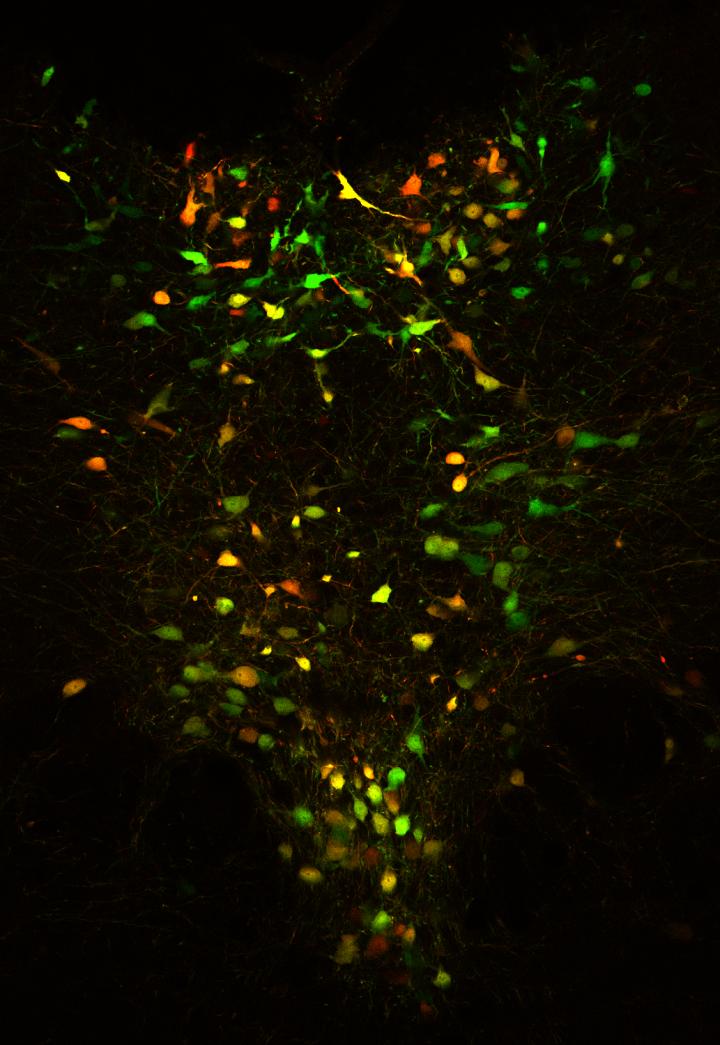
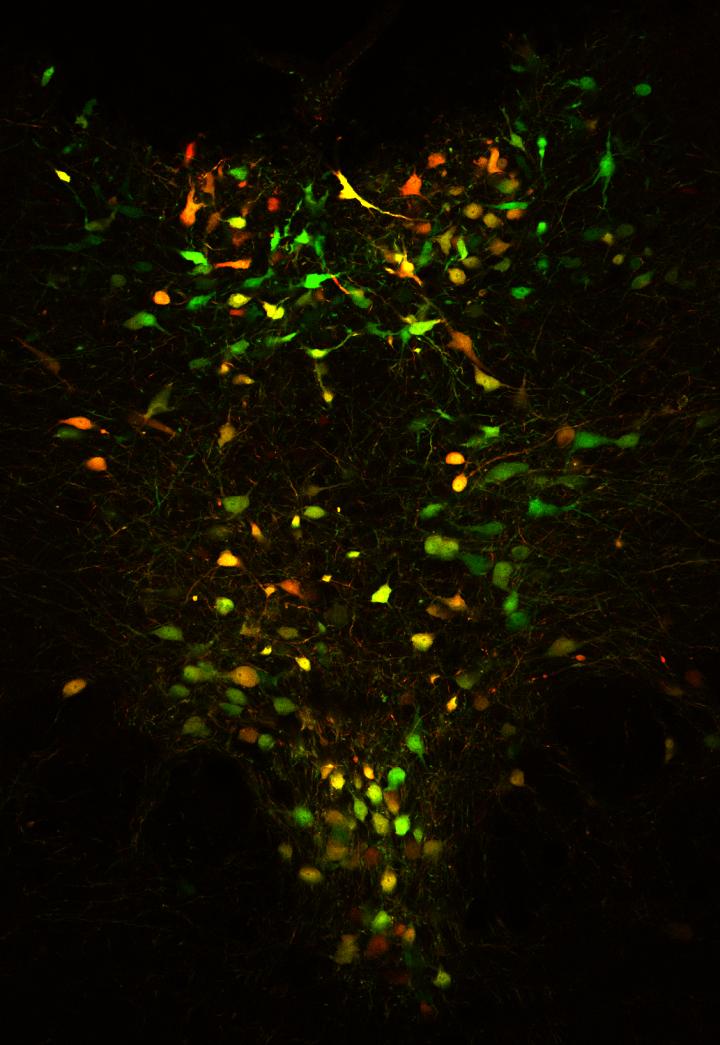
Once the task was in place, the scientists used a technology known as optogenetics to stimulate the serotonin-producing neurons using pulses of laser light delivered by an implanted optic fiber to the animals' brains.
"What we saw was that when those neurons were stimulated, the animals were willing to poke longer even when they were not getting water, says Lottem. Therefore, serotonin was not inhibiting their behavior because, in that case, the mice would have given up sooner." In other words, he concludes, "the activation of serotonin neurons promotes active persistence rather than mere patience".
Zachary Mainen, the lead author of this study, suggests that the results may ultimately help us to understand better how to treat depression, a disorder in which serotonin is implicated. "The difference between patience and persistence may sound subtle, but the implication is not: it could be the difference between quietly sitting in bed while the world goes by and jumping out of bed each day to greet it".
###
Media Contact
Maria João Soares
[email protected]
http://www.fchampalimaud.org/
Related Journal Article
http://dx.doi.org/10.1038/s41467-018-03438-y