


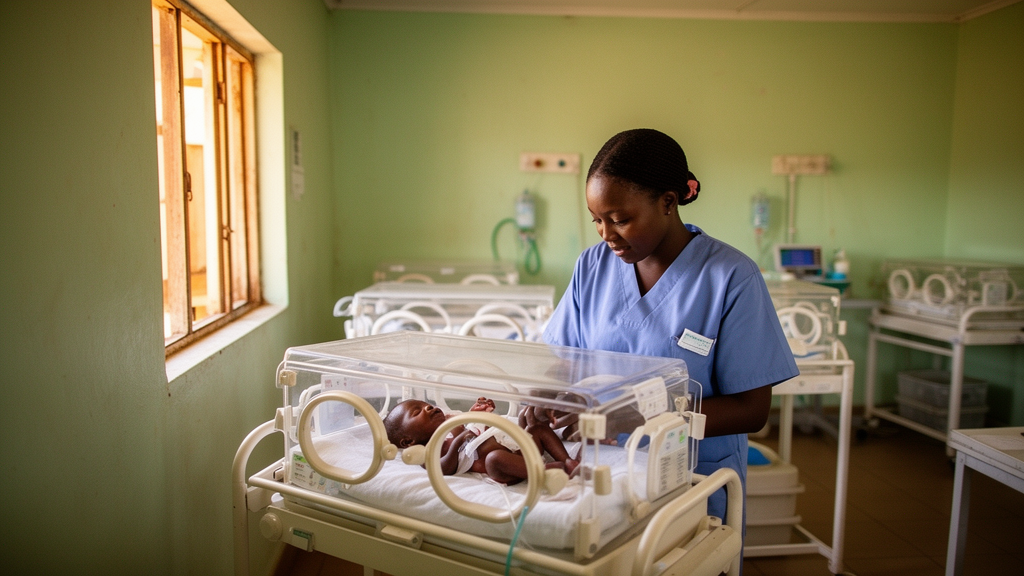
Nearly one in eight newborns admitted to the neonatal intensive care unit at Livingstone University Teaching Hospital in southern Zambia died during their stay, according to a retrospective cohort study analyzing 690 neonates admitted between May 2025 and January 2026. The researchers report a mortality proportion of 13.0 percent, with a 95 percent confidence interval of 10.6 to 15.8, and an incidence rate of 17.3 deaths per 1,000 neonate-days across 5,215 neonate-days of observation. Most deaths occurred within the first 14 days of admission, and the leading causes were neonatal sepsis, which accounted for 32.2 percent of deaths, and birth asphyxia, which accounted for 26.7 percent.
The study, published in Discover Pediatrics, stands apart from much of the earlier hospital-based research in Zambia because it used survival analysis rather than relying solely on mortality proportions. The team estimated survival probabilities with Kaplan–Meier methods and identified independent predictors of death through Cox proportional hazards regression. Previous studies at institutions such as the University Teaching Hospital in Lusaka and Ndola Teaching Hospital had predominantly employed descriptive or cross-sectional designs, leaving gaps in knowledge about the timing of death, incidence rates based on person-time, and survival patterns among hospitalized neonates, particularly in the country’s southern province.
Livingstone University Teaching Hospital is a tertiary referral facility that manages high-risk and critically ill newborns referred from surrounding health facilities in southern and western Zambia. Its neonatal unit functions as a Level II care unit with 40 beds, admitting approximately 1,200 to 1,500 neonates annually. The unit is staffed by senior pediatricians, six pediatric registrars, 22 nurses including nine specialized neonatal nurses, and medical interns. Its equipment includes two CPAP machines, six resuscitaires, eight phototherapy units, three cardiac monitors, 11 syringe and infusion pumps, three radiant heaters, a transcutaneous bilirubin machine, incubators, and an emergency trolley. Neonates requiring advanced management beyond the unit’s capacity are referred to the University Teaching Hospital in Lusaka.
The study population comprised all live-born neonates aged 0 to 28 completed days at admission during the study period, identified through a census sampling approach. Of 712 neonates admitted, 690 met the eligibility criteria and were included in the final analysis. Neonates with unknown dates of admission or outcome, and those referred immediately to other facilities before their outcome could be ascertained, were excluded. Data were extracted from routine NICU registers and patient records using a structured abstraction tool, capturing neonatal characteristics such as sex, gestational age, birth weight, Apgar score, admission temperature, random blood glucose, HIV exposure status, and need for respiratory support, along with maternal factors including age, parity, place and mode of delivery, and antenatal steroid exposure.
The baseline characteristics of the cohort revealed a predominantly male population, with 482 of the 690 neonates, or 73.4 percent, being boys. Most mothers were aged 20 to 34 years, the median maternal parity was 2, the median gestational age at birth was 38 weeks, and the median birth weight was 2,800 grams. The vast majority of deliveries, 93.8 percent, occurred in health facilities, with vaginal delivery the most common mode. Notably, antenatal corticosteroids were administered to only 15 of 549 eligible mothers, or 2.7 percent, a strikingly low coverage given that eligibility was defined as pregnancies between 28 and 34 weeks of gestation at risk of preterm delivery. Overall, 232 neonates, or 34.5 percent, required continuous positive airway pressure, and 55, or 9.3 percent, were HIV-exposed.
The Kaplan–Meier analysis showed that survival declined steeply during the early days of admission. Survival probability was 93.0 percent within the first two days, with a 95 percent confidence interval of 90.7 to 94.7, decreasing to 89.7 percent by days 2 to 4 and 86.7 percent by days 4 to 6. The decline continued through days 10 to 12, when survival reached 78.6 percent. After the second week, the curve stabilized, with no deaths recorded between days 14 and 20. A small number of additional deaths occurred after day 20, reducing survival to 69.5 percent by days 22 to 24, after which it remained unchanged. Survival also differed sharply by respiratory support status, with neonates requiring CPAP showing lower survival probabilities than those not receiving respiratory support, a difference significant at a log-rank p-value below 0.001.
In the multivariable Cox regression, three factors remained independently associated with mortality. Each additional week of gestation was associated with a 15 percent reduction in the hazard of death, with an adjusted hazard ratio of 0.85 and a 95 percent confidence interval of 0.79 to 0.91. Higher 5-minute Apgar scores were likewise protective, with an adjusted hazard ratio of 0.85 per unit increase and a confidence interval of 0.75 to 0.96. Conversely, requirement for CPAP was an independent predictor of increased mortality, with an adjusted hazard ratio of 2.75 and a confidence interval of 1.22 to 6.24, which the authors interpret as a marker of underlying illness severity rather than harm from the intervention itself. Sex and random blood glucose level were not independently associated with mortality after adjustment. Because the multivariable model required complete data on all included variables, the final analytical sample comprised 343 neonates among whom 43 deaths occurred, yielding approximately 8.6 events per variable.
The diagnostic profile of admissions was dominated by neonatal sepsis, affecting 187 neonates or 27.1 percent, followed by birth asphyxia at 142 cases or 20.6 percent, and prematurity and fetal growth disorders at 107 cases or 15.5 percent. Among the 90 deaths, sepsis was the leading cause at 29 deaths or 32.2 percent, followed by birth asphyxia at 24 deaths or 26.7 percent, and respiratory disorders of the newborn at 22 deaths or 24.4 percent. This contrasts with national Zambian data, where birth asphyxia at 30.2 percent and prematurity at 27.2 percent are the principal causes of neonatal mortality, followed by sepsis at 18.2 percent. The authors suggest the higher contribution of sepsis in their cohort likely reflects referral of critically ill neonates from rural facilities that often lack specialist obstetric and neonatal services.
The authors place their findings in a wider context of persistent global and regional inequities. Neonatal deaths worldwide have declined from approximately 5 million in 1990 to 2.4 million in recent years, yet newborn deaths now account for nearly half, or 47 percent, of all under-five mortality. Sub-Saharan Africa bears the highest burden, with an estimated 27 deaths per 1,000 live births, compared with roughly 21 per 1,000 in Central and Southern Asia. Zambia’s neonatal mortality rate is estimated at 21 deaths per 1,000 live births, with rural areas at 27 per 1,000 exceeding urban areas at 22 per 1,000. The country has committed to reducing neonatal mortality to 12 deaths per 1,000 live births by 2030 under Sustainable Development Goal Target 3.2. The reported NICU mortality of 13.0 percent falls within the documented 10 to 30 percent range for neonatal units in low- and middle-income countries, though it remains high for a tertiary facility and is lower than the 40.2 percent reported at the national quaternary referral center in Lusaka, which manages more complex cases.
The study has important limitations that shape how its findings should be read. Key maternal variables were incompletely documented, and the complete-case analysis may have introduced selection bias if participants with missing data differed from those included. The relatively small number of outcome events may have limited the precision of some estimates. Treating discharge as a censoring event assumes non-informative censoring, but because discharge decisions may be influenced by clinical status, that assumption may have been violated, potentially biasing survival estimates. The single-center, retrospective design also limits generalizability and precludes causal inference. Even so, the authors argue the findings point to concrete priorities: strengthening early neonatal stabilization, infection prevention, and timely sepsis management; improving neonatal resuscitation skills and early identification of high-risk infants; and expanding capacity for preterm care, essential equipment, and trained personnel. They also note that optimizing the delivery of CPAP, rather than its availability alone, is essential, since neonates who fail CPAP at their Level II unit must be referred roughly 470 kilometers to Lusaka for advanced respiratory support.
Subject of Research: Neonatal mortality incidence and clinical predictors among infants admitted to a tertiary neonatal intensive care unit in southern Zambia
Article Title: Mortality and associated factors among neonates admitted to the neonatal intensive care unit at a large urban hospital in southern Zambia
Article References: Siame, L., Mupeta, G., Mbasela, N., Kabidiki, C., Muyombu, A., Mandumbwa, K., Mutalange, M., Chakulya, M., Ngosa, M., Luyando, M., Kashitala, C.-J., Siame, N., Phiri, W., Chaambwa, H., Kapoma, C., Chiyeñu, K. O. R., Mawere, R., Benjamin, M., Masenga, S. K., … Hamooya, B. M. (2026). Mortality and associated factors among neonates admitted to the neonatal intensive care unit at a large urban hospital in southern Zambia. Discover Pediatrics, 1(1), Article 2. https://doi.org/10.1007/s44571-026-00002-8
Image Credits: AI Generated
DOI: 10.1007/s44571-026-00002-8
Keywords: neonatal mortality, neonatal intensive care unit, Zambia, neonatal sepsis, birth asphyxia, Kaplan-Meier survival analysis, Cox proportional hazards, gestational age, Apgar score, CPAP, prematurity, sub-Saharan Africa
News Source: Harold Sullivan. (October 29, 2026). Sepsis and Birth Asphyxia Drive Neonatal Deaths in Southern Zambia ICU. Scienmag.



