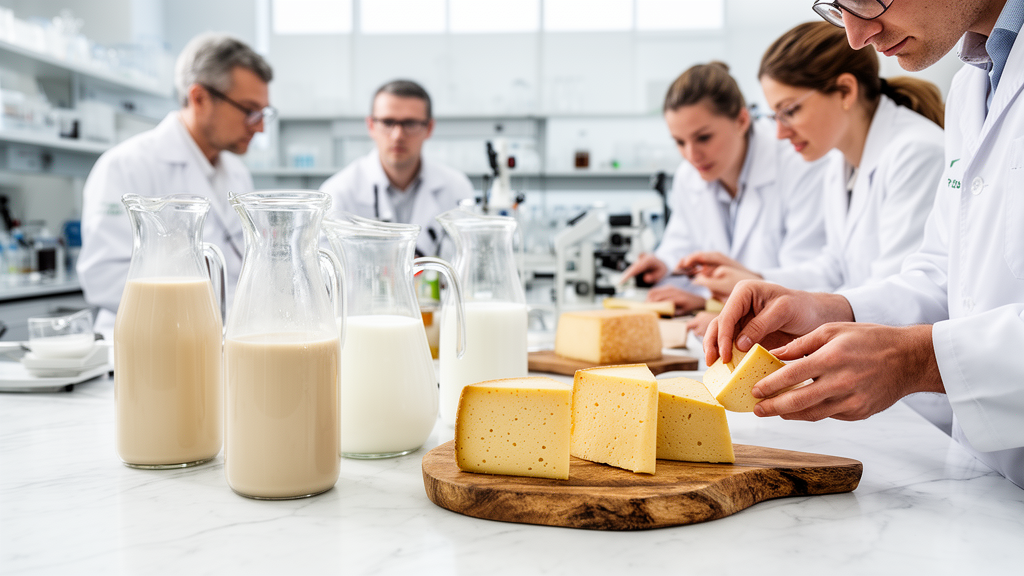
A comprehensive sensory evaluation comparing leading commercial dairy-free alternatives with conventional dairy products across ten food categories has revealed a pronounced performance divide between liquid beverages and structured solids. According to findings published in Future Foods from an analysis of the NECTAR Taste of the Industry 2026 dataset, plant-based beverages have achieved near-parity in overall consumer liking with traditional dairy benchmarks. In contrast, solid and semi-solid plant-based formulations, particularly mozzarella cheese, Greek-style yogurt, and butter, continue to suffer from substantial and statistically significant sensory deficits. The blinded consumer trials demonstrated that consumer acceptance is highly category-specific rather than reflecting a generalized attitude toward plant-derived foods. While liquid milk alternatives such as fluid milk, creamer, and barista-style milk exhibited paired liking scores that closely mirrored cow’s milk, cheese and cultured products faced steep penalties driven by persistent textural, melting, and flavor-release challenges inherent to non-dairy formulations.
The technical divergence between beverage categories and structured dairy formats stems from fundamental differences in food physical chemistry and macromolecular architecture. Conventional dairy products represent highly specialized colloidal systems: fluid milk is an oil-in-water emulsion and colloidal protein dispersion, whereas steamed barista milk forms a transient foam stabilized by surface-active milk proteins. In contrast, Greek yogurt relies on an acid-induced protein gel network, butter functions as a water-in-oil emulsion stabilized by a partially crystalline fat network, and ice cream represents a complex composite containing ice crystals, air cells, and fat globules suspended in an unfrozen continuous phase. Most complex of all, natural cheese features a calcium-associated casein micellar matrix whose response to heat dictates crucial functional behaviors including flow, stretch, oil retention, and fracture. Although food manufacturers utilize plant proteins, starches, vegetable fats, and hydrocolloids to emulate these physical attributes, plant macromolecules do not inherently possess the same interfacial adsorption, gelation, crystallization kinetics, or flavor-release dynamics as bovine dairy systems.
To rigorously quantify these sensory disparities, researchers Aeneas O. Koosis, Caroline Cotto, and Ellen Kuhl conducted a secondary statistical analysis of the NECTAR Taste of the Industry 2026 benchmark. The sensory evaluations were designed by NECTAR and executed by Palate Insights through in-person, blinded tasting panels at restaurant partner venues in San Francisco and New York City between September and November 2025. The investigation evaluated ninety-eight unique commercial dairy-free products alongside ten conventional dairy benchmarks spanning ten defined categories: fluid milk, barista milk, creamer, butter, cheddar cheese, mozzarella cheese, cream cheese, sour cream, ice cream, and Greek-style yogurt. Four exploratory products blending plant and conventional dairy ingredients were excluded. Conventional dairy benchmarks were selected based on retail sales volume in the multi-outlet channel to reflect products routinely consumed by the public, while dairy-free category leaders were selected post hoc from blinded tasting results as the single highest-scoring product for overall liking within each respective category.
The final sensory dataset comprised 1437 consumer respondents who generated 3220 overall-liking assessments and 79,027 recorded survey responses across the ten dairy benchmarks and ten selected dairy-free leaders. The consumer panel skewed female at 56.1 percent and was predominantly young to middle-aged, with 27.3 percent aged 18 to 25 and 32.9 percent aged 26 to 35, representing regular category consumers rather than a census-matched population. Omnivores represented 66.2 percent of respondents, while flexitarians constituted 24.5 percent, vegetarians 5.9 percent, and pescatarians 3.3 percent; additionally, 49.3 percent held a bachelor’s degree and 22.8 percent held a graduate degree. For the primary comparative evaluations, the researchers examined a paired subset of 1037 comparisons provided by 725 respondents who evaluated both the dairy benchmark and the dairy-free category leader under identical, randomized conditions, with individual category sample sizes ranging from 96 to 114 participants. Within this paired cohort, 170 participants contributed comparisons across more than one food category.
Statistical analysis of paired overall-liking scores, measured on a standard seven-point hedonic scale, revealed performance gaps ranging from negative 1.46 points to positive 0.17 points between dairy-free leaders and dairy benchmarks. Dairy-free mozzarella exhibited by far the largest sensory deficit, registering a paired mean difference of negative 1.46 points with a paired effect size Cohen’s dz of negative 0.88, remaining significant after Holm family-wise error rate correction. Yogurt and butter also exhibited substantial deficits, with paired mean differences of negative 0.68 points and negative 0.54 points respectively, both with a Cohen’s dz of negative 0.31 and both retaining statistical significance following Holm adjustment. Cream cheese displayed a paired difference of negative 0.42 points that was statistically significant prior to multiplicity correction but did not survive Holm control. In contrast, ice cream recorded a difference of negative 0.28 points, sour cream negative 0.26 points, cheddar cheese negative 0.25 points, creamer negative 0.06 points, fluid milk positive 0.02 points, and barista milk positive 0.17 points.
To assess whether non-significant superiority tests represented true sensory equivalence, the authors conducted exploratory two one-sided tests using a pre-specified equivalence boundary of plus or minus 0.5 points on the seven-point scale. Within this unadjusted framework, three beverage categories satisfied the equivalence criterion: creamer, fluid milk, and barista milk, whose ninety percent confidence intervals fell entirely within the half-point margin. However, none of these three categories retained equivalence after applying Holm or Bonferroni adjustments across all ten categories, indicating relative closeness rather than definitive sensory equivalence. When evaluating forty exploratory component ratings encompassing appearance, flavor, texture and mouthfeel, and similarity to dairy, fifteen comparisons remained statistically significant under Benjamini-Hochberg false-discovery rate control. Notably, fluid milk displayed an intriguing sensory paradox: while its flavor differed by only negative 0.14 points and its overall liking matched cow’s milk, participants rated its similarity to dairy negative 1.74 points lower and appearance negative 0.75 points lower, indicating that consumer acceptance did not require exact imitation.
Analysis of rating distributions illuminated substantial polarization in how consumers experienced leading dairy-free products compared with conventional dairy standards. For the top-performing liquid categories, consumer liking clustered heavily in the highest satisfaction tiers: ratings of six or seven on the seven-point scale were awarded to 69 percent of creamer leader tastings and 59 percent of sour cream leader tastings. By stark contrast, high ratings of six or seven were achieved by only 35 percent of participants evaluating the mozzarella leader and only 30 percent evaluating the yogurt leader. Even more telling was the prevalence of severe consumer dissatisfaction: ratings in the bottom band of one to three were assigned to 24 percent of mozzarella leader tastings and 29 percent of yogurt leader tastings, reflecting substantial sensory rejection. Demographic modeling evaluating paired liking differences across five age brackets demonstrated no statistically significant main effect of age or category-by-age interaction, although small sample sizes within specific category age brackets, ranging from 9 to 38 individuals, precluded firm conclusions about age-related differences.
A critical dimension of the investigation examined how consumer willingness to purchase shifted after tasting the products and subsequently inspecting their commercial packaging information. Participants completed stated purchase-intent ratings on a seven-point scale immediately after reviewing the nutrition facts panel and ingredient list for each product. Following this information disclosure, paired purchase-intent deficits widened markedly, with six of the ten categories exhibiting statistically significant deficits after Holm multiplicity correction. Mozzarella demonstrated the steepest drop at negative 1.54 points, followed by sour cream at negative 1.44 points, yogurt at negative 1.37 points, fluid milk at negative 1.03 points, cheddar cheese at negative 0.74 points, and butter at negative 0.71 points. The precipitous drop for fluid milk was especially striking, plunging into a substantial purchase deficit despite having achieved parity in blinded overall liking. Because information exposure was not randomized and no baseline purchase intent was recorded prior to revealing nutritional panels, the authors emphasized that these deficits cannot be definitively attributed to specific ingredient lists or nutrient disclosures.
To identify the specific sensory attributes responsible for lower consumer acceptance, the researchers conducted check-all-that-apply penalty analyses across appearance, flavor, and texture descriptors. In eight of the ten categories, the largest penalties associated with reduced overall liking were tied directly to flavor defects rather than appearance or mouthfeel. Category-specific penalty analyses identified off-flavor in barista milk and cheddar, artificial or chemical notes in butter, creamer, and mozzarella, stale or cardboard flavor in fluid milk, off-aftertaste in sour cream, and bitter taste in Greek yogurt as primary negative drivers. In the pooled analysis across all dairy-free leaders, the attributes most strongly associated with liking penalties were general off-flavor with a penalty of 1.85 points, cardboard or stale notes with a penalty of 1.81 points, and artificial or chemical notes with a penalty of 1.80 points. Stated pricing thresholds further illustrated consumer expectations, revealing median bargain to expensive-but-purchasable price ranges from $4.00 to $5.00 for sour cream, $4.50 to $5.00 for mozzarella, $5.00 to $6.50 for fluid milk, and $7.00 to $8.00 for yogurt.
The researchers highlighted several methodological boundaries that qualify their conclusions and establish priorities for future food science investigations. First, category leaders were identified post hoc from among available commercial entries, meaning the dataset cannot estimate category-wide performance averages or correct for statistical selection optimism. Second, the consumer evaluations were conducted in specific simplified culinary contexts using an urban consumer panel recruited in San Francisco and New York City, rather than a nationally representative sample. Third, the sensory trial lacked paired compositional, rheological, volatile chemical, or microstructural measurements that could directly link sensory deficits to specific molecular mechanisms or formulation ingredients. Nutritional equivalence also cannot be inferred from sensory comparability, as plant-based formulations differ fundamentally in nutrient profiles. Nonetheless, by making the complete de-identified dataset and analytical code openly available, this benchmark provides an objective quantitative roadmap for food scientists, demonstrating that while plant-based beverages have largely solved consumer taste requirements, structured dairy alternatives require substantial innovations in protein texturization, fat crystallization, and aroma release kinetics to achieve parity with traditional dairy.
Subject of Research: Sensory evaluation and consumer benchmarking of commercial dairy-free alternatives versus conventional dairy products
Article Title: Open-source benchmarking of dairy and dairy-free products
Article References: Koosis, A. O., Cotto, C., & Kuhl, E. (2026). Open-source benchmarking of dairy and dairy-free products. Future Foods, 14, Article 101253. https://doi.org/10.1016/j.fufo.2026.101253
Image Credits: AI Generated
DOI: 10.1016/j.fufo.2026.101253
Keywords: sensory benchmarking, plant-based milk, dairy alternatives, consumer liking, food science, mozzarella, Greek yogurt, dairy substitutes, check-all-that-apply analysis, equivalence testing, purchase intent, barista milk, emulsion stability, food texture, off-flavor perception, nutrition panel disclosure, consumer acceptance, food rheology
News Source: Daisy Hatcher. (November 26, 2026). Sensory Study Finds Plant-Based Beverages Rival Dairy While Cheeses Lag Behind. Scienmag.