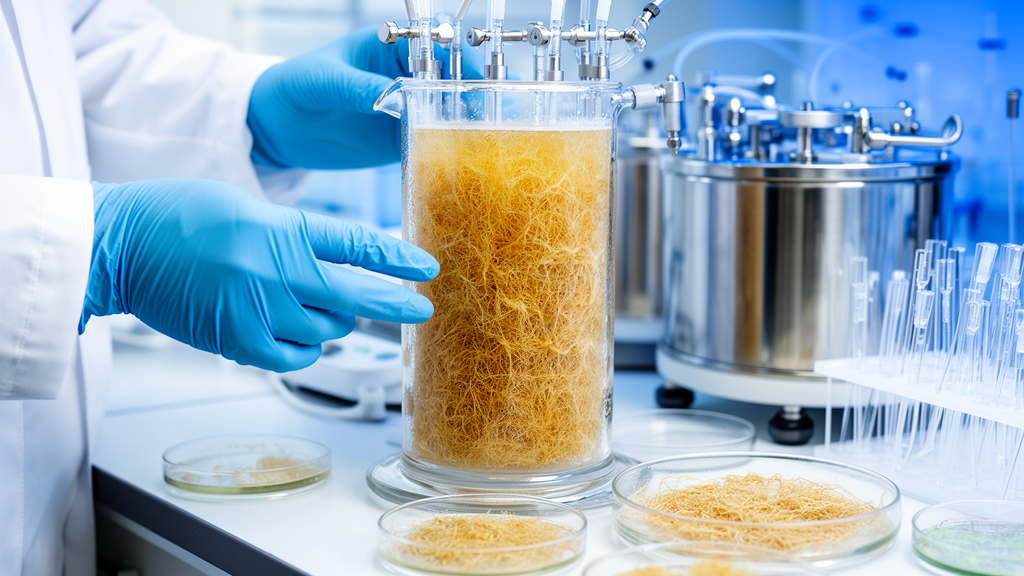
A laboratory investigation has demonstrated that modifying the nutritional environment of the endophytic fungus Talaromyces pinophilus strain J6 markedly increases the biosynthesis of 3-O-methylfunicone, providing sufficient quantities of the specialized polyketide metabolite to characterize its antimicrobial activity against the gastric pathogen Helicobacter pylori. Cultivating the fungal strain on potato dextrose agar supplemented with forty-five percent ammonium sulfate by weight over a seven-day incubation period led to a substantial elevation in metabolite yield relative to standard growth media. The resulting isolated compound exhibited measurable in vitro antibacterial efficacy against both a reference bacterial strain and multiple antibiotic-resistant clinical isolates. Chemical profiling and biological evaluations revealed that culture modulation offers a viable biotechnological route to harvest cryptic fungal constituents that otherwise remain expressed at low abundance. These experimental findings illustrate how environmental manipulation can overcome supply constraints in natural product discovery while revealing specific antimicrobial and cellular properties of fungal metabolites.
Clinical outcomes associated with this infection depend upon intricate interactions among bacterial virulence determinants, host immune responses, and environmental conditions. Managing this pathogen has grown increasingly difficult as conventional eradication regimens combining proton pump inhibitors with standard antibiotics, including clarithromycin, amoxicillin, and metronidazole, face declining clinical success rates exceeding twenty percent due to widespread antimicrobial resistance, treatment-related side effects, and inadequate patient compliance. The pathogen relies on specific cellular machinery for gastric persistence, including the urease enzyme complex for acid neutralization, flagellar motility systems for epithelial colonization, and the processive beta-clamp replication factor for continuous DNA synthesis, highlighting the pressing medical requirement for novel therapeutic scaffolds derived from diverse natural origins.
Endophytic fungi that colonize internal plant tissues without inducing symptomatic harm represent a diverse reservoir of specialized secondary metabolites shaped by ecological competition and potential evolutionary adaptation alongside host species. Under routine laboratory growth conditions, however, numerous biosynthetic gene clusters in filamentous fungi remain transcriptionally silent or unexpressed, functioning as orphan pathways whose chemical products cannot be observed or collected. Methodological strategies such as the One Strain-Many Compounds framework alter extrinsic cultivation variables, such as substrate composition, nutrient availability, and incubation time, to stimulate these unexpressed biosynthetic routes without resorting to genetic modification. Members of the genus Talaromyces are recognized producers of polyketide structures, particularly funicone derivatives consisting of a gamma-pyrone ring linked to an alpha-resorcylic acid core. Although 3-O-methylfunicone has previously documented antifungal and antiviral activities, its potential antibacterial properties against gastric bacterial pathogens and efficient cultivation protocols have historically lacked systematic empirical investigation.
The fungal organism utilized in this research, designated strain J6, was originally isolated from the aerial structures of Euphorbia umbellata collected within an Atlantic Forest-Cerrado transition zone in Bahia State, Brazil. Botanical identification of the host plant was deposited in the Alexandre Leal Costa Herbarium, and the biological materials were registered under national genetic heritage frameworks. Taxonomic classification of the endophyte was resolved through molecular sequencing of the beta-tubulin gene locus using specific oligonucleotide primers. Phylogenetic tree reconstruction via the Neighbor-Joining method and the Kimura two-parameter evolutionary distance model established that strain J6 forms a strongly supported monophyletic clade alongside the reference strain Talaromyces pinophilus CBS 631.66, confirmed by a bootstrap support value of ninety-nine percent across one thousand analytical replications, leading to the deposition of its genetic sequence in the GenBank database under accession number PQ963936.
To evaluate metabolite production, researchers cultivated strain J6 in triplicate at twenty-eight degrees Celsius in Petri dishes containing unsupplemented potato dextrose agar, medium modified with forty-five percent sodium tartrate dihydrate, or medium supplemented with forty-five percent ammonium sulfate. Daily sampling across a seven-day incubation period coupled with ultrahigh-performance liquid chromatography and high-resolution mass spectrometry showed that the fungus maintained robust mycelial growth despite osmotic stress. Base peak chromatograms in positive electrospray ionization mode identified a prominent signal at a retention time of 23.83 minutes in all conditions, corresponding to 3-O-methylfunicone. Quantitative chromatographic peak area measurements yielded values of 1.64E10 for the unmodified medium, 3.44E10 for the tartrate-amended plates, and 3.19E11 for the ammonium sulfate formulation, demonstrating an approximate ten-fold increase under ammonium sulfate supplementation compared to sodium tartrate. Daily time-course monitoring revealed that metabolite accumulation commenced on the first cultivation day and progressively climbed until reaching its peak concentration on the seventh day.
Using the optimized parameters, the research team conducted a preparative scale-up across one hundred Petri dishes of ammonium sulfate-supplemented medium incubated for seven days at twenty-eight degrees Celsius, yielding thirteen hundred milligrams of dried ethyl acetate crude extract. The extract underwent silica gel gravity column chromatography eluted with gradient mixtures of hexane, ethyl acetate, and methanol, yielding ten distinct fractions. The ninth fraction was subsequently purified by solid-phase extraction on a reverse-phase octadecylsilane cartridge eluted with aqueous methanol solutions, yielding sixty-five milligrams of pure 3-O-methylfunicone as a white powder, representing a five percent isolated yield relative to the crude mass. Unequivocal chemical structure validation was established through one-dimensional and two-dimensional nuclear magnetic resonance spectroscopy, confirming four diagnostic methoxy singlets, an E-configured propenyl moiety, meta-coupled aromatic protons, and the characteristic gamma-pyrone core alongside high-resolution mass spectrometry confirming the expected protonated molecular adduct.
Biological testing of purified 3-O-methylfunicone against Helicobacter pylori was executed using standard broth microdilution protocols under microaerophilic incubation conditions maintained at thirty-seven degrees Celsius with ten percent carbon dioxide. Assays tested the reference strain ATCC 43504 and three gastric biopsy clinical isolates—designated PX256792, PX256793, and PX256794—which were positive for cagA and vacA virulence genes and exhibited clinical resistance to amoxicillin. Minimum inhibitory concentrations for 3-O-methylfunicone ranged from 0.165 to 0.660 millimolar across the bacterial panel, with values of 0.165 millimolar for ATCC 43504, 0.660 millimolar for PX256792, 0.330 millimolar for PX256793, and 0.660 millimolar for PX256794. Minimum bactericidal concentrations preventing subsequent agar colony regrowth reached 0.330 millimolar for the reference strain and PX256793, 0.660 millimolar for PX256792, and 1.32 millimolar for PX256794. Across all tested organisms, the fungal compound demonstrated greater in vitro growth inhibition than metronidazole, with two-way analysis of variance confirming concentration-dependent bacterial suppression.
The study also assessed the compound in combination with conventional antibacterial drugs using checkerboard broth dilution assays to evaluate fractional inhibitory concentration indices. Combining 3-O-methylfunicone with clarithromycin produced a calculated index of 0.75, which denotes an additive therapeutic effect that suggests potential utility as an adjuvant partner. In contrast, combinations with amoxicillin and metronidazole resulted in index values of 2.00 and 1.00, respectively, classifying both interactions as indifferent and indicating independent pharmacological mechanisms. An in vitro enzymatic assay tracking ammonia production from urea hydrolysis revealed only weak direct urease enzyme inhibition, reaching 16.97 percent inhibition at the elevated compound concentration of 2.64 millimolar. Researchers noted that the rigid aromatic architecture of the funicone backbone likely limits binding within the highly polar catalytic pocket of bacterial urease, indicating that the primary antibacterial effect operates independently of direct enzymatic neutralization.
Cytotoxicity evaluations were conducted using colorimetric MTT metabolic assays in human gastric adenocarcinoma AGS cells and non-tumoral mouse fibroblast cells treated for forty-eight hours across a concentration gradient spanning 64 to 2060 micromolar. In gastric adenocarcinoma cultures, 3-O-methylfunicone produced a median inhibitory concentration of 0.24 plus or minus 0.03 millimolar, whereas fibroblast cultures displayed an inhibitory value of 0.57 plus or minus 0.01 millimolar. This differential response corresponded to a selectivity index of 2.37, indicating that the fungal compound was more than twofold less toxic toward non-malignant fibroblasts than toward tumoral gastric cells. By comparison, the reference chemotherapeutic agent cisplatin yielded median inhibitory concentrations of 37.96 micromolar against adenocarcinoma cells and 19.30 micromolar against fibroblasts, resulting in an unfavorable selectivity index of 0.51 that demonstrated greater proportional destruction of healthy control cells.
To investigate possible molecular mechanisms underlying the observed antibacterial responses, investigators performed in silico docking simulations against seven crystallographically resolved Helicobacter pylori proteins involved in motility, chemotaxis, nitrogen metabolism, and replication. Simulations conducted with AutoDock Vina and AutoDock 4 predicted favorable binding energy primarily toward the DNA polymerase III beta-clamp processivity factor at minus 5.56 kilocalories per mole and the nickel-accessory protein UreE at minus 4.57 kilocalories per mole. The beta-clamp complex was stabilized through extensive alkyl, pi-sigma, and carbon-hydrogen bonds contacting twelve residues across two protein chains, including Phe243, Ile248, and Leu368, closely matching redocking validation parameters. The authors emphasized that while these computational predictions suggest potential disruption of bacterial replication machinery, docking simulations remain hypothesis-generating models requiring subsequent biochemical validation rather than definitive proof of a singular physiological target.
Subject of Research: Optimization of 3-O-methylfunicone production by endophytic Talaromyces pinophilus and evaluation of its anti-Helicobacter pylori properties
Article Title: Enhancing 3-O-methylfunicone production by endophytic Talaromyces pinophilus J6 through culture optimization and its anti-Helicobacter pylori activity
Article References: Marques, M. V. A., Loose, D. N., Lima, C. S., Santos, S. M. Q., Pereira, C. L. S., Ramos, G. S., Queiroz, L. C., Gonçalves, R. C. R., & Silva, E. O. (2026). Enhancing 3-O-methylfunicone production by endophytic Talaromyces pinophilus J6 through culture optimization and its anti-Helicobacter pylori activity. Archives of Microbiology, 208(9), Article 474. https://doi.org/10.1007/s00203-026-05028-9
Image Credits: AI Generated
DOI: 10.1007/s00203-026-05028-9
Keywords: Talaromyces pinophilus, 3-O-methylfunicone, Helicobacter pylori, endophytic fungi, culture optimization, ammonium sulfate, antibacterial activity, minimum inhibitory concentration, minimum bactericidal concentration, gastric adenocarcinoma, clarithromycin, checkerboard assay, beta-clamp protein, molecular docking, polyketide, Euphorbia umbellata, mass spectrometry, nuclear magnetic resonance
News Source: Kristina Jarvis. (November 26, 2026). Fungal Culture Optimization Boosts Compound Yield Against Resistant Gastric Pathogen. Scienmag.