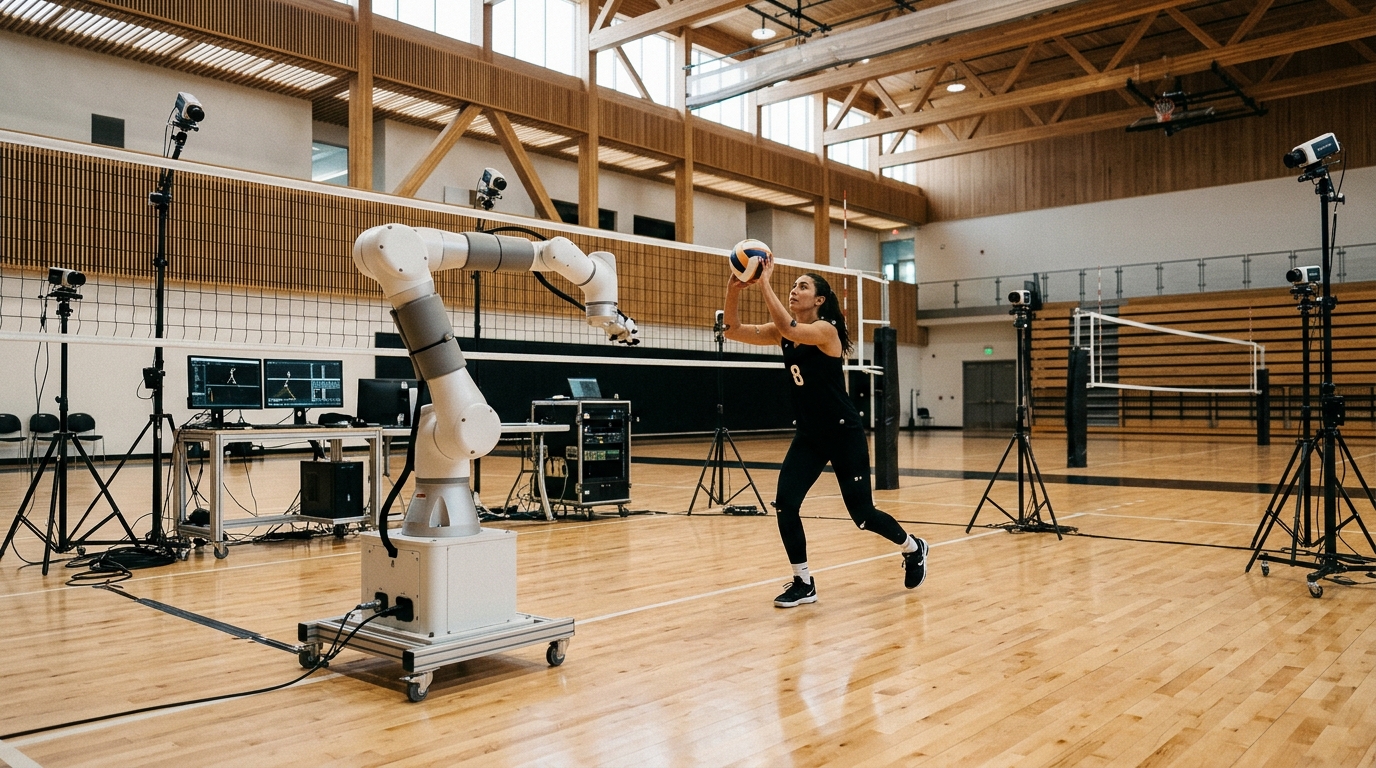
A new study in Frontiers in Neurorobotics describes an embodied neurorobotic framework that fuses five kinds of sensor data to interpret fast volleyball actions while estimating fatigue and jump load, and then routes those estimates through a mathematically constrained safety filter before any haptic or robotic feedback is issued. The work, led by Feng Xu of Bengbu University with Wuyi Zhu of Hefei University of Technology and Jiaoyu Wang of Bengbu University, was published on 4 November 2026 in Volume 20 of the journal. Crucially, the entire evaluation rests on a fully synthetic, seeded benchmark rather than human recordings, so the authors frame their claims as reproducible computational behavior, not field safety or injury-prevention evidence.
The system targets a problem familiar to anyone who has tried to make sense of wearable data in fast sports: the same body configuration can mean different things depending on context. An elevated arm might signal a serve, a set, attack preparation, or simple recovery. Volleyball was chosen as a representative dynamic human-motion scenario because it packs diverse sensing requirements and rapid motion changes into sub-second time scales, combining physical execution, spatial context, physiological state, and environmental transitions. The researchers emphasize that the sport serves as a validation scenario for a general perception and feedback framework for complex embodied environments, not as the sole application objective.
Architecturally, the pipeline begins with synchronization. Inertial measurement unit, pose, plantar-pressure, ultra-wideband, and physiological measurements arrive with their own timestamps and are aligned to a common analysis clock by nearest-neighbor or linear interpolation, subject to a maximum admissible timing gap. Each channel is then standardized using training-partition statistics. The framework combines a reliability-aware sensor-fusion transformer with a bidirectional long short-term memory network, known as a BiLSTM. Before self-attention runs, an explicit quality gate scales each modality token by a reliability score built from signal-to-noise cues, timestamp freshness, range validity, and a binary availability mask, so low-quality channels enter query, key, and value formation with reduced amplitude and a fully absent modality is zeroed and masked from contributing keys or values at all.
After the cross-modal attention exchange, a second mechanism applies normalized reliability pooling, which differs from unweighted token averaging: when a sensor becomes unreliable, it loses direct influence on the fused representation. The authors also prove a cross-modal perturbation bound, showing that a corrupted modality receives a coefficient that decreases with its reliability while reliability pooling suppresses directly contaminated output when cross-modal leakage stays below one. The bidirectional LSTM then performs temporal reasoning over the fused sequence, because volleyball actions unfold as structured temporal patterns and a monitoring decision is produced after a short fixed analysis window. At 50 Hz, each archived 36-step window spans 0.72 seconds, and a sliding implementation can update once a new sample arrives after the initial buffer fills.
The categorical output spans eight volleyball states: serve, receive, set, attack, block, dig, transition, and recovery. Alongside action recognition, the model produces two continuous estimates, a normalized fatigue state and a normalized jump-load state, through separate nonlinear heads with layer normalization and dropout. Training combines a classification loss with label smoothing, smooth-L1 regression penalties on the two continuous targets, and a small predictive-entropy term to discourage diffuse action posteriors. Missing-modality augmentation samples a Bernoulli mask once per sensor and training window, and normalized sensor features receive additional Gaussian perturbations with a standard deviation of 0.012, teaching the network to redistribute evidence instead of relying on a single dominant channel.
The safety layer sits between the monitoring network and any assistance device, such as a vibrotactile band, projected cue, or robotic ball-feeding unit. A nominal command is never executed directly; instead, a quadratic projection solves for the closest admissible command, with the first constraint reserving exactly the safety margin required by bounded estimation and disturbance errors. The paper establishes a conditional one-step barrier-satisfaction result: if the state-estimation error and disturbance are bounded and the projection remains feasible, the true successor state satisfies the barrier condition, and forward invariance of the safe set follows whenever feasibility is maintained. An adaptive margin can also turn perception uncertainty into actuation conservatism, suppressing aggressive directional cues or limiting a ball feeder’s speed and frequency when uncertainty rises.
On the benchmark, which generated 50 virtual athlete profiles with 20 windows each, 36 synchronized steps per window, and 32 channels distributed across IMU, pose, pressure, UWB, and physiology, the complete model achieved 87.0% accuracy and 0.872 macro-F1. Across the 10 held-out virtual-athlete profiles, accuracy was 0.870 ± 0.086 with a cluster-bootstrap 95% confidence interval of 0.820–0.920. The split was performed by virtual-profile identity before evaluation, with 30 profiles for training, 10 for validation, and 10 for testing, preventing windows from one profile from appearing in multiple partitions. Relative to the transformer-only, early-fusion BiLSTM, and no-quality-gate baselines, the proposed model improved profile-level accuracy by 0.170, 0.165, and 0.155, with two-sided exact sign-flip tests giving p-values of 0.00195, 0.00195, and 0.00391 respectively.
The comparison also exposed trade-offs. The transformer-only baseline achieved a lower jump-load RMSE, and the early-fusion BiLSTM matched the proposed model’s fatigue RMSE at the displayed precision of 0.117, indicating a meaningful multi-task trade-off rather than uniform dominance on every metric. A confusion-matrix analysis showed the largest off-diagonal count was set classified as transition, followed by receive classified as dig and block classified as attack, patterns consistent with adjacent tactical phases sharing similar inertial and physiological signatures. Removing single modalities at test time revealed uneven information distribution: dropping pressure changed macro-F1 by only about 0.04, while removing UWB or physiology caused the largest classification losses, with physiology removal producing the lowest macro-F1 at 0.466.
Robustness tests separated graceful noise tolerance from harder information loss. Additive noise at 0.35 normalized amplitude reduced macro-F1 by roughly 0.04 from the clean value, whereas simultaneously removing IMU and pose reduced it to 0.504. The authors note that slight improvements at low noise amplitudes fall within finite-sample variation and should not be read as beneficial noise. A separate concern emerged from calibration: the clean expected calibration error was 0.440, meaning softmax confidence scores are not suitable as calibrated probabilities, and the paper argues that post-hoc or distribution-aware calibration would be needed before real feedback deployment. An illustrative scalar safety-filter simulation ran 180 deterministic feedback steps in which the unconstrained nominal trajectory exceeded the normalized safety boundary in 168 steps while the barrier-filtered trajectory had zero violations, intervening in 122 steps and maintaining a minimum realized barrier of 0.00265.
The authors are explicit about the limits of what these results establish. Because no human-subject volleyball data were used, the findings demonstrate algorithmic behavior under controlled conditions and cannot be interpreted as clinical, physiological, or competition-field performance estimates. The test set contains only 10 virtual profiles and 200 windows, so confidence intervals remain wide and cannot characterize real population heterogeneity, and the corruption study does not reproduce every field failure mode such as placement drift, pose occlusion synchronized with contact events, UWB multipath, or cross-device clock drift. The bidirectional estimator waits for the full short window, making it best suited to near-real-time training feedback rather than zero-delay reflex assistance. The team outlines next steps: prospective multi-athlete validation with informed consent and data governance, causal low-latency edge implementations, and closed-loop evaluation with haptic wearables and robotic ball-feeding hardware measuring cue latency, safety-filter interventions, user trust, and longitudinal coaching benefit. Until then, the terms safety and protection refer only to the stated mathematical barrier conditions and the illustrative simulation, not to proven injury prevention in athletes.
Subject of Research: Reliability-aware multimodal sensor fusion with safety-constrained neurorobotic feedback for human motion monitoring in volleyball training, validated on a synthetic benchmark
Article Title: Reliability-aware multimodal sensor fusion for human motion monitoring with safety-constrained neurorobotic feedback in sports training
Article References: Xu, F., Zhu, W., & Wang, J. (2026). Reliability-aware multimodal sensor fusion for human motion monitoring with safety-constrained neurorobotic feedback in sports training. Frontiers in Neurorobotics, 20, Article 1973789. https://doi.org/10.3389/fnbot.2026.1973789
Image Credits: AI Generated
DOI: 10.3389/fnbot.2026.1973789
Keywords: sensor fusion, neurorobotics, volleyball, BiLSTM, transformer, wearable sensors, safety filter, fatigue estimation, jump load, synthetic benchmark, human motion monitoring, reliability-aware attention
News Source: Denise Maddox. (November 6, 2026). Sensor-fusion AI watches volleyball moves and keeps robot feedback inside safety limits. Scienmag.