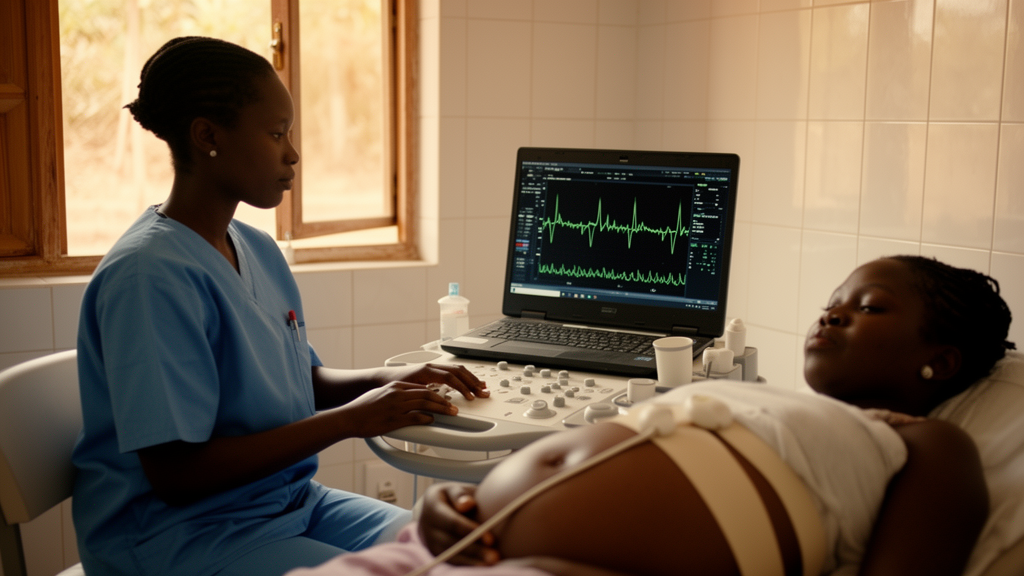
Researchers in Norway and Tanzania have developed an artificial intelligence framework that can reconstruct missing segments of fetal heart rate recordings and forecast the signal’s short-term evolution, addressing one of the most persistent technical obstacles in wearable fetal monitoring. The model, called FHRFormer, is a self-supervised transformer-based autoencoder trained on 4,486 fetal heart rate recordings collected with the Moyo monitor during labor in Tanzanian hospitals. In tests on an independent hold-out dataset, the best-performing configuration reconstructed artificially masked signal segments with a peak signal-to-noise ratio of 41.38 decibels, a structural similarity index of 0.9984, and a correlation coefficient of 0.9993 against the original data. The team, led by Kjersti Engan and Neel Kanwal of the University of Stavanger together with colleagues at Haydom Lutheran Hospital and Stavanger University Hospital, published the work in Frontiers in Digital Health. Their central achievement is a reconstruction method that preserves both the fine-grained shape of the fetal heart rate trace and its spectral characteristics, which simpler gap-filling techniques tend to erase.
The clinical motivation behind the work is stark. Approximately 10 percent of newborns require assistance to initiate breathing at birth, and around 5 percent need advanced ventilatory support, according to figures cited by the researchers. Continuous fetal heart rate monitoring during labor is a pivotal tool for detecting fetal distress, because it enables early identification of hypoxia, acidosis, and other markers of compromise, allowing clinicians to intervene before problems escalate. Traditional cardiotocography machines can detect fetal distress early, but their high cost and need for specialized infrastructure make them impractical in many low-resource settings. Wearable fetal heart rate monitors such as the Moyo device, which combines a Doppler ultrasound sensor and an accelerometer in a unit strapped to the mother’s abdomen, offer a portable and cost-effective alternative that permits extended, non-invasive monitoring without substantially restricting maternal mobility. The Moyo device is programmed to alert healthcare personnel if the detected fetal heart rate remains outside the range of 110 to 160 beats per minute for 10 minutes, or outside 100 to 180 beats per minute for 3 minutes.
That freedom of movement, however, comes at a price. When the mother moves, the sensor can be displaced, causing signal dropouts that leave gaps in the recording. These missing segments compromise clinical interpretation and degrade the reliability of the artificial intelligence models increasingly used to predict neonatal outcomes from fetal heart rate data. The problem is particularly serious because the diagnostic value of the signal lies in features such as short- and long-term baseline variability and deceleration patterns, which are essential for accurate risk stratification. Conventional inpainting methods, such as linear or spline interpolation, often oversimplify the physiological complexity of fetal heart rate dynamics. Linear interpolation, for example, replaces missing segments with straight lines that remove beat-to-beat variability, a feature clinicians rely on when judging fetal wellbeing. Spline and cubic interpolation preserve smoothness better but remain prone to oversmoothing transient patterns like abrupt decelerations or oscillations, distorting the very features that matter most.
More sophisticated approaches have their own shortcomings. Wavelet-based methods decompose signals into time-frequency components and can preserve localized patterns over short gaps, but they struggle with longer dropouts because of trade-offs between time and frequency resolution, especially in the non-stationary fetal heart rate signals that arise as fetal behavior changes during labor. Sparse representation techniques, including dictionary-learning methods that reconstruct missing samples from learned signal bases, assume local stationarity that may not hold during active labor, and their fixed dictionary sizes pose challenges when dropout durations vary. Classical probabilistic approaches such as Gaussian Processes handle missing data through smoothing but falter on the non-stationary, non-Gaussian character of longer recordings. Meanwhile, deep learning architectures that have dominated biomedical signal analysis carry structural limitations of their own: convolutional neural networks struggle to model long-range temporal dependencies across extended recordings, and recurrent networks, despite their ability to handle sequences, are practically constrained by vanishing gradients and the decay of hidden state information over long spans.
FHRFormer was designed to overcome these constraints by exploiting the transformer architecture’s global self-attention mechanism, which ensures a constant path length between any two points in the fetal heart rate trace. The framework follows the masked autoencoding paradigm: the input signal is divided into non-overlapping patches, a random subset of those patches is masked out, and the model learns to reconstruct the missing segments from the surrounding visible context. The architecture consists of a five-layer encoder and a five-layer decoder with 16 attention heads, an intermediate dimension of 1,024, and bidirectional attention throughout, since signal inpainting is inherently non-causal and the encoder must leverage both preceding and succeeding context to fill a gap. Masked positions receive a shared learnable mask token, and sinusoidal positional encodings preserve the temporal order of the sequence. Crucially, the training objective combines a mean squared error on the masked patches with a focal frequency loss computed on the discrete Fourier transform magnitude spectrum of each masked patch, weighted equally in the final loss.
That dual-domain objective is what distinguishes FHRFormer from purely temporal reconstruction schemes. Standard temporal loss functions optimize for global amplitude alignment and remain indifferent to phase shifts and spectral distribution. By directly penalizing spectral deviations in the frequency domain, the focal frequency loss compels the decoder to reproduce the true power distribution of the original signal, which the authors link to superior scores on spectral metrics such as peak signal-to-noise ratio, structural similarity, and the Fréchet Inception Distance. The training data came from the Safer Births project, a collaborative research initiative involving international research institutions and hospitals in Tanzania, with data collected in two phases at two urban and one rural Tanzanian hospital between October 2015 and June 2018, and again between December 2019 and July 2021, encompassing 5,225 recorded labors from 5,225 distinct participants. The study focused exclusively on labors initially assessed as normal upon hospital admission, using the final hour before birth, trimmed or zero-padded to 7,200 time steps and normalized between 0 and 220 beats per minute.
The dataset was split at the patient level into 4,486 training, 369 validation, and 370 test recordings, with a single random shuffle across both collection phases and all three hospital sites, so no subset is concentrated in a narrow time window or a single location. Because each one-hour recording yields many non-overlapping patches, the training set alone provides over one million patch instances for the self-supervised reconstruction objective. Before training, the researchers applied a noise reduction algorithm developed and validated specifically for Doppler-based fetal heart rate signals recorded with the Moyo monitor within the same cohort, addressing frequency-doubling and frequency-halving artifacts from Doppler shift error and applying linear interpolation as an initial gap-filling step; a binary mask of missing locations was retained so FHRFormer could refine those estimates. Evaluation metrics were computed exclusively on originally observed data points held out during masking, excluding pre-processed interpolations to prevent bias, and reconstructions were rescaled to original units of beats per minute before scoring.
The results reveal a clear structural trade-off. Across input patch sizes ranging from 30 to 480 samples, reconstruction accuracy fell consistently as patch size grew: the 30-sample configuration achieved the lowest error profile on both validation and test sets, while the 480-sample configuration dropped to a peak signal-to-noise ratio of 22.95 decibels on the test set. The authors interpret this as an operational threshold where the model balances local morphological resolution against sequence-level trends; larger patches sacrifice the capacity to capture the rapid, transient oscillations characteristic of true fetal heart rate signals, and flattening micro-variability is clinically problematic because it serves as an essential indicator of fetal health status. Masking ratio experiments told a similar story, with performance peaking at a 15 percent masking ratio and degrading continuously as more of the signal was withheld. The authors note this aligns with the practical constraints of wearable monitoring, where dropouts typically occur as localized, transient blocks rather than total signal loss, and that higher masking ratios degrade the structural context available to the encoder.
Beyond reconstruction, the team adapted the pre-trained model for forecasting by coupling its latent weights to a recursive progressive prediction module. Using a 30-minute historical context window and a 15-second prediction horizon, the model iteratively appends each estimated block to the input sequence to generate successive short-term predictions. The authors report that this recursive loop remained stable against rapid error accumulation and that the model outperformed the generalized time-series foundation model TimeGPT, which they say struggles to adapt to the highly non-stationary accelerations and decelerations of intrapartum physiology. The short horizon was a deliberate choice: an embedded alarm feature within a wearable monitor must flag an emerging deceleration within seconds to be clinically actionable. The researchers are explicit about limitations, however. The model provides no probabilistic uncertainty estimates, reconstruction accuracy was evaluated on artificially masked segments because true values are unavailable for real dropouts, all recordings came from Moyo monitors in Tanzanian hospitals, and performance on other monitor types and populations remains unestablished. No clinical decisions or neonatal outcomes were evaluated, and any clinical use would require prospective validation. For now, the framework’s immediate contribution is to retrospective research, enabling incomplete recordings to be used in developing models that predict the need for intervention or resuscitation, with real-time integration into wearable devices remaining a longer-term goal.
Subject of Research: Self-supervised transformer-based reconstruction and forecasting of fetal heart rate time series from wearable monitors
Article Title: FHRFormer: a self-supervised masked transformer framework for fetal heart rate time-series inpainting and forecasting
Article References: Engan, K., Kanwal, N., Bukhay, A. Y., Blacy, L., Munyaw, Y., Mduma, E., & Ersdal, H. L. (2026). FHRFormer: a self-supervised masked transformer framework for fetal heart rate time-series inpainting and forecasting. Frontiers in Digital Health, 8, 1900897. https://doi.org/10.3389/fdgth.2026.1900897
Image Credits: AI Generated
DOI: 10.3389/fdgth.2026.1900897
Keywords: fetal heart rate, transformer, self-supervised learning, masked autoencoder, signal inpainting, time-series forecasting, wearable monitoring, Moyo monitor, Tanzania, Safer Births, deep learning, health informatics
News Source: Blake Davidson. (October 26, 2026). Self-supervised AI rebuilds missing fetal heart rate signals from Tanzanian labor recordings. Scienmag.