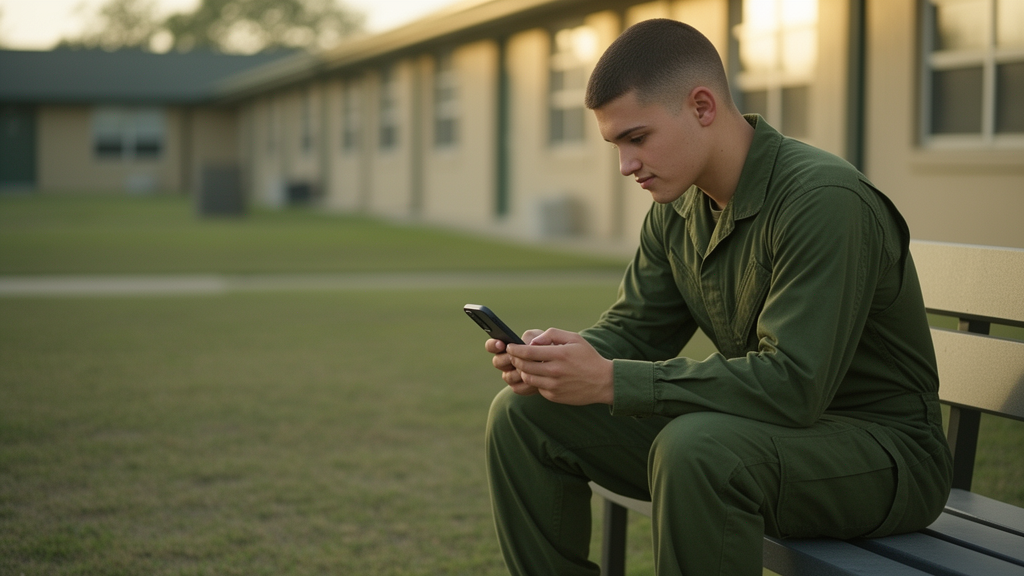
Among U.S. service members, suicide risk has remained persistently elevated for decades, and the healthcare settings where they most often seek help are primary care clinics rather than specialty mental health services. A new study published in BMC Digital Health reports early results from a randomized clinical trial testing whether a smartphone application called Aviva, a digital adaptation of an evidence-based suicide prevention therapy, can work as an add-on to standard care in that environment. The findings concern feasibility, acceptability, usability, and safety during implementation, not yet clinical efficacy, which the researchers will report only after the trial finishes enrolling and following its participants.
The study is part of a larger umbrella project called Augmenting Suicide Prevention Interventions for Service Members, organized through The Ohio State University College of Medicine. The trial is taking place at Fort Carson, Colorado, and spans three primary care clinics, an emergency department, an outpatient behavioral health clinic, and an inpatient psychiatric facility. Participants are active-duty soldiers receiving routine medical care at the Evans Army Community Hospital. To enroll, they had to be currently serving, at least 18 years old, and to have endorsed suicidal ideation within the past week or a suicide attempt within the past 30 days. They also needed to own a compatible smartphone running Apple iOS 11 or higher or Android OS 8.1 or higher.
Screening at the participating clinics relies on routine suicide risk assessment with the Patient Health Questionnaire-9 and the Columbia Suicide Severity Rating Scale, administered at every visit. Patients who screened positive were referred to a research clinician who explained the study, confirmed eligibility, and completed informed consent. At the time of reporting, 295 participants had enrolled against a target of 350, the sample size calculated to provide 85.1 percent power to detect a clinically meaningful reduction in suicidal ideation scores. Of those enrolled, 160 were randomized to the Aviva condition and 135 to the treatment-as-usual control, using a computerized, stratified randomization algorithm balancing gender, severity of suicidal ideation, and history of suicide attempt.
Aviva is a self-directed smartphone application built to deliver Brief Cognitive Behavioral Therapy for Suicide Prevention with fidelity to the original protocol. That therapy has shown consistent reductions in post-treatment suicide attempt rates compared with treatment as usual across five randomized clinical trials, two of them specific to active-duty military, with significant reductions of roughly 40 to 60 percent in post-treatment suicide risk relative to treatment as usual. The app guides users through the core treatment components, beginning with a module that helps them build an individualized model of their suicide risk, a digital crisis response plan, and a plan for limiting access to potentially lethal means of suicide. Users progress at their own pace through a chatbot-guided interface, and no clinician training is required to deliver the treatment itself.
Because Aviva was designed as a supplement to standard care rather than a replacement, all participants continued to receive medical and mental healthcare as typically provided by the military health system. Those in the control condition developed a safety plan consistent with local procedures and were referred for standard care. To reduce performance bias, control participants also downloaded the Suicide Safety Plan app, a digital version of the safety planning intervention already used at Fort Carson, which mirrors the digital format of the Aviva condition and includes comparable safety elements such as warning signs, coping strategies, social supports, and crisis contacts. The trial is registered at ClinicalTrials.gov under identifier NCT06318962, and the primary outcome, suicide attempt during 12 months of follow-up assessed with the Self-Injurious Thoughts and Behaviors Interview-Revised, will be analyzed after full enrollment.
The engagement results are the centerpiece of the current report. Of the 160 participants randomized to Aviva, 155 completed initial assessment data, and 132 went on to engage with the app, yielding an 82.5 percent engagement rate among those randomized and a week-one engagement figure of 85.2 percent among those with initial data. Once engaged, retention was strong: 92.4 percent of participants who started Aviva in week one, 122 of 132, continued to access it in some capacity through week twelve, even if they did not fully complete later modules. Participants started an average of 8.55 modules, with a standard deviation of 3.94, and completed an average of 8.43 modules, with a standard deviation of 4.04, representing roughly 70 percent of the total Aviva protocol.
Those averages, however, conceal a steep drop-off at the level of full completion. Attrition from the first session to the twelfth was 52 percent among those who began the app, meaning 48 percent fully completed all modules. Module-specific completion ranged from a high of 98.5 percent for the My Plan module, 130 of 132 participants, down to 46.9 percent for the skills review and 43.9 percent for the post-Aviva review. Total average usage across all modules was slightly over eight hours, 8.43 hours. That figure stands out against published benchmarks for digital mental health tools, where nearly 50 percent of users fail to log in a second time, up to 89 percent engage only once, a recent meta-analysis found only 44 percent of participants completed all available modules, and average total usage across the life of an intervention was just 3.9 hours.
Usability and satisfaction data reinforce the feasibility picture, with caveats about sample sizes. A total of 92 individuals, 69.7 percent of Aviva users completing the first module, filled out the System Usability Scale, an industry-standard 10-item measure scored from 0 to 100, where scores above 68 indicate above-average usability. Aviva’s mean was 68.14, essentially matching the global mean of 68 derived from more than 500 studies, and item-level responses suggested the app was easy to access and understand, engaging, and usable without significant technical assistance. The authors caution that the scale has been used across a broad array of digital tools not specific to mental health or suicidality, so interpretation against suicide-specific comparisons is limited. Satisfaction measured with the Youth Satisfaction Questionnaire one month after treatment engagement showed high scores, with item and subscale means at or above 3.5 across nearly all domains, the exceptions being two items within the outcomes subscale concerning school and work performance and satisfaction with family life.
One six-month comparison did emerge from the ongoing follow-up. On overall treatment satisfaction, Aviva participants reported a mean score of 4.44 compared with 3.99 for those in the treatment-as-usual group, a statistically significant difference with t(155) = 3.42 and p < .001. On safety, the researchers report that initial evidence during implementation raised no concerns, and that no major safety concerns were identified. The study carried substantial safety infrastructure: research clinicians contacted participants weekly for the first 12 weeks after baseline to assess risk, monitor safety, and check adherence, with each check-in lasting about 10 to 15 minutes, and standardized procedures governed emergency responses, including off-site and after-hours situations. The trial was approved by institutional review boards at The Ohio State University and The University of Memphis, reviewed by the Department of Defense’s Office of Human Research Oversight, and adheres to CONSORT reporting guidelines.
The authors are explicit that these results do not establish efficacy. The clinical efficacy analysis using suicide-specific outcomes, suicidal ideation and attempts, will be reported after full trial enrollment and follow-up are complete. They also acknowledge that the high initial engagement was facilitated by study procedures in which a study clinician assisted with onboarding and app access, and that the weekly check-ins may themselves have influenced engagement, retention, and persistence, limiting conclusions about Aviva as a purely self-directed tool. The substantial attrition in full module completion raises questions about scalability and about whether the app could function as an independent treatment rather than an add-on, and limited completion of some assessment measures may have introduced bias. The context matters as well: the 2024 VA/DoD Clinical Practice Guideline acknowledges the potential of scalable digital interventions for reducing suicidal ideation but emphasizes that evidence remains insufficient to support effectiveness in preventing suicide-specific outcomes. Within those limits, the study supports Aviva as a feasible, acceptable, and usable treatment add-on for suicide prevention in an integrated military healthcare system, with engagement and persistence rates well above national averages for comparable digital apps, and points toward brief periodic human contact as a possible ingredient in making self-directed digital care work for people at elevated suicide risk.
Subject of Research: Feasibility and usability of a self-directed digital suicide prevention therapy add-on for U.S. service members
Article Title: Acceptability, feasibility, and usability of a self-directed digital therapeutic to prevent suicidal ideation and behaviors in an integrated military healthcare system
Article References: Rudd, M. D., Wine, M., Pedler, R., Gleason, V. L., Kratholm, O., Tempchin, J., Gonclaves, V., & Bryan, C. J. (2026). Acceptability, feasibility, and usability of a self-directed digital therapeutic to prevent suicidal ideation and behaviors in an integrated military healthcare system. BMC Digital Health, 4(1), Article 61. https://doi.org/10.1186/s44247-026-00293-6
Image Credits: AI Generated
DOI: 10.1186/s44247-026-00293-6
Keywords: suicide prevention, digital mental health, military health, randomized clinical trial, smartphone app, cognitive behavioral therapy, service members, primary care, engagement, usability, Fort Carson, Aviva
News Source: Ophelia Keating. (October 30, 2026). Self-guided app shows strong engagement in military suicide prevention trial. Scienmag.