• HOME
  • NEWS
  • EXPLORE
    • CAREER
      • Companies
      • Jobs
    • EVENTS
    • iGEM
      • News
      • Team
    • PHOTOS
    • VIDEO
    • WIKI
  • BLOG
  • COMMUNITY
    • FACEBOOK
    • INSTAGRAM
    • TWITTER
Thursday, June 25, 2026
BIOENGINEER.ORG
No Result
View All Result
  • Login
  • HOME
  • NEWS
  • EXPLORE
    • CAREER
      • Companies
      • Jobs
        • Lecturer
        • PhD Studentship
        • Postdoc
        • Research Assistant
    • EVENTS
    • iGEM
      • News
      • Team
    • PHOTOS
    • VIDEO
    • WIKI
  • BLOG
  • COMMUNITY
    • FACEBOOK
    • INSTAGRAM
    • TWITTER
  • HOME
  • NEWS
  • EXPLORE
    • CAREER
      • Companies
      • Jobs
        • Lecturer
        • PhD Studentship
        • Postdoc
        • Research Assistant
    • EVENTS
    • iGEM
      • News
      • Team
    • PHOTOS
    • VIDEO
    • WIKI
  • BLOG
  • COMMUNITY
    • FACEBOOK
    • INSTAGRAM
    • TWITTER
No Result
View All Result
Bioengineer.org
No Result
View All Result
Home NEWS Science News Chemistry

Self-driving microrobots

Bioengineer by Bioengineer
December 10, 2019
in Chemistry
Reading Time: 3 mins read
0
IMAGE
Share on FacebookShare on TwitterShare on LinkedinShare on RedditShare on Telegram

IMAGE

Credit: Yong Dou/Columbia Engineering


Most synthetic materials, including those in battery electrodes, polymer membranes, and catalysts, degrade over time because they don’t have internal repair mechanisms. If you could distribute autonomous microrobots within these materials, then you could use the microrobots to continuously make repairs from the inside. A new study from the lab of Kyle Bishop, associate professor of chemical engineering, proposes a strategy for microscale robots that can sense symptoms of a material defect and navigate autonomously to the defect site, where corrective actions could be performed. The study was published in Physical Review Research December 2, 2019.

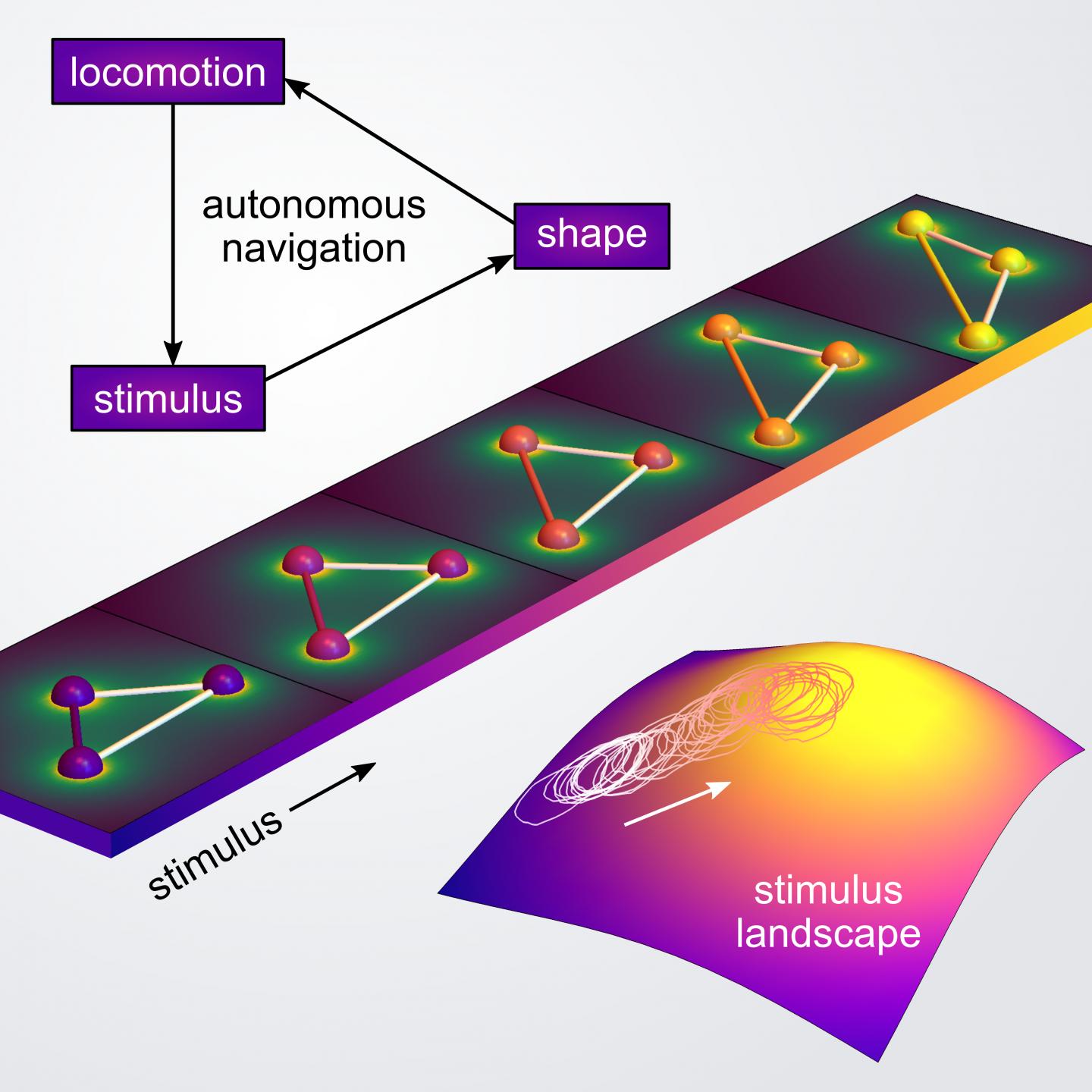
Swimming bacteria look for regions of high nutrient concentration by integrating chemical sensors and molecular motors, much like a self-driving car that uses information from cameras and other sensors to select an appropriate action to reach its destination. Researchers have tried to mimic these behaviors by using small particles propelled by chemical fuels or other energy inputs. While spatial variations in the environment (e.g., in the fuel concentration) can act to physically orient the particle and thereby direct its motion, this type of navigation has limitations.

“Existing self-propelled particles are more like a runaway train that’s mechanically steered by the winding rails than a self-driving car that’s autonomously guided by sensory information,” says Bishop. “We wondered if we could design microscale robots with material sensors and actuators that navigate more like bacteria.”

Bishop’s team is developing a new approach to encode the autonomous navigation of microrobots that is based on shape-shifting materials. Local features of the environment, such as temperature or pH, determine the three-dimensional shape of the particle, which in turn influences its self-propelled motion. By controlling the particle’s shape and its response to environmental changes, the researchers model how microrobots can be engineered to swim up or down stimulus gradients, even those too weak to be directly felt by the particle.

“For the first time, we show how responsive materials could be used as on-board computers for microscale robots, smaller than the thickness of a human hair, that are programmed to navigate autonomously,” says Yong Dou, a co-author of the study and a PhD student in Bishop’s lab. “Such microrobots could perform more complex tasks such as distributed sensing of material defects, autonomous delivery of therapeutic cargo, and on-demand repairs of materials, cells, or tissues.”

Bishop’s team is now setting up experiments to demonstrate in practice their theoretical navigation strategy for microrobots, using shape-shifting materials such as liquid crystal elastomers and shape memory alloys. They expect to show the experiments will prove that
stimuli-responsive, shape-shifting microparticles can use engineered feedback between sensing and motion to navigate autonomously.

###

This work was supported by the Center for Bio-Inspired Energy Science, an Energy Frontier Research Center funded by the U.S. Department of Energy, Office of Science, Basic Energy Sciences under Award DE-SC0000989.

LINKS

Paper: https://journals.aps.org/prresearch/abstract/10.1103/PhysRevResearch.1.032030

DOI: 10.1103/PhysRevResearch.1.032030

Kyle Bishop: https://engineering.columbia.edu/faculty/kyle-bishop

Chemical engineering: https://cheme.columbia.edu/

Media Contact
Holly Evarts
[email protected]
212-854-3206

Related Journal Article

http://dx.doi.org/10.1103/PhysRevResearch.1.032030

Tags: Chemistry/Physics/Materials Sciences
Share13Tweet8Share2ShareShareShare2

Related Posts

AI and Physics Collaborate to Design Advanced Hydrogen Storage Materials

June 25, 2026

International Team Including Dresden Scientists Develops Novel Designer Proteins for Advanced Study of Living Tissue

June 25, 2026

New Study Uncovers Key Factors Driving Water Chemistry in Nanoscale Environments

June 25, 2026

Plasma Technology Extends Catalyst Lifespan in Hydrogen Production

June 24, 2026
Please login to join discussion

POPULAR NEWS

  • Saying Goodbye to PGY-6: Pediatric Fellowship Realities

    103 shares
    Share 41 Tweet 26
  • Multi-Hospital Study Reveals Long Covid Burden Is Twice as High as Current Estimates

    92 shares
    Share 36 Tweet 23
  • Detection of EDCs in Breast Milk and Infant Urine Up to Six Months Highlights Early Exposure Risks

    77 shares
    Share 31 Tweet 19
  • New Drug Candidate Developed at McMaster Shows Potential for Treating Brain Cancer

    58 shares
    Share 23 Tweet 15

About

We bring you the latest biotechnology news from best research centers and universities around the world. Check our website.

Follow us

Recent News

Tracking Lanthanide-Labeled Microplastics in Plants

POSTECH Researchers Slash Cost of Reconstituted Cell-Free Systems by 95%

AI and Physics Collaborate to Design Advanced Hydrogen Storage Materials

Subscribe to Blog via Email

Success! An email was just sent to confirm your subscription. Please find the email now and click 'Confirm' to start subscribing.

Join 82 other subscribers
  • Contact Us

Bioengineer.org © Copyright 2023 All Rights Reserved.

Welcome Back!

Login to your account below

Forgotten Password?

Retrieve your password

Please enter your username or email address to reset your password.

Log In
No Result
View All Result
  • Homepages
    • Home Page 1
    • Home Page 2
  • News
  • National
  • Business
  • Health
  • Lifestyle
  • Science

Bioengineer.org © Copyright 2023 All Rights Reserved.