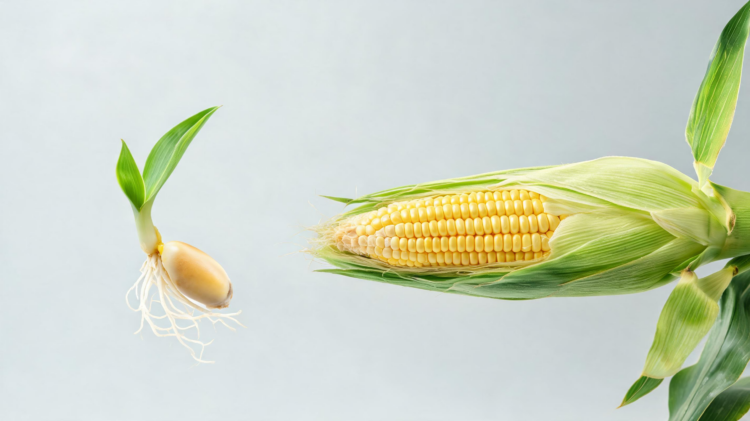
A small piece of a young maize plant could help remove one of biotechnology’s most persistent obstacles: getting tropical varieties to grow in the laboratory. In a study of four maize varieties cultivated in Cameroon, researchers found that split internodes and young leaves taken from two-week-old seedlings could reliably produce callus, a mass of dividing plant cells that can serve as the starting material for regeneration and genetic transformation. The results suggest that laboratories may not always need immature embryos, the traditional source of tissue for maize culture, to begin developing biotechnology systems for locally important tropical germplasm. That matters because maize is a central food crop across sub-Saharan Africa, while many tropical varieties are poorly represented in transformation research and often respond unpredictably to tissue culture. The work does not yet demonstrate that the callus can regenerate into fertile plants or support genome editing, but it identifies practical combinations of plant tissue, genetic background and growth regulators that could move those goals closer.
Plant tissue culture begins with a biological reset. Under carefully controlled conditions, specialized cells can lose aspects of their original identity and begin dividing as an undifferentiated tissue known as callus. With the right hormonal signals, some callus can later form roots, shoots or embryos and eventually develop into a complete plant. This ability, called cellular totipotency, underpins several crop technologies, including Agrobacterium-mediated transformation, particle bombardment, doubled-haploid production and CRISPR-based genome editing. Maize, however, is notably difficult to culture, particularly when researchers work with tropical and subtropical genotypes. Immature zygotic embryos have historically been favored because they can produce embryogenic callus, but they are available only during a narrow developmental window and generally require controlled pollination, seasonal planning and suitable greenhouse facilities. Seedling-derived explants could offer a more accessible alternative because they can be produced from mature seeds and prepared under laboratory conditions throughout the year.
Danielle Christelle Tinak Ekom and Abba Haïcha Diko evaluated the approach using the local varieties ATP, CHABA, CHH and KASSAI. The seeds were surface-sterilized and germinated on Murashige and Skoog basal medium supplemented with sucrose and plant growth regulators. After two weeks, the researchers cut the seedlings into two types of explants. Internodes were split longitudinally to expose tissue near the shoot meristem, while young leaves were cut into pieces approximately half a centimeter long. The explants were then placed on five callus-induction media, each based on the same mineral salts and vitamins but containing different combinations of the synthetic auxin 2,4-dichlorophenoxyacetic acid, or 2,4-D, and the cytokinins benzylaminopurine, known as BAP, or kinetin. The formulations also included casein hydrolysate, silver nitrate and spermidine, compounds used to support culture performance and, in the case of silver nitrate, reduce ethylene accumulation that can inhibit maize callus growth.
The researchers maintained the cultures in complete darkness at approximately 25 degrees Celsius for six weeks, transferring them to fresh medium after 21 days. They recorded the percentage of explants that formed callus and calculated relative fresh weight growth rate, a measure based on the increase between initial and final tissue weight. Statistical analysis used a randomized complete block design covering four varieties, two explant types and five media, with two-way analysis of variance followed by Duncan’s multiple range test at a significance threshold of 0.05. Callus became visible after about one week on all media and from both types of explant. By the end of the culture period, the tissues displayed several forms, including soft, watery white or cream callus; cream-to-brown callus; and more friable, granular tissue that showed a tendency toward early root formation. The authors emphasize that these appearances are preliminary indicators, not proof that a callus is embryogenic.
The clearest pattern was the strong influence of genotype. Split internodes from CHABA produced the highest reported induction response, reaching 76.2 percent on one medium, while ATP and CHH generally performed better than KASSAI. Media designated M1 and M3 were broadly effective for internode-derived callus, with induction above 50 percent in several variety combinations. M2 produced the weakest responses, indicating that its balance of auxin and cytokinin was poorly suited to internode callogenesis in these materials. The leaf explants told a slightly different story. ATP reached the highest leaf-based induction rate, 80.25 percent on M3, followed by CHABA and KASSAI, whereas CHH was the least responsive leaf source. Even so, every variety formed callus from leaf pieces under the tested conditions, showing that the tissue could provide a useful secondary route when internodes are unsuitable.
Growth rate revealed another important distinction. Split internodes consistently generated more rapidly expanding callus than leaves. CHABA showed the strongest proliferation, with relative fresh weight growth rates exceeding 5,000 percent on M1 and M3. Leaf-derived callus from the same variety also grew vigorously, surpassing 3,000 percent on those media, but remained less proliferative overall. The researchers caution that such striking percentages should not be interpreted as equivalent to a five-thousand-fold increase in useful biological material or as evidence of superior regeneration potential. Fresh weight can rise sharply when callus absorbs water, becomes highly vacuolated and develops a loose, watery structure. In other words, rapid tissue expansion may reflect hydration as much as the production of dense, developmentally competent cells. This distinction is crucial for laboratories choosing material for transformation, because abundant callus is not necessarily embryogenic callus.
The hormone results fit the basic biology of plant regeneration. Auxins such as 2,4-D can promote dedifferentiation and stimulate the formation of early callus, while cytokinins help regulate cell division and influence whether tissue continues proliferating or begins differentiating. The most favorable responses generally came from media containing 2 to 2.5 milligrams per liter of 2,4-D together with BAP or kinetin, corresponding to the M1–M3 group. The outcome was not universal, however: the same medium could produce very different results in different varieties, and the interaction between genotype and medium was statistically significant. That variability reflects the fact that tissue culture is governed not only by the recipe in the vessel but also by the genetic and physiological state of the plant. Differences in hormone signaling, cell-cycle control, stress responses and tissue organization can determine whether an explant remains inactive, produces watery callus or enters a pathway capable of regeneration.
The study therefore represents a foundation rather than a finished transformation platform. The authors did not test whether the induced calli could produce shoots, roots and fertile plants, nor did they use histological or molecular markers to confirm embryogenic competence. Further experiments must identify which callus types can regenerate, determine whether the tissues remain genetically stable during prolonged culture and optimize the transition from induction media to regeneration media. Those steps will be especially important for CHABA and ATP, the varieties that displayed the most promising combinations of induction and proliferation. If subsequent work succeeds, seedling-derived split internodes and leaves could make tropical maize biotechnology less dependent on immature embryos and specialized facilities. That would give researchers a practical starting point for improving locally adapted varieties threatened by climate change, pests, diseases and declining soil quality, while preserving the genetic resources that farmers already rely on.
One practical strength of the protocol is that it begins with mature caryopses rather than relying on a precisely timed reproductive tissue. The seedlings were generated under defined laboratory conditions, and the explants were prepared at a common two-week developmental stage. That standardization can reduce one source of experimental variation: the physiological differences associated with embryo age. It does not eliminate variation altogether, because seed quality, germination behavior and the exact position of an internode or leaf segment may still affect the cells that respond. For this reason, a useful next step would be to define explant sampling landmarks and seedling size criteria in enough detail for independent laboratories to reproduce the comparison.
The treatment design also illustrates why tissue-culture optimization is usually empirical rather than transferable as a single universal recipe. The five media varied the relative influence of 2,4-D, BAP and kinetin, allowing the researchers to examine hormonal combinations rather than testing an auxin alone. Such comparisons can reveal a response window in which cells divide without immediately differentiating, but the best induction medium may not be the best medium for later plant development. Regeneration commonly requires a change in hormonal conditions, and the study’s results should therefore be used to select candidate combinations for subsequent experiments, not as a complete culture system.
Several components of the medium are particularly relevant to interpreting the results. Casein hydrolysate supplies a complex mixture of nitrogenous and other organic compounds, while spermidine is associated with processes involved in cell proliferation and stress responses. Silver nitrate was included because ethylene can accumulate in sealed culture vessels and suppress callus proliferation. These additives may have contributed to the observed responses, but their effects were not separated experimentally from those of the growth regulators. A future factorial comparison could determine whether each component is necessary for every genotype or whether some varieties would respond equally well to a simpler and less costly formulation.
The statistical structure provides a framework for identifying interactions that would be missed by comparing averages alone. With varieties, explant sources and media combined in a randomized complete block design, the researchers could assess whether a medium’s effect depended on genetic background or tissue type. Nevertheless, callus induction percentage and fresh-weight growth rate describe quantity more directly than developmental quality. Confirmation of embryogenic potential will require regeneration tests, characterization of shoot and root formation, and evaluation of plants recovered from culture. Testing regenerated plants for fertility and phenotypic or genetic stability would then determine whether the method can support breeding and transformation rather than merely produce proliferating tissue.
That distinction is important for tropical maize improvement. A protocol that works across several locally maintained varieties can serve as a screening platform, helping researchers compare transformation or editing conditions without first obtaining immature embryos from every genotype. It may also support experiments on varieties whose agronomic value is local but whose tissue-culture behavior has not been extensively documented. The immediate contribution of this work is thus methodological: it expands the set of accessible starting tissues and identifies genotype-specific responses that can guide the more demanding stages of regeneration and genetic improvement.
Subject of Research: Callus induction from seedling-derived explants in tropical maize
Article Title: Seedling-derived split internode and leaf explants as efficient alternatives for callus induction in tropical maize
Article References: Tinak Ekom, D. C., & Diko, A. H. (2026). Seedling-derived split internode and leaf explants as efficient alternatives for callus induction in tropical maize. BMC Agriculture, 2(1), Article 28. https://doi.org/10.1186/s44399-026-00051-z
Image Credits: AI Generated
DOI: 10.1186/s44399-026-00051-z
Keywords: Tropical maize, Callus induction, Plant tissue culture, Split internodes, Leaf explants, 2,4-D, Plant regeneration, Crop biotechnology, Seedling-derived, split, internode, leaf
Cite Scienmag News
APA
MLA
Chicago
Scienmag. (August 28, 2026). Seedling Tissue Offers New Route to Tropical Maize Genetic Improvement. https://scienmag.com/seedling-tissue-offers-new-route-to-tropical-maize-genetic-improvement/
Scienmag. “Seedling Tissue Offers New Route to Tropical Maize Genetic Improvement.” Scienmag, 28 August 2026, https://scienmag.com/seedling-tissue-offers-new-route-to-tropical-maize-genetic-improvement/. Accessed 28 August 2026.
Scienmag. “Seedling Tissue Offers New Route to Tropical Maize Genetic Improvement.” Scienmag. August 28, 2026. https://scienmag.com/seedling-tissue-offers-new-route-to-tropical-maize-genetic-improvement/
Copy citation
Download RIS
Tags: 2,4-Dbiotechnology for sub-Saharan AfricaCallus inductioncallus production from seedling tissueschallenges in tropical maize breedingCrop biotechnologygenetic modification of tropical maizeinternodelaboratory cultivation of tropical maizeleafLeaf explantsmaize genome editingmaize regeneration from young tissueMaize tissue culturemaize transformation techniquesPlant regenerationPlant tissue cultureplant tissue culture methodsSeedling-derivedsplitSplit internodesTropical maizetropical maize genetic improvementuse of seedling tissues in plant biotechnology