Tree hyraxes are medium-sized mammals living in the canopies of tropical forests. They are shy and only move at night, which is why next to nothing has been known about their living habits or behaviour so far.
However, researchers from the University of Helsinki have now, by combining various techniques, been able to observe the life of a local tree hyrax species living in the fragmented mountain forests of Taita Hills in Kenya.
The movements of nocturnal tree hyraxes were monitored with the help of a thermal imaging camera. The camera revealed which tree and vine species were particularly favoured by the tree hyraxes, which species’ leaves they ate and which species provided them with suitable hiding places for the day. Among other things, the new data revealed that tree hyraxes are social. They do not sulk in a fork of a tree, as has been previously commonly assumed.
The automated acoustic recorders placed in the forests inhabited by tree hyraxes collected diverse information on communication between the animals and their other activities in the dark hours of the night. Thanks to the recordings, it was possible to estimate the number of tree hyraxes in the different forest patches in Taita Hills. The estimated population is no more than 2,000–4,000 individuals.
“In small forest patches, the calls of tree hyraxes were rarely heard, and only in the early hours of the morning. These few surviving animals are making every effort to avoid detection and the attention of potential poachers,” says Doctoral Researcher Hanna Rosti from the Faculty of Biological and Environmental Sciences, who has long studied tree hyraxes.
Tree hyrax forests were previously laser scanned from the air. Models of forest structure produced using airborne laser scanning equipment (lidar) confirmed that tree hyraxes particularly prefer places where the forest is dense and multistructured and where the largest trees reach heights of more than 45 metres.
“The results acquired through this research will move tree hyrax conservation significantly forward, not only in Taita Hills but also in other parts of Africa. The methods used can also be applied to other nocturnal animals that are difficult to get close to,” rejoices Professor Jouko Rikkinen from the Finnish Museum of Natural History Luomus of the University of Helsinki.
All the research findings will have valuable practical use, as attempts will be made to boost reforestation efforts in Taita Hills by means aimed at promoting the protection and preservation of the numerous endemic species.
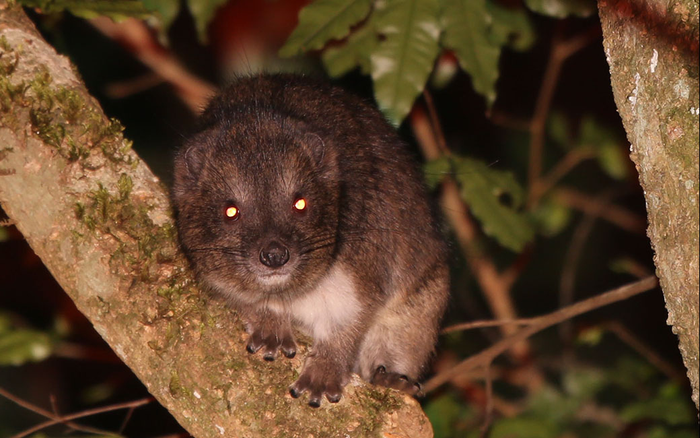
Credit: Hanna Rosti, [email protected]
Tree hyraxes are medium-sized mammals living in the canopies of tropical forests. They are shy and only move at night, which is why next to nothing has been known about their living habits or behaviour so far.
However, researchers from the University of Helsinki have now, by combining various techniques, been able to observe the life of a local tree hyrax species living in the fragmented mountain forests of Taita Hills in Kenya.
The movements of nocturnal tree hyraxes were monitored with the help of a thermal imaging camera. The camera revealed which tree and vine species were particularly favoured by the tree hyraxes, which species’ leaves they ate and which species provided them with suitable hiding places for the day. Among other things, the new data revealed that tree hyraxes are social. They do not sulk in a fork of a tree, as has been previously commonly assumed.
The automated acoustic recorders placed in the forests inhabited by tree hyraxes collected diverse information on communication between the animals and their other activities in the dark hours of the night. Thanks to the recordings, it was possible to estimate the number of tree hyraxes in the different forest patches in Taita Hills. The estimated population is no more than 2,000–4,000 individuals.
“In small forest patches, the calls of tree hyraxes were rarely heard, and only in the early hours of the morning. These few surviving animals are making every effort to avoid detection and the attention of potential poachers,” says Doctoral Researcher Hanna Rosti from the Faculty of Biological and Environmental Sciences, who has long studied tree hyraxes.
Tree hyrax forests were previously laser scanned from the air. Models of forest structure produced using airborne laser scanning equipment (lidar) confirmed that tree hyraxes particularly prefer places where the forest is dense and multistructured and where the largest trees reach heights of more than 45 metres.
“The results acquired through this research will move tree hyrax conservation significantly forward, not only in Taita Hills but also in other parts of Africa. The methods used can also be applied to other nocturnal animals that are difficult to get close to,” rejoices Professor Jouko Rikkinen from the Finnish Museum of Natural History Luomus of the University of Helsinki.
All the research findings will have valuable practical use, as attempts will be made to boost reforestation efforts in Taita Hills by means aimed at promoting the protection and preservation of the numerous endemic species.
Journal
Scientific Reports
DOI
10.1038/s41598-022-10235-7
Article Title
Habitat preferences, estimated abundance and behavior of tree hyrax (Dendrohyrax sp.) in fragmented montane forests of Taita Hills, Kenya
Article Publication Date
15-Apr-2022