Populations of fish in the ocean are notoriously variable, waxing and waning in often unpredictable ways. Knowing what drives changes in fish population sizes is important for managing fisheries and conserving species.
For the first time, scientists have linked the ecology of adult fish populations inhabiting coral reefs with the dispersal of baby fish between reefs, reporting the dynamics of a living network called a "marine metapopulation."
"It's not like studying deer in a forest, where one need only count births and deaths to understand how population size changes, which is difficult enough," says senior author Mark Hixon, professor in the Department of Biology at the University of Hawaii at Manoa.
"The challenge of understanding changes in reef fish abundance in a metapopulation is to measure simultaneously egg production by adults on multiple reefs and the dispersal of baby fish among those reefs, as well as other factors," explains first author Darren Johnson, assistant professor in the Department of Biological Sciences at California State University, Long Beach.
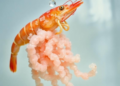
Challenge indeed. Like many ocean species, most coral reef fishes cast their tiny babies (called "larvae") into the ocean currents, where they may or may not eventually find a reef on which to settle.
"The larvae are like lottery tickets, some of which are lucky and most of which perish," reports co-author Mark Christie, assistant professor in the Department of Biological Sciences at Purdue University. "The larvae that survive may return to the same reef as their parents or settle on a reef hundreds of miles away."
But how can these tiny babies be tracked, let alone linked to their parents?
New genetic methods analyzing small samples of fin tissue from captured and released fish allowed the scientists to compare adult bicolor damselfish in the Bahamas with baby fish appearing on the same or other reefs over three years, thereby matching parents with their offspring.
"Such patterns of larval connectivity have now been documented many times using genetic methods," says co-author Tim Pusack, assistant professor at Williams College, "but we closed the population life-cycle loop by integrating larval dispersal with egg production by adults."
Quantifying what they called "demographic connectivity," the scientists calculated larval dispersal as a function of initial egg production by adding artificial nests to reefs in which the damselfish laid their eggs.
"We counted how many eggs each nest produced, thereby learning how many offspring were produced at each reef," reports co-author Christopher Stallings, associate professor in the College of Marine Science at the University of South Florida. "Combining these data with the genetic parentage data, we were able to estimate how many of the larvae that leave a reef come home, and how many travel to other reefs."
The most important reefs for replenishing the overall metapopulation showed high levels of successful larval dispersal relative to the number of eggs produced.
Studying only larval dispersal alone, or egg production alone, both typical of previous studies, did not provide a clear picture of the drivers of fish abundance.
"This is the first field study to successfully measure both dispersal and egg production," reports Oregon State University fisheries oceanographer J. Wilson White, who was not involved in the study. "These results reinforce the need to link those two pieces to understand population changes."
The integration of such difficult to measure information will allow scientists to identify the most valuable reefs to protect for conservation and management of coral reef fishes.
###
Funded by the National Science Foundation, this research was recently published in the peer-reviewed scientific journal Ecology.
Media Contact
Mark Hixon
[email protected]
808-956-6427
@UHManoaNews
http://manoa.hawaii.edu
https://www.hawaii.edu/news/2018/06/01/secrets-of-fish-population-changes-revealed/
Related Journal Article
http://dx.doi.org/10.1002/ecy.2343