A new paper in Genome Biology and Evolution, published by Oxford University Press, finds that the annulated sea snake, a species of venomous snake found in ocean waters around Australia and Asia, appears to have evolved to see an extended palette of colors after its ancestors lost that ability in response to changing environments.
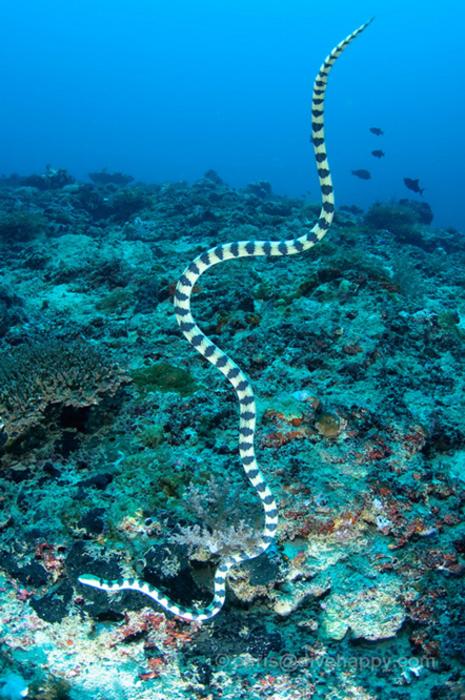
Credit: Chris Mitchell/ Genome Biology and Evolution
A new paper in Genome Biology and Evolution, published by Oxford University Press, finds that the annulated sea snake, a species of venomous snake found in ocean waters around Australia and Asia, appears to have evolved to see an extended palette of colors after its ancestors lost that ability in response to changing environments.
Color vision in animals is primarily determined by genes called visual opsins. While there have been multiple losses of opsin genes during the evolution of tetrapods (the group including amphibians, reptiles, and mammals), the emergence of new opsin genes is extremely rare. Before this study, the only evolution of new opsin genes within reptiles appeared to have occurred in species of Helicops, a genus of snake from South America.
This study used published reference genomes to examine visual opsin genes across five ecologically distinct species of elapid snakes. The history of elapids, a family of snakes that includes cobras and mambas in addition to the annulated sea snake, presents an opportunity to investigate the molecular evolution of vision genes. Early snakes had lost two visual opsin genes during their dim-light burrowing phase and could only perceive a very limited range of colors. However, some of their descendants now occupy brighter environments; two elapid lineages have even moved from terrestrial to marine environments within the last 25 million years.
Researchers here found that the annulated sea snake possesses four intact copies of the opsin gene SWS1. Two of these genes have the ancestral ultraviolet sensitivity, and two have evolved a new sensitivity to the longer wavelengths that dominate ocean habitats. The study’s authors believe that this sensitivity may provide the snakes with better color discrimination to distinguish predators, prey and/or potential mates against colorful marine backgrounds. This is dramatically different from the evolution of opsins in mammals like bats, dolphins, and whales during ecological transitions; they experienced further opsin losses as they adapted to dim-light and aquatic environments.
“The earliest snakes lost much of their ability to see color due to their dim-light burrowing lifestyle,” said the paper’s lead author Isaac Rossetto. “However, their sea snake descendants now occupy brighter and more spectrally-complex marine environments. We believe that recent gene duplications have dramatically expanded the range of colors sea snakes can see. For reference, us humans have a similarly expanded sensitivity to colors, while cats and dogs are partially color-blind much like those early snakes.”
The paper, “Functional Duplication of the Short-Wavelength-Sensitive Opsin in Sea Snakes: Evidence for Reexpanded Colour Sensitivity Following Ancestral Regression,” is available (at midnight on July 12th) at: https://academic.oup.com/gbe/article-lookup/doi/10.1093/gbe/evad107.
Direct correspondence to:
Isaac Rossetto
PhD Candidate – Sea Snake Evolution
The University of Adelaide
North Terrace, Adelaide, South Australia 5005, AUSTRALIA
[email protected]
To request a copy of the study, please contact:
Daniel Luzer
[email protected]
Journal
Genome Biology and Evolution
DOI
10.1093/gbe/evad107
Method of Research
Content analysis
Subject of Research
Animals
Article Title
Functional Duplication of the Short-Wavelength-Sensitive Opsin in Sea Snakes: Evidence for Reexpanded Colour Sensitivity Following Ancestral Regression
Article Publication Date
12-Jul-2023
COI Statement
N/A