• HOME
  • NEWS
  • EXPLORE
    • CAREER
      • Companies
      • Jobs
    • EVENTS
    • iGEM
      • News
      • Team
    • PHOTOS
    • VIDEO
    • WIKI
  • BLOG
  • COMMUNITY
    • FACEBOOK
    • INSTAGRAM
    • TWITTER
Wednesday, April 1, 2026
BIOENGINEER.ORG
No Result
View All Result
  • Login
  • HOME
  • NEWS
  • EXPLORE
    • CAREER
      • Companies
      • Jobs
        • Lecturer
        • PhD Studentship
        • Postdoc
        • Research Assistant
    • EVENTS
    • iGEM
      • News
      • Team
    • PHOTOS
    • VIDEO
    • WIKI
  • BLOG
  • COMMUNITY
    • FACEBOOK
    • INSTAGRAM
    • TWITTER
  • HOME
  • NEWS
  • EXPLORE
    • CAREER
      • Companies
      • Jobs
        • Lecturer
        • PhD Studentship
        • Postdoc
        • Research Assistant
    • EVENTS
    • iGEM
      • News
      • Team
    • PHOTOS
    • VIDEO
    • WIKI
  • BLOG
  • COMMUNITY
    • FACEBOOK
    • INSTAGRAM
    • TWITTER
No Result
View All Result
Bioengineer.org
No Result
View All Result
Home NEWS Science News

Sea scorpions: The original sea monster

Bioengineer by Bioengineer
April 18, 2017
in Science News
Reading Time: 2 mins read
0
Share on FacebookShare on TwitterShare on LinkedinShare on RedditShare on Telegram
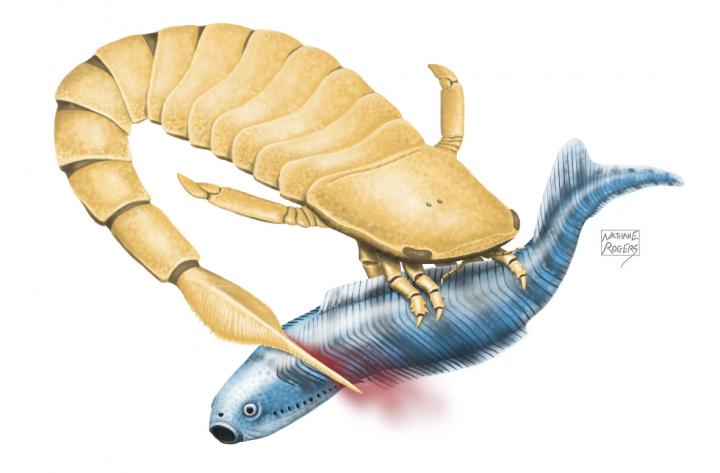
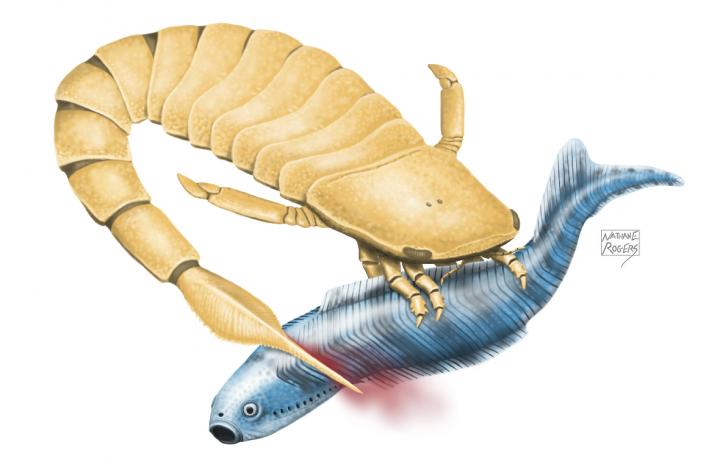
IMAGE

Credit: Nathan Rogers

Four hundred and thirty million years ago, long before the evolution of barracudas or sharks, a different kind of predator stalked the primordial seas. The original sea monsters were eurypterids–better known as sea scorpions.

Related to both modern scorpions and horseshow crabs, sea scorpions had thin, flexible bodies. Some species also had pinching claws and could grow up to three metres in length. New research by University of Alberta scientists Scott Persons and John Acorn hypothesise that the sea scorpions had another weapon at their disposal: a serrated, slashing tail spine.

Armed and dangerous

"Our study suggests that sea scorpions used their tails, weaponized by their serrated spiny tips, to dispatch their prey," says Scott Persons, paleontologist and lead author on the study.

Sparked by the discovery of a new fossil specimen of the eurypterid Slimonia acuminata, Persons and Acorn make the biomechanical case that these sea scorpions attacked and killed their prey with sidelong strikes of their serrated tail.

The fossil, collected from the Patrick Burn Formation near Lesmahagow, Scotland, shows a eurypterid Slimonia acuminate, with a serrated-spine-tipped tail curved strongly to one side.

Powerful weapons

Unlike lobsters and shrimps, which can flip their broad tails up and down to help them swim, eurypterid tails were vertically inflexible but horizontally highly mobile.

"This means that these sea scorpions could slash their tails from side to side, meeting little hydraulic resistance and without propelling themselves away from an intended target," explains Persons. "Perhaps clutching their prey with their sharp front limbs eurypterids could kill pretty using a horizontal slashing motion."

Among the likely prey of Slimonia acuminata and other eurypterids were ancient early vertebrates.

###

The paper, "A sea scorpion's strike: New evidence of extreme lateral flexibility in the opisthoma of eurypterids," was published in The American Naturalist in April 2017.

Media Contact

Katie Willis
[email protected]
780-248-1215
@ualberta

http://www.ualberta.ca

############

Story Source: Materials provided by Scienmag

Share12Tweet8Share2ShareShareShare2

Related Posts

Cutting-Edge “Smart” Drugs Revolutionize Cancer Treatment

April 1, 2026
KIST-IAE Collaborative Team Surpasses Performance Limits in Lithium-Air Batteries with Innovative Two-Dimensional Catalyst

KIST-IAE Collaborative Team Surpasses Performance Limits in Lithium-Air Batteries with Innovative Two-Dimensional Catalyst

April 1, 2026

Brain Metastases Show Unique Macrophage Spatial Patterns

April 1, 2026

PRSS56 Drives and Treats Human High Myopia

April 1, 2026
Please login to join discussion

POPULAR NEWS

  • blank

    Revolutionary AI Model Enhances Precision in Detecting Food Contamination

    96 shares
    Share 38 Tweet 24
  • Imagine a Social Media Feed That Challenges Your Views Instead of Reinforcing Them

    1006 shares
    Share 398 Tweet 249
  • Promising Outcomes from First Clinical Trials of Gene Regulation in Epilepsy

    51 shares
    Share 20 Tweet 13
  • Popular Anti-Aging Compound Linked to Damage in Corpus Callosum, Study Finds

    43 shares
    Share 17 Tweet 11

About

We bring you the latest biotechnology news from best research centers and universities around the world. Check our website.

Follow us

Recent News

Cutting-Edge “Smart” Drugs Revolutionize Cancer Treatment

KIST-IAE Collaborative Team Surpasses Performance Limits in Lithium-Air Batteries with Innovative Two-Dimensional Catalyst

Brain Metastases Show Unique Macrophage Spatial Patterns

Subscribe to Blog via Email

Enter your email address to subscribe to this blog and receive notifications of new posts by email.

Join 78 other subscribers
  • Contact Us

Bioengineer.org © Copyright 2023 All Rights Reserved.

Welcome Back!

Login to your account below

Forgotten Password?

Retrieve your password

Please enter your username or email address to reset your password.

Log In
No Result
View All Result
  • Homepages
    • Home Page 1
    • Home Page 2
  • News
  • National
  • Business
  • Health
  • Lifestyle
  • Science

Bioengineer.org © Copyright 2023 All Rights Reserved.