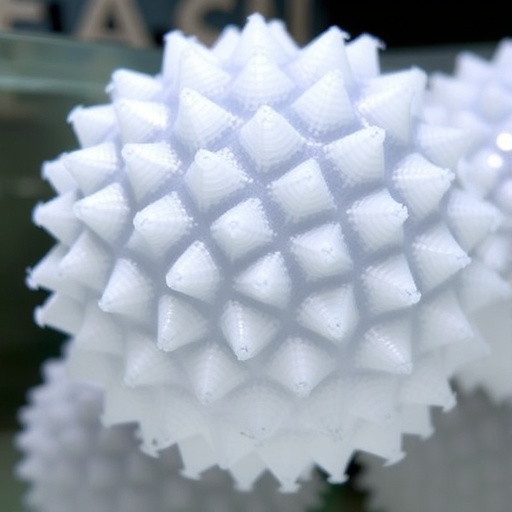
A new lightweight material inspired by the unusual structure of sea cucumber skin could offer a powerful way to suppress electromagnetic pollution across the X and Ku frequency bands, according to research published in Nano-Micro Letters. The material combines niobium carbide MXene, cobalt-containing nitrogen-doped carbon nanosheet arrays and a carbon-fiber aerogel into a three-dimensional electromagnetic wave absorber. Its architecture is designed to address a major challenge in modern wireless technology: creating materials that can block or dissipate unwanted electromagnetic radiation without adding substantial weight, bulk or mechanical fragility.
Electromagnetic waves are essential to radar, satellite communications, wireless networks and many defense systems, but uncontrolled reflections and interference can reduce signal reliability and expose electronic equipment to electromagnetic leakage. Conventional shielding materials, particularly dense metals, often work by reflecting radiation rather than absorbing it. That approach can create secondary electromagnetic pollution and adds considerable mass. Lightweight absorbers are therefore being developed to convert electromagnetic energy into heat through carefully engineered electrical and magnetic losses. The new composite takes this strategy further by building a porous, multiscale structure in which several mechanisms operate simultaneously.
The inspiration comes from the sea cucumber, an animal capable of rapidly changing the stiffness of its body wall. Sea cucumber tissues contain fibrous structural elements embedded in a soft matrix, allowing the organism to combine flexibility, strength and adaptability. The researchers translated this biological principle into an interconnected carbon-fiber aerogel framework. Carbon fibers form a low-density skeleton with continuous pathways for electrical transport, while the aerogel’s open pores reduce weight and provide space for electromagnetic waves to enter rather than simply bounce from the surface. This three-dimensional network also acts as a platform for growing and anchoring the active nanoscale components.
At the center of the design is Nb2CTx MXene, a two-dimensional niobium carbide material belonging to the MXene family. MXenes are known for their metallic conductivity, layered morphology and chemically active surface terminations, which can include oxygen-, hydroxyl- and fluorine-related groups. In an electromagnetic absorber, these properties help produce conductive losses as incident waves drive mobile charge carriers through the material. However, highly conductive two-dimensional sheets can also reflect a large fraction of incoming radiation if they are densely stacked. The researchers address that problem by integrating the MXene with porous carbon and nanosheet arrays, dispersing conductive domains and creating a more gradual impedance transition between air and the absorber.
The second major component consists of cobalt-associated nitrogen-doped carbon nanosheet arrays. These nanosheets increase the number of interfaces inside the composite, creating locations where electromagnetic energy can be repeatedly scattered, polarized and dissipated. Nitrogen atoms incorporated into the carbon lattice modify its electronic structure and generate defects that promote dipolar polarization. Cobalt contributes magnetic loss and can also influence the formation and organization of the surrounding carbon architecture. Together, the conductive MXene, defect-rich nitrogen-doped carbon and cobalt-related magnetic centers establish a balanced combination of dielectric and magnetic responses, a key requirement for broadband absorption.
The material’s performance depends not only on its chemical composition but also on the way its components are arranged. The carbon-fiber aerogel provides a hierarchical framework, with large interconnected pores supporting the overall structure and smaller gaps formed between nanosheets and MXene layers. These voids increase the distance traveled by electromagnetic waves inside the material and encourage multiple internal reflections. Every additional interaction gives conductive charges, defects, interfaces and magnetic centers more opportunities to dissipate the wave’s energy. The porous architecture also helps tune impedance matching, allowing radiation to penetrate the composite before absorption takes place.
According to the study, the resulting absorber operates effectively in the X and Ku bands, frequency ranges widely used in radar, satellite links and other high-frequency communication technologies. The reported design combines low density with strong attenuation, demonstrating how a material can be engineered to absorb radiation without relying on a thick or heavy coating. Its performance is attributed to the cooperative action of conductive loss from the MXene and carbon network, polarization loss at heterogeneous interfaces, magnetic loss associated with cobalt-containing structures, defect-induced relaxation and repeated scattering within the aerogel. Rather than depending on one dominant mechanism, the composite distributes energy dissipation across its entire volume.
The sea cucumber-inspired strategy could be particularly significant for applications requiring both electromagnetic protection and structural efficiency. Aerogel-based absorbers may be integrated into lightweight aircraft, drones, satellites, portable electronics, radar-absorbing components and communication equipment where every gram matters. The carbon-fiber framework may also offer mechanical support that is difficult to achieve with powders or fragile films alone. Although further work will be needed to evaluate long-term durability, environmental stability, large-scale manufacturing and performance under real operating conditions, the study illustrates the growing influence of bioinspired design in advanced materials research. By combining an adaptable biological concept with two-dimensional MXene chemistry, magnetic nanostructures and porous carbon engineering, the researchers have created a platform that could help make electromagnetic shielding lighter, broader in frequency and more efficient.
Subject of Research: Lightweight sea cucumber-inspired Nb2CTx MXene@Co nitrogen-doped carbon nanosheet arrays@carbon fiber aerogels for electromagnetic wave absorption
Article Title: Building of lightweight Nb2CTx MXene@Co nitrogen-doped carbon nanosheet arrays@carbon fiber aerogels for high-efficiency electromagnetic wave absorption in X and Ku bands inspired by sea cucumber
Image Credits: AI Generated
DOI: 10.1007/s12274-024-6898-5
Keywords: Nb2CTx MXene, cobalt, nitrogen-doped carbon, carbon fiber aerogel, electromagnetic wave absorption, X band, Ku band, bioinspired materials, lightweight shielding, sea cucumber-inspired design
Tags: bio-inspired electromagnetic interference mitigationCo-doped carbon nanosheetscomposite materials for wireless communicationelectromagnetic pollution mitigationenvironmentally friendly electromagnetic shieldinglightweight electromagnetic shielding materialsmultiscale electromagnetic interference suppressionnitrogen-doped Nb2CTx MXeneporous aerogel electromagnetic absorbersSea cucumber-inspired electromagnetic wave absorberthermal dissipation of electromagnetic energyX and Ku-band wave absorption