


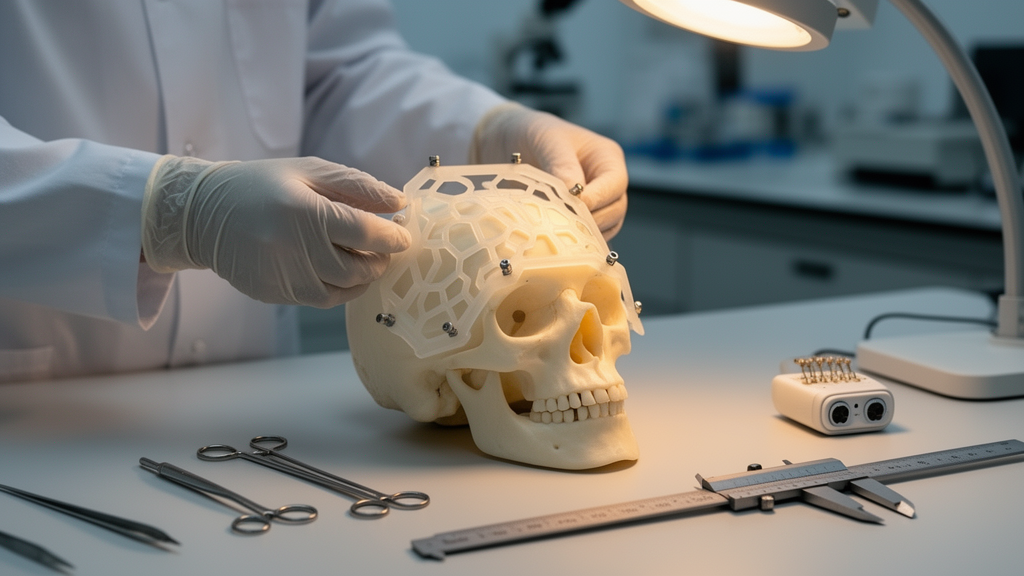
A 3D-printed stencil fixed to the skull with a single screw dramatically outperformed the standard hand-held template when surgeons-in-training marked out craniectomies for responsive neurostimulation implants, according to a randomized crossover bench study published in Acta Neurochirurgica. In the model, the ferrule of the device seated flush on the first attempt in every craniectomy marked with the stencil, compared with only a quarter of those marked freehand.
The generator sits in a craniectomy, a shallow well of removed bone, that must precisely match the device’s ferrule. Surgeons currently trace the outline using a hand-held template that moves freely across the curved surface of the skull. Any error in that traced outline usually remains hidden until after the bone has been removed, when the ferrule simply fails to fit. The research team, led by Mokshal H. Porwal and Alexander C. Whiting, designed a 3D-printed stencil that is anchored during marking with one screw placed in the bone that is about to be removed, eliminating the movement that makes freehand tracing unreliable.
To test the device, the researchers ran a randomized crossover bench study in which eight surgical residents each performed four craniectomies on 3D-printed skulls: two marked with the new stencil and two with the conventional template. The primary outcome was first-pass fit, defined as flush seating of the ferrule at the first attempt. Secondary outcomes included the number of attempts required, operative time, craniectomy size, and operator confidence, analyzed with exact within-operator randomization tests.
The results favored the stencil on every measure. The ferrule seated at the first attempt in 16 of 16 stencil-marked craniectomies versus 4 of 16 template-marked ones, a 100 percent versus 25 percent difference that was statistically significant. Operative time was shorter with the stencil, at 99.7 seconds versus 136.9 seconds, and the resulting craniectomies were smaller, measuring 22.5 square centimeters versus 23.8 square centimeters. Operators also reported higher confidence, averaging 6.6 out of 10 with the stencil compared with 4.1 with the template. Every individual operator needed fewer attempts, worked faster, and produced a smaller craniectomy with the stencil, regardless of seniority.
The authors conclude that, in a bench model, a marking stencil anchored to bone destined for removal achieved first-pass fit of the RNS ferrule in every craniectomy, without enlarging the craniectomy or leaving a screw hole in the retained skull. Because the anchoring screw sits within the bone that is subsequently removed, the technique leaves no permanent hardware behind. The findings are limited to a simulated bench setting with resident operators and printed skulls, and the study is a technical report of a device concept rather than evidence from clinical use; the article was published as open access on October 13, 2026.
Subject of Research: A bench study testing a screw-anchored 3D-printed stencil for marking craniectomies for responsive neurostimulation implants
Article Title: A screw-anchored stencil for responsive neurostimulation craniectomy: a randomized crossover bench study
Article References: Porwal, M. H., Jaffee, S., Lamsam, L., & Whiting, A. C. (2026). A screw-anchored stencil for responsive neurostimulation craniectomy: a randomized crossover bench study. Acta Neurochirurgica. https://doi.org/10.1007/s00701-026-07063-3
Image Credits: AI Generated
DOI: 10.1007/s00701-026-07063-3
Keywords: responsive neurostimulation, craniectomy, 3D-printed stencil, surgical technique, epilepsy, bench study, randomized crossover, neurosurgery, ferrule fit, surgical residents, medical device, screw-anchored
News Source: Ophelia Keating. (October 29, 2026). Screw-Anchored Stencil Guides Responsive Neurostimulation Craniectomy in Bench Study. Scienmag.



