Credit: Bruno et al.
Haptic interfaces have been readily adopted because of their intuitive ease of use and convenience. Obvious examples are the screens for your mobile phone or other computing devices where keyboards have been eliminated. This technology, which has been welcomed in everyday life, can also find a home in scientific research, especially in the case of "point and click" interfaces. The haptic interface provides the immediate "front end". An equally powerful and parallel development has been cloud computing technology, where information and processing power can be shared between multiple users. The combination of these two technologies can provide both ease of use in information analysis and a wide area of application in sharing and making use of the analysis.
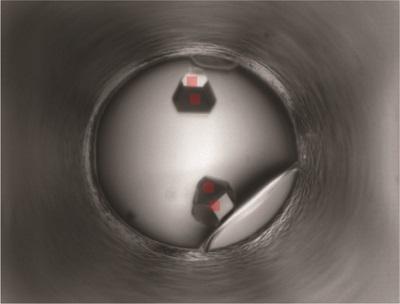
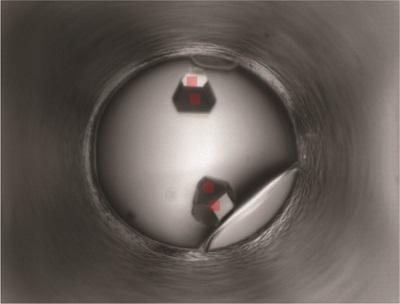
Point and click interfaces are common in many forms of instrumentation. An image is displayed and a human operator interprets that image, together with any associated data, feeding back results with the motion and click of a mouse and sometimes keyboard data entry. In the field of X-ray crystallography, the initial images that need to be interpreted are typically experiments aimed at the crystallisation of biological macromolecules. Each is viewed and classified in order to guide and optimise crystallisation efforts. If success occurs in the crystallisation step, another application of imaging occurs and the images of mounted crystals are used to position them appropriately with respect to the X-ray beam for diffraction analysis. For limited studies, point and click interfaces are convenient, but as the number of images involved begin to increase, even these user-friendly interfaces can become burdensome.
At the Hauptman-Woodward Medical Research Institute, the High-Throughput Crystallisation Screening Centre provides a crystallisation screening service sampling 1536 different chemical conditions. If a potential crystal is identified, the laboratory providing the sample then conducts optimisation experiments centred around the screening results. Once optimised, the resulting crystals are used for diffraction studies.
In a recent paper, scientists from Hauptman-Woodward, Diamond Light Source and Universities in the US [Bruno et al. (2016), J. Appl. Cryst. 49, doi:10.1107/S160057671601431X study the crystallisation outcome and how it is linked to the subsequent diffraction analysis, with the aim of facilitating or potentially eliminating an initial optimisation step. Their study focuses attention on the value and importance of the user interface and process.
Embracing a haptic interface to enable the visualisation, classification and notation of experimental crystallisation data with a cloud-based database of images allows multiple collaborators to share the information and to fill the missing link between screening and diffraction characterisation. Information is passed directly to the beamline so that the crystallization screening plate can be analysed in the beam efficiently. This work broadly demonstrates the power of haptic interfaces and web computing to create a shareable scientific environment in crystallography and beyond.
###
Media Contact
Dr. Jonathan Agbenyega
[email protected]
01-244-342-878
@iucr
http://www.iucr.org