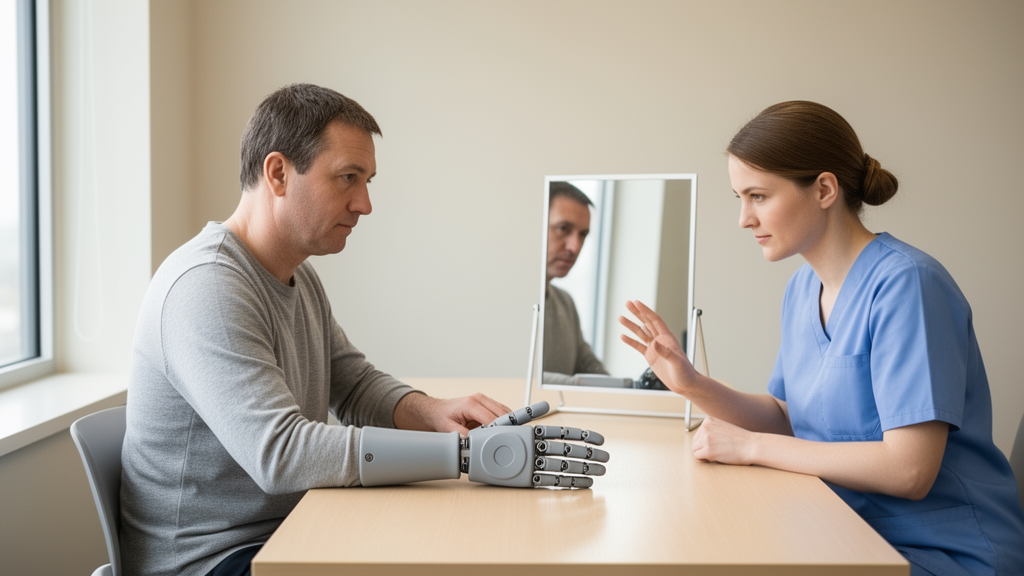
A scoping review published in the Bulletin of Faculty of Physical Therapy has mapped the research landscape on mirror therapy, soft robotic gloves, and their combined use in upper-limb rehabilitation after stroke, and the headline finding is a striking imbalance. Across 84 included studies reporting 2,634 stroke participants, 54 studies (64.3%) examined mirror therapy alone, 27 (32.1%) examined soft robotic glove-based rehabilitation alone, only two studies (2.4%) directly combined the two approaches, and a single study (1.2%) directly compared them. The authors, Mohammed Hindi Alwatifi and Wafaa Abd Ali Hattab, describe the literature as predominantly two parallel evidence streams rather than a mature body of direct combined-intervention research, and they are explicit that the review maps the extent and characteristics of the evidence without determining which intervention is more effective.
The review followed Joanna Briggs Institute methodology and PRISMA-ScR reporting guidance. The original search covered PubMed/MEDLINE, Scopus, and the Cochrane Central Register of Controlled Trials between July 10 and July 20, 2026, with supplementary searches in September 2026 that included a corrected Scopus strategy, in which the mirror therapy and soft robotic glove concept blocks were combined with OR rather than requiring both concepts simultaneously, and a new IEEE Xplore search to improve coverage of engineering and rehabilitation-technology literature. The updated database search identified 939 records across the four databases, and after deduplication, screening, and full-text assessment, 72 studies entered the evidence set from the database pathway, with 12 more added through citation searching. Notably, the review’s protocol was not prospectively registered in a dedicated review registry, a point the authors acknowledge directly, and the associated clinical-trial registration is distinct from the review itself.
Study designs were dominated by randomized controlled or clinical trials, which accounted for 53 of the 84 studies (63.1%), followed by 16 pilot or feasibility studies (19.0%), 12 other interventional or experimental designs (14.3%), and three studies categorized as other or unclear (3.6%). The geographic distribution of the evidence was led by China with 15 studies (17.9%), South Korea with 11 (13.1%), Italy with nine (10.7%), Taiwan with eight (9.5%), and Hong Kong with six (7.1%), with country charted as the location where the clinical study and recruitment were conducted rather than by first-author affiliation. The studies spanned 2008 to 2026, and the authors caution that the 2026 contribution represents a partial publication year because the original search closed in July 2026 and supplementary searches ran in September 2026.
Stroke stage was unevenly characterized across the evidence base. Chronic stroke was explicitly represented in 31 studies (36.9%), subacute stroke in 15 (17.9%), acute stroke in five (6.0%), and mixed acute and subacute populations in two (2.4%), while in 31 studies (36.9%) the stroke stage was unspecified or otherwise classified. The authors flag this limited acute-stage representation as a critical gap, noting that more clearly characterized acute-stage research would improve mapping across the stroke-recovery continuum. They also note that the 2,634 participant figure represents participants reported across studies and should not be interpreted as a verified count of unique individuals across potentially related reports.
Intervention dosage emerged as highly heterogeneous and often incompletely reported. Four-week programs were charted in 18 studies (21.4%), two- to three-week programs in 11 (13.1%), five- to six-week programs in nine (10.7%), seven- to eight-week programs in four (4.8%), and programs longer than eight weeks in two (2.4%). Eighteen studies (21.4%) involved a single session or device evaluation, and duration remained not reported or not recoverable in 11 studies (13.1%). Treatment frequency varied as well, with five sessions per week explicitly charted in 24 studies (28.6%) and three sessions per week in nine (10.7%), while frequency was not reported, not supported, or not applicable in 20 studies (23.8%). Session length was similarly inconsistent, with 37 studies (44.0%) lacking a reportable session duration and 18 studies (21.4%) reporting complex multi-component doses that could not be reduced to a single comparable figure. The authors state plainly that no single duration, frequency, or session length should be interpreted as an optimal regimen from this review.
Outcome measurement showed comparable diversity. The Fugl-Meyer Assessment, including its upper-extremity motor domain, was the most commonly reported instrument, charted in 35 studies (41.7%), followed by the Action Research Arm Test in 12 studies (14.3%), the Box and Block Test in nine (10.7%), spasticity or Modified Ashworth Scale outcomes in 13 (15.5%), and activities of daily living or functional-independence outcomes in 19 (22.6%). These study-level categories can overlap because a single study may report several outcome domains. The authors characterize the frequencies as descriptive study-level mapping rather than evidence of comparative measurement quality, and they conclude that outcome selection reflected differences in intervention objectives, rehabilitation settings, and study designs rather than the adoption of a standardized assessment framework.
The technology mapping revealed a diverse and evolving device landscape. Among explicit soft robotic glove characteristics, pneumatic or soft-pneumatic actuation appeared in three studies (3.6%), fabric or textile soft-glove construction in two (2.4%), tendon or cable-driven soft systems in two (2.4%), commercial Gloreha systems in four (4.8%), and brain-computer interface-controlled systems in four (4.8%), with these flags non-mutually exclusive and calculated against all 84 studies. Mirror therapy delivery was likewise varied, with conventional physical mirror therapy charted in 44 studies (52.4%), virtual or digital mirror approaches in eight (9.5%), robotic mirror approaches in three (3.6%), and mesh-glove adjuncts in three (3.6%). Integrated technologies included EEG in four studies (4.8%), fNIRS or NIRS in four (4.8%), brain-computer interfaces in five (6.0%), sEMG or EMG in six (7.1%), and virtual reality in five (6.0%). The authors distinguish direct cerebral measures such as EEG and fNIRS from peripheral muscle-activity measures such as sEMG, and they caution that the presence of these technologies does not by itself demonstrate neuroplasticity or superior recovery, and that mechanistic statements about cortical reorganization should be treated as proposed or partially investigated rather than established effects.
Safety reporting was a notable weakness. Twenty-three studies (27.4%) explicitly reported no serious or adverse safety signal, four (4.8%) described an adverse event or safety-related withdrawal, and five (6.0%) mentioned safety with insufficiently clear status, but safety was not reported at all in 52 studies (61.9%). The authors emphasize that these 52 studies must not be interpreted as having demonstrated an absence of adverse events. Adherence or attrition information was reported in 55 studies (65.5%), partially reported in 23 (27.4%), and not reported in six (7.1%), with no pooled adherence percentage calculated because definitions and denominators varied. Rehabilitation settings were mapped conservatively, with hospital or clinical settings identified in 55 studies (65.5%), laboratory or device-evaluation settings in 22 (26.2%), and home or telerehabilitation settings in six (7.1%).
The review identifies several further research gaps beyond the acute-stage and safety issues. Follow-up schedules varied and were frequently absent or short, and the authors call for studies with clearly defined longer-term follow-up to determine whether observed functional changes are maintained beyond the immediate intervention period. Objective physiological assessment remained a small component of the evidence base, and future research is urged to distinguish direct cerebral measures from peripheral physiological measures and rehabilitation-control interfaces using clearly defined protocols. Cost-effectiveness, resource utilization, implementation requirements, and scalability were not consistently represented in the mapped dataset, a gap the authors consider particularly relevant for wearable and home-based rehabilitation technologies.
The authors also acknowledge limitations of the mapping exercise itself. No formal critical appraisal or risk-of-bias assessment was undertaken, consistent with the evidence-mapping purpose, so study-design categories should not be read as measures of methodological quality. Databases such as Embase, Web of Science, ACM Digital Library, and PEDro were not systematically searched, meaning engineering and other relevant evidence may remain underrepresented. In the original retrieval pathway, 49 of 121 reports sought (40.5%) could not be obtained despite attempts including Google Scholar and ResearchGate searches and direct contact with study authors, a level of non-retrieval the authors explicitly acknowledge as a potential source of retrieval and selection bias. Duplicate independent data charting for every included study was also not prospectively documented. Within these constraints, the review delivers a structured evidence map intended to inform future clinical and engineering research, and it concludes that future studies should prioritize clearly characterized stroke stages, longer follow-up, standardized outcome reporting, explicit safety assessment, and rigorous evaluation of integrated mirror therapy and soft robotic glove approaches, while avoiding conclusions about comparative treatment superiority.
Subject of Research: A scoping review mapping the evidence on mirror therapy, soft robotic gloves, and their combined use in upper-limb rehabilitation after stroke
Article Title: Mapping the current evidence on mirror therapy, soft robotic gloves, and their combined use in upper limb rehabilitation after stroke: a scoping review
Article References: Alwatifi, M. H., & Hattab, W. A. A. (2026). Mapping the current evidence on mirror therapy, soft robotic gloves, and their combined use in upper limb rehabilitation after stroke: a scoping review. Bulletin of Faculty of Physical Therapy, 31(1), Article 44. https://doi.org/10.1186/s43161-026-00381-8
Image Credits: AI Generated
DOI: 10.1186/s43161-026-00381-8
Keywords: stroke rehabilitation, mirror therapy, soft robotic glove, scoping review, upper limb, evidence map, neurorehabilitation, robotics, adverse events, outcome measures, research gaps, PRISMA-ScR
News Source: Cassandra Pierce. (October 28, 2026). Scoping review maps 84 studies of mirror therapy and soft robotic gloves after stroke. Scienmag.