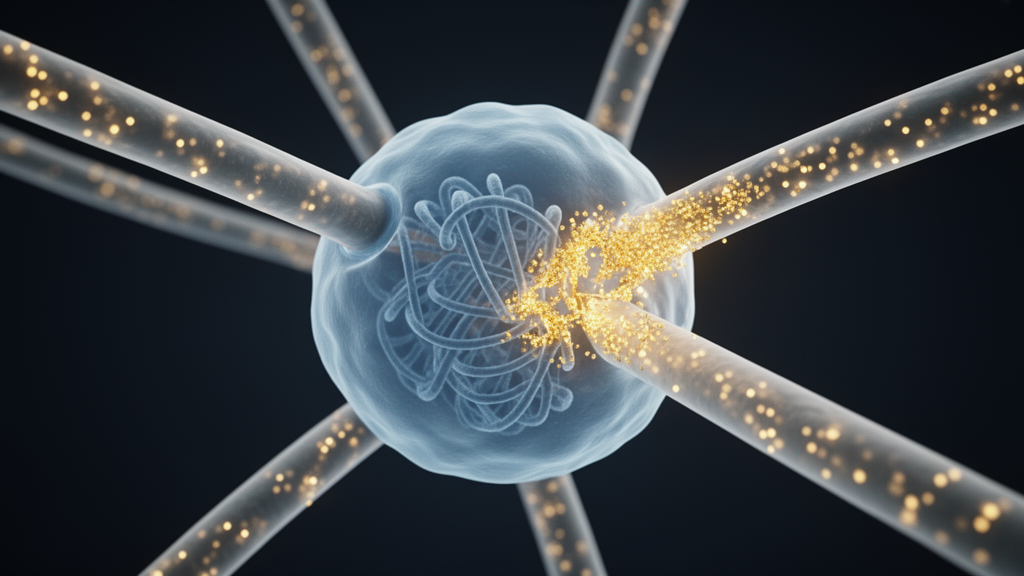
When DNA suffers a double-strand break, the cell does more than mobilize repair proteins to the damaged site. A new study published in Nature Cell Biology shows that the cytoskeleton itself takes part in the response: microtubules become more heavily acetylated, the perinuclear vimentin cage is pushed away from the nucleus, and the nuclear envelope begins to ripple and deform. Those transient shape fluctuations, the authors report, loosen the nucleus enough to let broken DNA ends wander locally, improving the odds that the cell finds the correct template for error-free repair by homologous recombination.
The team, led by Sam Wallis and Wai Yiu Tse in Susana Godinho’s laboratory at Barts Cancer Institute, Queen Mary University of London, worked primarily with non-transformed human RPE-1 retinal epithelial cells. They treated the cells with several genotoxic agents, including cisplatin, doxorubicin and ionizing radiation, and tracked both the damage and the cytoskeletal response in single cells. Cisplatin treatment for 24 hours roughly doubled tubulin acetylation, and the increase correlated with the number of 53BP1 foci, a standard marker of double-strand breaks. Doxorubicin produced a similar rise only after 24 hours, not at 4 hours, pointing to a delayed, time-dependent response rather than an acute one.
Ionizing radiation gave the clearest timeline. After a 2 Gy dose, double-strand breaks peaked at 2 hours, yet tubulin acetylation did not begin to rise until 4 to 6 hours, reached a significant threefold increase at 8 hours and peaked near tenfold at 72 hours. The modification then fell back to baseline by 120 hours, when damage markers and the cell-cycle profile had also returned to pre-irradiation levels. The acetylation dynamics mirrored nuclear p21, a late marker of the DNA damage response, suggesting the rise coincides with later stages of repair rather than the initial insult.
To see whether the acetylated microtubules actually moved the breaks, the researchers filmed live cells expressing 53BP1 fused to red fluorescent protein. Damaged breaks showed localized, random sub-diffusive motion, with an anomalous diffusion coefficient below 1, indicating wiggly movement rather than directed transport. Depleting αTAT1, the enzyme that acetylates α-tubulin at lysine 40, significantly reduced that motion. Destroying microtubules with nocodazole or removing the kinesin-1 motor KIF5B abolished it entirely. Overexpressing αTAT1 intensified break mobility, confirming the effect runs through tubulin acetylation.
The next question was mechanical. Using live imaging and a computational method that converts the circular nuclear outline into polar coordinates, the team quantified transient deformations they call nuclear shape fluctuations. About 70 percent of cisplatin-treated cells displayed one or two such fluctuations, lasting 2 to 10 minutes, and the largest oscillations clustered near the centrosome, the main microtubule-organizing center sitting beside the nucleus. Nocodazole eliminated the fluctuations, as did αTAT1 depletion, while paclitaxel, which stabilizes microtubules, also suppressed them even though it raises acetylation levels, showing that dynamic microtubules, not just acetylated ones, are required.
Atomic force microscopy revealed the underlying softening. Nuclear stiffness dropped after DNA damage, but blocking tubulin acetylation prevented that softening. Conversely, overexpressing αTAT1, or treating cells with tubacin, an HDAC6 inhibitor that boosts tubulin acetylation without affecting histones, was enough to trigger nuclear fluctuations even without any DNA damage. A class I HDAC inhibitor that raises histone acetylation but not tubulin acetylation had no such effect, and AlphaFold3 modelling predicted strong interaction between αTAT1 and α-tubulin but not between αTAT1 and histones, supporting tubulin acetylation as the specific mechanical lever.
The vimentin cage emerged as the key intermediary. This intermediate-filament network normally stiffens the nucleus and shields it from mechanical stress, but it can be hauled away along acetylated microtubules by kinesin-1 motors. After DNA damage, vimentin was displaced from the nuclear surface, exposing the envelope to centrosomal microtubules, and the displacement required both αTAT1 and KIF5B. Critically, removing vimentin by RNA interference rescued nuclear fluctuations and break mobility even in cells lacking tubulin acetylation, provided microtubules were still intact. The same rescue worked by depleting plectin, a cytoskeletal cross-linker that anchors vimentin to the nucleus.
Does that mobility actually matter for repair? When the team blocked acetylation with αTAT1 siRNA, cells failed to clear 53BP1 foci even 24 hours after drug washout, a result confirmed by neutral comet assay and reproduced in HEK-293, U2OS and HeLa lines. Restoring mobility through vimentin or plectin co-depletion fully rescued repair after cisplatin, arguing the link is causal rather than correlational. A CRISPR knockout of ATAT1 showed a specific delay in resolving RAD51 foci, a marker of homologous recombination, between 6 and 8 hours after irradiation, while 53BP1 and phospho-DNA-PK foci, markers of non-homologous end joining, resolved on schedule. In a direct-repeat GFP reporter assay, αTAT1 loss cut homologous recombination efficiency by roughly 40 percent, yet class-switch recombination in B cells, a readout of non-homologous end joining, was unaffected.
The mechanism appears to lie in homology search, the rate-limiting step in which a single-stranded DNA filament scans the nucleus for a matching template. RAD51 filament morphology offered a clue: ATAT1 knockout cells accumulated rod-shaped filaments, similar to cells lacking the RAD54L motor that drives active strand invasion, while double loss of αTAT1 and RAD54L produced a synergistic rise in complex branched and coiled structures, a signature of severely defective search. The authors interpret this as tubulin-acetylation-driven local mobility providing the random three-dimensional component of search, cooperating with RAD54L-driven active search.
When mobility is lost for good, the consequences compound. Persistent breaks in ATAT1 knockout cells clustered into large foci, reaching about 40 percent of cells four days after cisplatin washout, and those large foci drifted to the nuclear periphery, an actin- and myosin-dependent process distinct from the microtubule-driven local motion. Cells carrying such clusters arrested in G1 and, by day 7, roughly 30 percent had entered senescence. Knockout cells also showed heightened sensitivity to HR-dependent agents such as olaparib, talazoparib and cisplatin, with proliferation reduced by about 40 and 30 percent respectively, while doxorubicin, whose breaks can be repaired by either pathway, had a milder effect. The authors propose that nuclear fluctuations act as a mechanical strategy to accelerate error-free repair, and note that selectively inhibiting DSB mobility could one day sensitize tumors to existing chemotherapies, though how microtubule forces propagate to chromatin remains an open question.
Subject of Research: How tubulin acetylation regulates nuclear mechanics and DNA double-strand break repair
Article Title: Tubulin acetylation regulates nuclear shape fluctuations and DNA repair
Article References: Wallis, S., Tse, W. Y., Donker, L., Baxter, A., Dave, N., Weber, A., Gillespie, E., Chen, B., Burden, J. M., Friskes, A., Medema, R. H., Charras, G., Calado, D. P., & Godinho, S. A. (2026). Tubulin acetylation regulates nuclear shape fluctuations and DNA repair. Nature Cell Biology. https://doi.org/10.1038/s41556-026-02096-3
Image Credits: AI Generated
DOI: 10.1038/s41556-026-02096-3
Keywords: tubulin acetylation, DNA double-strand breaks, nuclear mechanics, vimentin, homologous recombination, αTAT1, microtubules, 53BP1, RAD51, cell senescence, kinesin-1, DNA repair
News Source: Drew Townsend. (October 28, 2026). Microtubule Acetylation Softens the Nucleus to Speed DNA Break Repair. Scienmag.