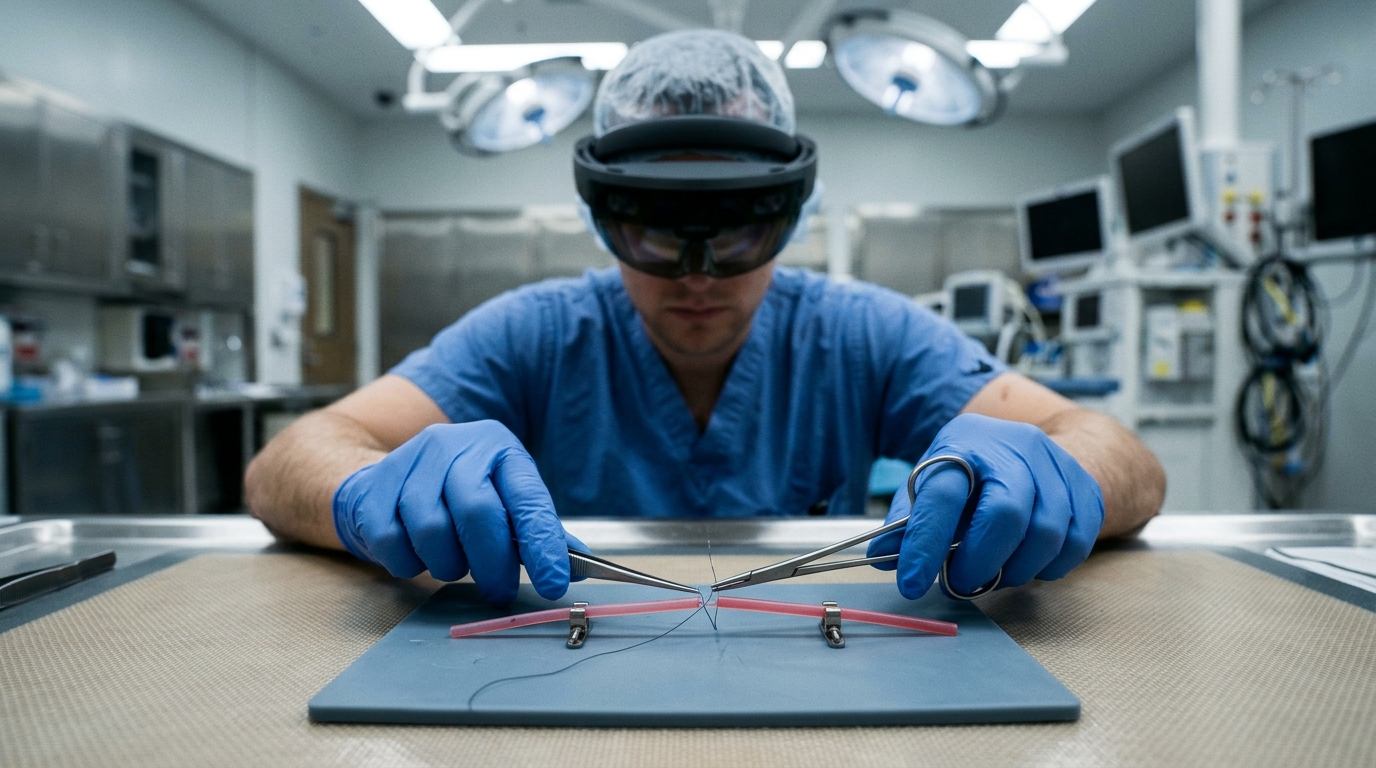
A comprehensive scoping review examining immersive reality technologies for microvascular anastomosis training has identified notable technical promise alongside critical literature gaps, concluding that clinical transfer to the operating room, educational effectiveness, and cost-effectiveness remain entirely unproven. The review, published in Maxillofacial Plastic and Reconstructive Surgery by Kezia Rachellea Mustakim, Carolina Stevanie, Giuseppe D’Albis, Saverio Capodiferro, Soung Min Kim, and Muhammad Ruslin, evaluated the existing global evidence to explore how virtual and immersive systems could assist surgical education in educationally limited and resource-constrained environments.
Microvascular free flap transfer serves as an essential surgical technique in contemporary oral and maxillofacial reconstruction. However, mastering the delicate skills required for microvascular anastomosis continues to pose substantial challenges in low-resource settings. Trainees in these environments face steep barriers because traditional surgical skill acquisition depends heavily on expensive specialized instrumentation and direct, continuous supervision from experienced surgical experts.
To determine whether emerging immersive reality platforms offer viable training alternatives, the research team conducted a formal scoping review adhering strictly to the PRISMA-ScR guidelines. The investigators carried out systematic literature searches across four major electronic databases, specifically PubMed/MEDLINE, Embase, the Cochrane Library, and Scopus, capturing relevant investigations published between 2010 and April 2026.
Despite the broad search timeframe spanning more than sixteen years, only seven studies published between 2010 and 2024 met the formal inclusion criteria for the scoping review. While these identified studies indicated that immersive reality platforms could successfully support specific microsurgical tasks, the authors observed that the vast majority described early proof-of-concept prototypes that had undergone only limited technical and educational validation.
Furthermore, the scoping review revealed that none of the seven evaluated studies examined or implemented a structured microvascular reconstruction curriculum. Crucially, the researchers noted that none of the included investigations directly evaluated maxillofacial reconstructive surgeons or surgical trainees in their assessments. In addition, none of the published literature specifically addressed microvascular anastomosis curricula designed for head and neck reconstruction.
Given these pronounced omissions, the review emphasized that key questions surrounding the real-world adoption of immersive reality systems remain unanswered. Although the evaluated technologies demonstrate engineering promise, their actual instructional effectiveness, economic cost-effectiveness, and direct transferability of acquired microsurgical competencies to human operating room procedures have yet to be substantiated by rigorous empirical research.
To overcome these persistent educational disparities and resource barriers, the authors introduced an author-proposed staged curriculum framework. Under this structured framework, lower-cost immersive reality platforms would first provide foundational orientation, instrument handling practice, depth perception training, suture sequencing exercises, and ergonomic visualization. Once trainees master these core digital fundamentals, they would systematically progress to conventional bench models, biological tissue practice, and ultimately supervised clinical operative training.
Subject of Research: Immersive reality training for oral and maxillofacial microvascular reconstruction
Article Title: Immersive reality training for oral and maxillofacial microvascular reconstruction in resource-limited settings
Article References: Mustakim, K. R., Stevanie, C., D’Albis, G., Capodiferro, S., Kim, S. M., & Ruslin, M. (2026). Immersive reality training for oral and maxillofacial microvascular reconstruction in resource-limited settings. Maxillofacial Plastic and Reconstructive Surgery. https://doi.org/10.1186/s40902-026-00530-y
Image Credits: AI Generated
DOI: 10.1186/s40902-026-00530-y
Keywords: microvascular reconstruction, immersive reality, microvascular anastomosis, oral and maxillofacial surgery, surgical simulation, free flap transfer, scoping review, resource-limited settings, PRISMA-ScR, surgical education, suture sequencing, depth perception, instrument handling, ergonomic visualization, staged curriculum framework, head and neck reconstruction, microsurgical skills
News Source: Ophelia Keating. (November 17, 2026). Scoping Review Finds Immersive Reality Microvascular Training Lacks Clinical Validation. Scienmag.