A team of Florida State University researchers has further developed a new generation of organic-inorganic hybrid materials that can improve image quality in X-ray machines, CT scans and other radiation detection and imaging technologies.
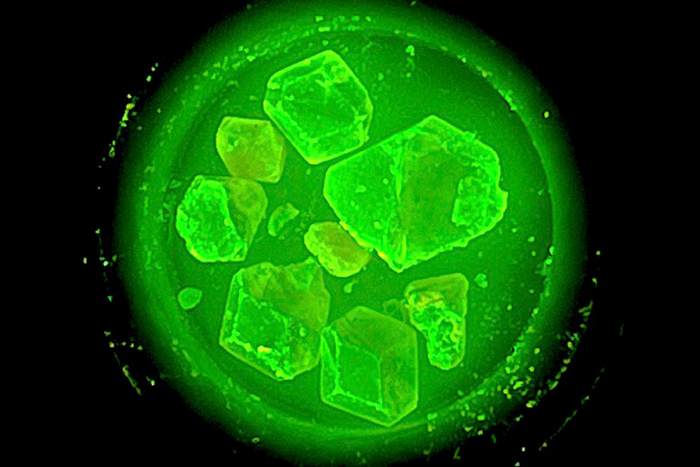
Credit: Courtesy of Biwu Ma.
A team of Florida State University researchers has further developed a new generation of organic-inorganic hybrid materials that can improve image quality in X-ray machines, CT scans and other radiation detection and imaging technologies.
Professor Biwu Ma from the Department of Chemistry and Biochemistry and his colleagues have developed a new class of materials that can act as highly efficient scintillators, which emit light after being exposed to other forms of high energy radiations, such as X-rays.
The team’s most recent study, published in Advanced Materials, is an improvement upon their previous research to develop better scintillators. The new design concept produces materials that can emit light within nanoseconds, orders of magnitude faster than previously developed materials, allowing for better imaging.
“Reducing the radioluminescence decay lifetime of scintillators to nanoseconds is an important breakthrough,” Ma said. “Using a hybrid material made up of both organic and inorganic components means each component can be used for the part of the process where it is most effective.”
WHY IS THIS IMPORTANT?
Scintillators are used in all sorts of imaging applications. Health care settings, security X-rays, radiation detectors and other technologies use them and would benefit from better image quality.
The new generation of organic metal halide hybrid scintillators developed by Ma’s team has numerous improvements over existing ones. In addition to significantly better radioluminescence response, the manufacturing process is simpler than the process used for other scintillators, and it uses abundant and cheap materials.
WHAT’S DIFFERENT ABOUT THIS SCINTILLATOR?
Think of a scintillator as a sort of translator between two types of energy, taking a form of high energy radiation, such as an X-ray, and converting it into visible light. Less radiation passes through denser parts of an object, and that difference can be used to distinguish higher-density objects, such as bones or metal, from lower-density ones, such as soft tissue. The radiation that passes through an object then interacts with the scintillator, which generates visible light that is detected by a sensor to make an image.
Today’s scintillators use mainly inorganic materials to transform high energy radiation into visible light for producing images. These materials are rigid, use rare Earth elements, and require energy-consuming, high-temperature manufacturing processes.
Ma and his team have been working on zero-dimensional organic metal halide hybrids, with which they have performed pioneering research since 2018. These organic-inorganic hybrids are made of small groups of negatively charged inorganic components, called metal halide clusters, and positively charged organic molecules. They’re “zero-dimensional” at the molecular level because the metal halide clusters are fully isolated and surrounded by organic molecules.
In the first version of scintillators based on this material, the metal halides absorb high energy radiation and emit visible light. In this latest iteration, metal halide components and organic molecules work together. The metal halides absorb high energy radiation and transfer energy to the organic components, which emit visible light.
Light emissions from organic molecules take place on the scale of nanoseconds, much faster than the microseconds or milliseconds required for metal halides to emit light.
“The faster the decay of radioluminescence, the more precise we can measure the timing of photon emissions,” Ma said. “That leads to higher resolution and contrast in images.”
WHAT’S NEXT?
With the help of the FSU Office of Commercialization, Ma and his team have filed patents on organic metal halide hybrid scintillators. The office’s GAP Commercialization Investment Program provided funding to develop the technology for potential partnerships with private companies, which would make the scintillators available on a wider scale.
“This is a continuation of our push for better materials over the years, from 2018, when we first discovered this class of materials, to 2020, when we used them for scintillation for the first time,” Ma said. “This is another major breakthrough.”
This study was supported by the National Science Foundation and Florida State University.
This paper’s first author was FSU graduate student Tunde Blessed Shonde. Other co-authors were Maya Chaaban, He Liu, Oluwadara Joshua Olasupo, Azza Ben-Akacha, Fabiola G. Gonzalez, Kerri Julevich, Xinsong Lin, J. S. Raaj Vellore Winfred, all from FSU, and Luis M. Stand and Mariya Zhuravleva from the University of Tennessee, Knoxville.
Journal
Advanced Materials
DOI
10.1002/adma.202301612
Article Title
Molecular Sensitization Enabled High Performance Organic Metal Halide Hybrid Scintillator
Article Publication Date
29-Mar-2023
COI Statement
B.M., T.B.S., and M.C. have filed a provisional patent application entitled “Scintillation Materials and Methods” based on this work to the United States Patent and Trademark office on July 20, 2022 (No. 63/390,793).