

• HOME
  • NEWS
  • EXPLORE
    • CAREER
      • Companies
      • Jobs
    • EVENTS
    • iGEM
      • News
      • Team
    • PHOTOS
    • VIDEO
    • WIKI
  • BLOG
  • COMMUNITY
    • FACEBOOK
    • INSTAGRAM
    • TWITTER
Saturday, June 13, 2026
BIOENGINEER.ORG
No Result
View All Result
  • Login
  • HOME
  • NEWS
  • EXPLORE
    • CAREER
      • Companies
      • Jobs
        • Lecturer
        • PhD Studentship
        • Postdoc
        • Research Assistant
    • EVENTS
    • iGEM
      • News
      • Team
    • PHOTOS
    • VIDEO
    • WIKI
  • BLOG
  • COMMUNITY
    • FACEBOOK
    • INSTAGRAM
    • TWITTER
  • HOME
  • NEWS
  • EXPLORE
    • CAREER
      • Companies
      • Jobs
        • Lecturer
        • PhD Studentship
        • Postdoc
        • Research Assistant
    • EVENTS
    • iGEM
      • News
      • Team
    • PHOTOS
    • VIDEO
    • WIKI
  • BLOG
  • COMMUNITY
    • FACEBOOK
    • INSTAGRAM
    • TWITTER
No Result
View All Result
Bioengineer.org
No Result
View All Result
Home NEWS Science News Biology

Scientists unlock planthoppers’ role in rice stripe virus reproduction

Bioengineer by Bioengineer
August 10, 2017
in Biology
Reading Time: 2 mins read
0
Share on FacebookShare on TwitterShare on LinkedinShare on RedditShare on Telegram
IMAGE

Credit: IOZ

Recently, researchers from the Institute of Zoology of the Chinese Academy of Sciences have discovered how a severe rice virus reproduces inside the small brown planthopper, a major carrier of the virus, and have published this work in eLIFE.

Rice stripe virus (RSV) causes major damage to rice crops each year. The study could inform future strategies for controlling the spread of this and other viruses that can lead to devastating effects on rice, wheat, cotton and other crops.

"Most plant viruses depend on insects to carry them between plants, and many plant viruses can reproduce inside the cells of these carrier insects, or 'vectors', without actually harming them," said CUI Feng, a professor of zoology.

"RSV, one of the most notorious plant viruses, is carried by the small brown planthopper and, once inside the cells, manages to achieve a balance with the insect's immune system."

Viral infections in animal hosts activate a pathway by which a type of enzyme, called c-Jun N-terminal kinase (JNK), is signalled to respond. But how exactly viruses regulate this pathway in vectors remains an open question and CUI said the answer would provide important clues for intervening in the spread of plant viruses.

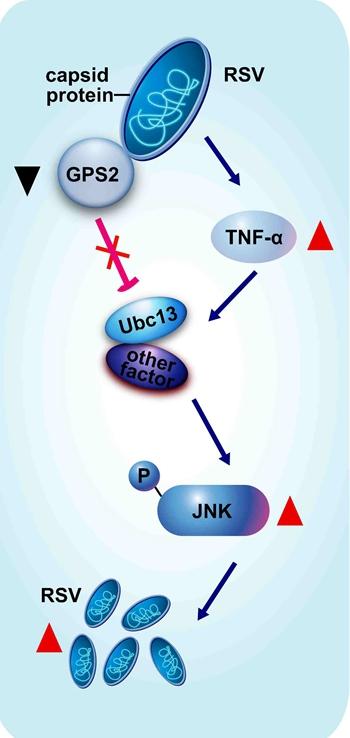
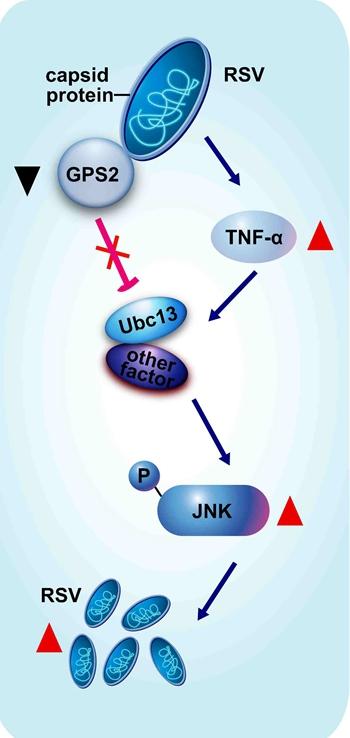
To address this question, CUI and her team explored the effect of RSV on the JNK signalling pathway in the small brown planthopper. By protein-protein interaction and gene expression interference assays, they found that the virus activates the pathway in various ways, but especially through the interaction of a planthopper protein called G protein pathway suppressor 2 (GPS2), and a viral protein called capsid protein.

"The interaction between these two proteins promotes RSV reproduction inside the planthopper, ultimately leading to disease outbreak when the insect carries the virus among rice crops," says WANG Wei, a postdoctoral researcher.

"We discovered that RSV infection increased the level of another protein called Tumor Necrosis Factor-α (TNF-α) and decreased the level of GPS2 in the insect vector. The virus capsid, which stores all of RSV's genetic material, competitively binds GPS2 to stop it from inhibiting the JNK activation machinery. JNK activation then promotes RSV replication in the vector, while inhibiting this pathway causes a significant reduction in virus production, therefore delaying disease outbreak in plants."

The findings suggest that inhibiting the JNK pathway, either by lowering JNK expression, strengthening interactions with GPS2 or weakening the effects of TNF-a, could be beneficial for rice agriculture.

"Such inhibition could be achieved through breeding or other means of genetic modification," WANG said. "In some cases, it could be possible to administer the appropriate chemical compounds to rice plants to reduce the spread of RSV."

The results, entitled "The c-Jun N-terminal kinase pathway of a vector insect is activated by virus capsid protein and promotes viral replication," can be accessed online in eLIFE.

###

Media Contact

Cui Feng
[email protected]

http://english.cas.cn/

Original Source

http://english.cas.cn/newsroom/research_news/201708/t20170809_181828.shtml http://dx.doi.org/10.7554/eLife.26591


Share13Tweet8Share2ShareShareShare2

Related Posts

Breakthrough Non-Invasive Prenatal Test Matches Invasive Methods in Accuracy, Offering Enhanced Safety and Reduced Costs — Biology

Breakthrough Non-Invasive Prenatal Test Matches Invasive Methods in Accuracy, Offering Enhanced Safety and Reduced Costs

June 12, 2026
Identifying Retinal Cell Subgroups May Boost Success of Cell Transplants — Biology

Identifying Retinal Cell Subgroups May Boost Success of Cell Transplants

June 12, 2026

New Study Uncovers How the Brain Revises Its Predictions

June 12, 2026

Decoding Ebola Persistence in Human Brain Organoids

June 12, 2026
Please login to join discussion

POPULAR NEWS

  • ESMO 2025: mRNA COVID Vaccines Enhance Efficacy of Cancer Immunotherapy

    325 shares
    Share 130 Tweet 81
  • Saying Goodbye to PGY-6: Pediatric Fellowship Realities

    98 shares
    Share 39 Tweet 25
  • Multi-Hospital Study Reveals Long Covid Burden Is Twice as High as Current Estimates

    91 shares
    Share 36 Tweet 23
  • Common Food Preservatives Associated with Elevated Blood Pressure and Increased Heart Disease Risk

    59 shares
    Share 24 Tweet 15

About

We bring you the latest biotechnology news from best research centers and universities around the world. Check our website.

Follow us

Recent News

Tacrolimus Dosing Tailored by Genetics in Pediatric Transplants

Older Adults’ Views on Digital Alarm Systems

Collagen Gene Expression Predicts DCIS Progression

Subscribe to Blog via Email

Enter your email address to subscribe to this blog and receive notifications of new posts by email.

Join 82 other subscribers
  • Contact Us

Bioengineer.org © Copyright 2023 All Rights Reserved.

Welcome Back!

Login to your account below

Forgotten Password?

Retrieve your password

Please enter your username or email address to reset your password.

Log In
No Result
View All Result
  • Homepages
    • Home Page 1
    • Home Page 2
  • News
  • National
  • Business
  • Health
  • Lifestyle
  • Science

Bioengineer.org © Copyright 2023 All Rights Reserved.
