


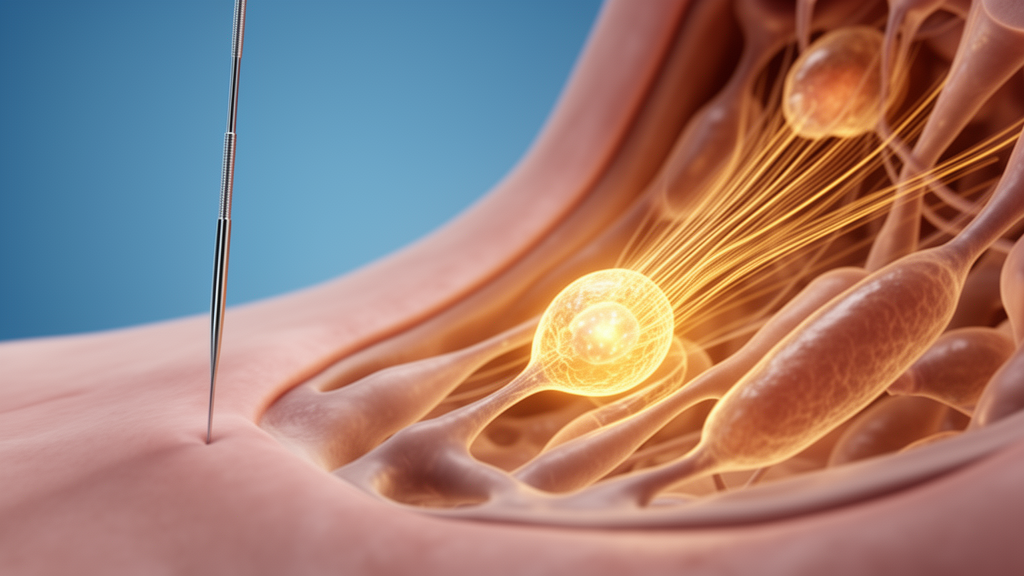
Acupuncture has been practiced for centuries, but the question of how a needle’s physical push becomes a biochemical signal that dulls pain has remained stubbornly open. A new study in mice, published in the journal Chinese Medicine, now maps a complete molecular chain from mechanical force to pain relief, identifying the stretch-activated ion channel Piezo1 in muscle cells at the ST36 acupoint as the critical first link. According to the researchers, this channel converts needling-generated mechanical stimulation into a calcium-driven signaling cascade that ultimately raises local adenosine levels and activates pain-suppressing adenosine A1 receptors in a model of inflammatory pain.
The team, led by investigators at Tianjin University of Traditional Chinese Medicine, worked with male C57BL/6J mice in which inflammatory pain was induced by injecting complete Freund’s adjuvant into one hind paw. Twenty-four hours after the injection, when the animals showed paw swelling, redness and a markedly reduced threshold to radiant heat, the researchers applied a standardized acupuncture protocol at bilateral ST36 acupoints, known in humans as Zusanli on the lower leg. Needles were inserted perpendicularly to a depth of roughly two to three millimeters, rotated evenly at 180 revolutions per minute for two minutes, and the manipulation was repeated every five minutes over a thirty-minute retention period. Paw withdrawal latency, measured with a thermal radiation analgesia meter, served as the primary behavioral readout.
The depth of insertion proved decisive. Deep needling that reached the muscle layer significantly reversed the inflammatory hypersensitivity, whereas shallow subcutaneous insertion at approximately one millimeter, verified by anatomical dissection to remain above the muscle fascia, produced no significant analgesic effect. Needling at ST25, an abdominal acupoint whose spinal afferent input does not overlap with that of the inflamed hind limb, likewise failed to relieve pain. Within the muscle layer of ST36, only deep acupuncture robustly increased both calmodulin expression and phosphorylation of calcium/calmodulin-dependent protein kinase II, while shallow needling activated these signals mainly in the non-muscle connective tissue.
To test whether Piezo1 initiates this cascade, the researchers first mapped its distribution. Immunohistochemistry and immunofluorescence showed Piezo1 protein in both the muscle layer and the non-muscle layer of the acupoint region, with the muscle layer signal strongly colocalized with the myocyte marker myosin. In the non-muscle layer, the channel also appeared in mast cells, fibroblasts and vascular endothelial cells. The team then delivered a myocyte-specific adeno-associated virus carrying short hairpin RNA against Piezo1 directly into the ST36 muscle. The knockdown, which reduced the Piezo1-to-GAPDH ratio by 57.5 percent, did not alter baseline thermal pain thresholds under inflammatory conditions, but it attenuated the analgesic effect of acupuncture by 41.1 percent and blunted the acupuncture-induced rise in CaMKII phosphorylation and calmodulin expression.
Pharmacology told a matching story in both directions. Local pretreatment with GsMTx4, a mechanosensitive channel inhibitor, concentration-dependently weakened acupuncture analgesia and suppressed CaMKII phosphorylation and calmodulin upregulation. Conversely, Yoda1, a Piezo1-preferring agonist, partially mimicked the analgesic effect of acupuncture in a concentration-dependent manner while elevating the same molecular markers. Electromyographic recordings from the tibialis anterior muscle showed that Piezo1 knockdown also reduced the integrated needle-evoked electrical activity, linking the channel to the local muscle response that accompanies the traditional Deqi sensation.
Downstream of the channel, the researchers traced a dual-source calcium amplification scheme. Extracellular calcium chelation with EGTA antagonized acupuncture analgesia, indicating that the initial signal is an influx from outside the cell. Chelating intracellular calcium with BAPTA-AM reduced analgesia and CaMKII activation, while the ionophore A23187, which raises intracellular calcium, actually worsened inflammatory hyperalgesia and directly elevated CaMKII phosphorylation. Blocking calmodulin with trifluoperazine or knocking it down genetically in myocytes likewise suppressed both analgesia and CaMKII phosphorylation, positioning calmodulin as the sensor that hands the calcium signal to its kinase target.
The cascade then moves into the cell’s energy machinery. Transmission electron microscopy revealed that acupuncture increased mitochondrial density and altered the coupling distance between the sarcoplasmic reticulum and mitochondria in acupoint muscle. Western blotting showed upregulation of the IP3R1-GRP75-VDAC1 complex and phosphorylated mitochondrial calcium uniporter, the molecular bridge that ferries calcium from the sarcoplasmic reticulum into mitochondria. Enzyme-linked immunosorbent assays confirmed that ATP and adenosine levels rose at the acupoint after needling. When the IP3R inhibitor 2-APB or the mitochondrial calcium uniporter inhibitor RU360 was injected locally, analgesia weakened and the metabolic gains diminished, and Piezo1 knockdown similarly collapsed the structural coupling, protein upregulation and ATP and adenosine increases, placing the channel upstream of the entire organellar pathway.
Perhaps the most visually striking evidence came from in vivo two-photon calcium imaging. Using a myocyte-targeted GCaMP6m calcium indicator validated against the MYH4 myosin marker, the researchers recorded real-time calcium dynamics in acupoint muscle during electroacupuncture delivered at one milliampere and one hertz. Electroacupuncture evoked rapid, synchronized calcium transients in myocytes in both healthy and CFA-treated mice, and local GsMTx4 pretreatment markedly diminished these transients during and after stimulation. Behavioral testing paralleled the imaging: electroacupuncture relieved inflammatory hypersensitivity, and GsMTx4 partially reversed that relief while also suppressing the electroacupuncture-induced CaMKII phosphorylation and calmodulin expression. The authors caution, however, that electroacupuncture cannot fully reproduce the mechanical characteristics of manual needle manipulation, so the imaging findings should be interpreted with that limitation in mind.
At the output end of the pathway, the adenosine A1 receptor emerged as the terminal effector. The A1 receptor antagonist DPCPX, applied locally at ST36, dose-dependently reduced acupuncture analgesia. In a rescue experiment, coadministration of the A1 receptor agonist CPA with GsMTx4 significantly restored the analgesic effect that the channel blocker had diminished, supporting a hierarchical Piezo1-calcium-adenosine cascade in which downstream receptor activation can compensate for impaired upstream channel function. The authors note that the ATP-to-adenosine conversion step itself remains a correlative working model: they did not characterize CD39/CD73-mediated enzymatic hydrolysis or distinguish intracellular from extracellular purinergic signaling, and direct visualization of mitochondrial calcium transfer with probes such as Rhod-2 was not performed.
The study’s limitations are stated plainly. Mechanical parameters such as force magnitude and torque were not quantitatively measured, and dose-response thresholds of needling intensity were not explored. Only male mice in a single inflammatory pain model were tested, limiting generalizability to females and other pain phenotypes. Piezo1’s presence in non-myocyte acupoint cells means auxiliary contributions cannot be excluded, and several pharmacological tools, including 2-APB and GsMTx4, have documented off-target activities. All findings derive from animal experiments and require validation in humans. Within those bounds, the work delivers a concrete peripheral mechanism: myocyte Piezo1 at ST36 transduces needle force into calcium influx, calmodulin and CaMKII signaling, sarcoplasmic reticulum-mitochondrial calcium transfer, elevated ATP and adenosine, and A1 receptor-mediated pain relief, offering a molecular framework for acupoint-specific analgesia and a potential target for future non-opioid strategies.
Subject of Research: The mechanotransduction pathway by which myocyte Piezo1 converts acupuncture mechanical stimulation into adenosine-mediated analgesia in a mouse model of inflammatory pain
Article Title: Piezo1-mitochondrial calcium uniporter coupling-dependent mechanotransduction basis for acupuncture to drive analgesia
Article References: Yao, K., Xia, J., Dou, B., Fan, Z., Forhad, S. M., Chen, Z., Ma, L., Li, J., Deng, K., Lin, X., Niu, P., Fang, Y., Liu, Y., Wang, S., Xu, Z., & Guo, Y. (2026). Piezo1-mitochondrial calcium uniporter coupling-dependent mechanotransduction basis for acupuncture to drive analgesia. Chinese Medicine, 21(1), Article 231. https://doi.org/10.1186/s13020-026-01502-0
Image Credits: AI Generated
DOI: 10.1186/s13020-026-01502-0
Keywords: acupuncture, Piezo1, calcium signaling, calmodulin, CaMKII, mitochondria, adenosine, A1 receptor, inflammatory pain, ST36 acupoint, mechanotransduction, two-photon imaging
News Source: Drew Townsend. (October 28, 2026). Scientists Trace How Acupuncture’s Mechanical Force Becomes Pain Relief. Scienmag.



