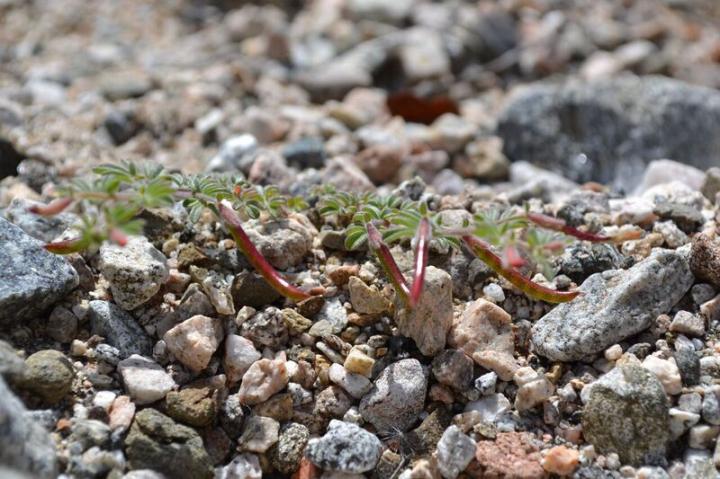
Credit: Sachs lab, UC Riverside.
RIVERSIDE, Calif. – Scientists at the University of California, Riverside and Oregon State University have received a grant of $1.24 million from the National Science Foundation to study the health and sustainability of critical symbioses between plants and bacteria across California, focusing on the evolution, ecology, and genetics of these interactions.
Symbiotic bacteria in soils transform how plants interact with their environment. These bacteria are well known for their tolerance to stress and abilities to enhance plant growth and improve outcomes in interactions with competitors and pathogens.
But these symbioses vary greatly in their effects on plant health and fitness. Little is understood about the forces that sustain this variation and drive the spread of symbionts that interact yet fail to benefit plants.
"Our goal is to better understand this variation and generate a predictive framework to quantify the ecological services these key bacteria provide to plants and to the environment," said Joel L. Sachs, an associate professor in the department of evolution, ecology, and organismal biology at UC Riverside and the grant's principal investigator. "We will study the parameters that influence symbiosis and help guide how microbes can be better deployed to increase productivity of agricultural systems and promote health of humans and the planet."
The five-year Dimensions of Biodiversity award from the National Science Foundation allows for a collaboration between UC Riverside and Oregon State University, where Jeffrey H. Chang, an associate professor of botany and plant pathology, is also a principal investigator. UCR will receive nearly $893,000, of the funding.
Researchers at both universities will use the relationship between native California legumes and nitrogen-fixing Bradyrhizobium bacteria to study the drivers of variation in symbioses. The project will employ environmental sampling of interacting plants, bacteria, and soil. Genetic approaches and greenhouse experiments will also be performed. The research will determine the magnitude of benefits the bacteria provide to the host, which bacterial genes facilitate benefit or exploitation of the host, and how the host responds and defends itself against ineffective symbionts.
The project will also train undergraduate and graduate students, as well as two postdoctoral fellows at the two universities. The team led by Sachs and Chang will educate local farmers on plant-microbe interactions and soil amendments, and will generate and curate a collection of plant and bacterial variants available to other researchers free of charge.
"This is a critical time for California as our agriculture needs are changing over time," said UCR's Morris F. Maduro, interim chair of the department of evolution, ecology, and organismal biology and a professor of biology. "Dr. Sachs' work has the potential to have major implications for our state economy over many years, as farmers could directly benefit from the research findings. Our department is particularly excited for this grant as it will fulfill the University of California's core missions of teaching and training, while also reaching out to the broader community."
###
The University of California, Riverside is a doctoral research university, a living laboratory for groundbreaking exploration of issues critical to Inland Southern California, the state and communities around the world. Reflecting California's diverse culture, UCR's enrollment is now nearly 23,000 students. The campus opened a medical school in 2013 and has reached the heart of the Coachella Valley by way of the UCR Palm Desert Center. The campus has an annual statewide economic impact of more than $1 billion.
Media Contact
Iqbal Pittalwala
[email protected]
951-827-6050
@UCRiverside
http://www.ucr.edu