The University of Texas at Austin will host an international gathering of earthquake researchers focused on better understanding the conditions that cause earthquakes and the science behind where and when they happen.
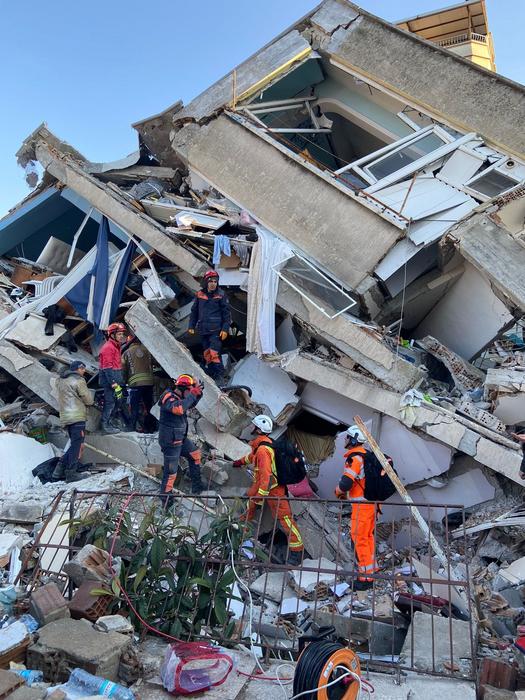
Credit: UK-ISAR/Flickr
https://www.flickr.com/photos/foreignoffice/52678985044/in/album-72177720305860170/
The University of Texas at Austin will host an international gathering of earthquake researchers focused on better understanding the conditions that cause earthquakes and the science behind where and when they happen.
The First International Earthquake Science Symposium takes place in Austin, Texas, Feb. 15-16, 2024, and brings together research scientists from the U.S., Chile, Germany and Japan. The U.S., Chile and Japan are home to some of the world’s largest earthquake faults.
Experts will discuss promising advances in earthquake science, from nanoscale rock physics to placing sensors directly inside earthquake faults.
Demian Saffer, director of the University of Texas Institute for Geophysics (UTIG), which will be hosting the meeting, said that the symposium followed several significant discoveries, many of them led by research teams at UTIG.
“The scientific community has made important advances in earthquake physics in the past few years through the development of new computational models, lab experiments, and major field programs that have imaged earthquake source regions and installed cutting-edge monitoring instruments,” Saffer said. “By bringing together experts from across the globe we can share our collective progress and plan a next generation of international collaborative programs.”
After decades of research, scientists understand the general reasons why earthquakes happen but are still unpacking the complex forces that determine exactly when and where they occur and how strong they are. That’s why earthquakes such as the twin tremors that killed at least 55,000 people in Turkey and Syria in February 2022 remain largely unpredictable.
However, advances have been made, including recent research from UTIG that detected patterns of early-warning foreshocks in artificial lab-made quakes — a promising discovery if similar patterns are detected in nature. Other recent breakthroughs led by UTIG include a new understanding of how rocks heal after an earthquake and the discovery that seamounts may dampen larger earthquakes. UTIG researchers have also led large-scale collaborations with partners in Japan, Chile, Germany and others. Examples include the deepest ever offshore probe, the largest supercomputer-driven imaging of an earthquake fault, and a National Science Foundation-funded collaboration to study the world’s largest earthquake faults.
Symposium co-organizer Thorsten Becker, a professor at the UT Jackson School of Geosciences who also leads the NSF project, said that scientists have made major advances in their ability to image and monitor earthquake faults. The next step, he said, is for researchers to develop a new generation of computer models that can interpret the flood of information and determine whether predicting earthquakes is even possible.
The First International Earthquake Science Symposium will be held at UT’s Pickle Research Campus and is open to all interested parties. Speakers and participants include researchers from UT, University of California, Berkeley, Massachusetts Institute of Technology, the Pontificia Universidad Católica de Chile, the Japan Agency for Marine-Earth Science and Technology (JAMSTEC) and Germany’s GEOMAR Helmholtz Centre for Ocean Research Kiel. JAMSTEC and GEOMAR are the leading national marine geophysics research centers in Japan and Germany.
For more information including how to attend, visit ig.utexas.edu/symposium-2024.
UTIG is a research unit of the Jackson School of Geosciences.