Credit: Press photo
Scientists of Peter the Great Saint-Petersburg Polytechnic University (SPbPU) in collaboration with the French, Swiss and Polish researchers have found unique atomic-scale processes in crystal lattice of antiferroelectric lead zirconate during synchrotron x-ray scattering experiment. The discovery is the first step toward creating efficient electrolyte-free accumulators of electric energy.
The article "Critical scattering and incommensurate phase transition in antiferroelectric PbZrO3 under pressure" was published in Scientific Reports of the Nature group.
During the experiment, the scientists tried to understand the microscopic physics of antiferroelectrics – materials that are very difficult to describe theoretically. The model object of this group is lead zirconate. The properties of this crystal are representative among lead-based antiferroelectrics and, having studied them, scientists can use the obtained microscopic picture for describing the properties of sufficiently broad range of materials. Understanding the physics of these materials is essential for creating new functional materials targeted at particular applications.
Under the external influence this crystal may have two types of lattice dipole ordering, where the dipoles are arranged either parallel or antiparallel to each other. The functional properties of the material depend on the type of lattice order.
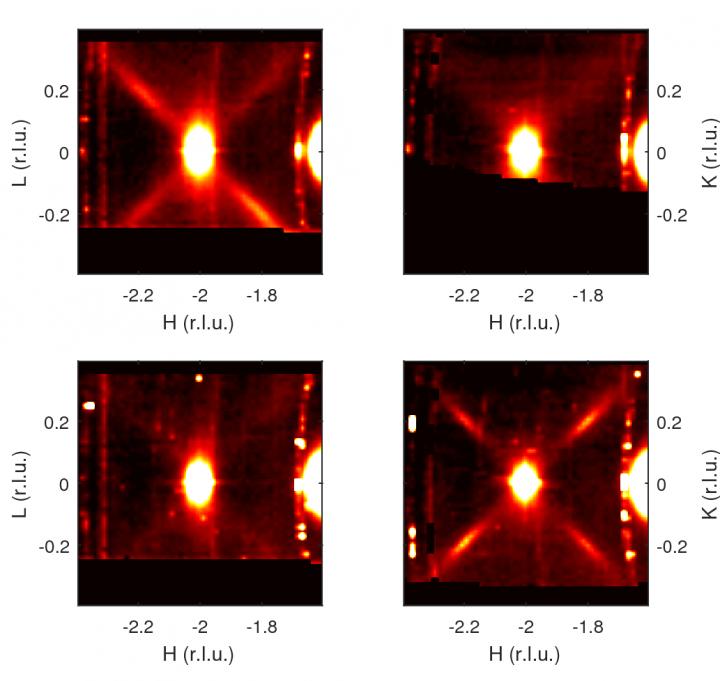
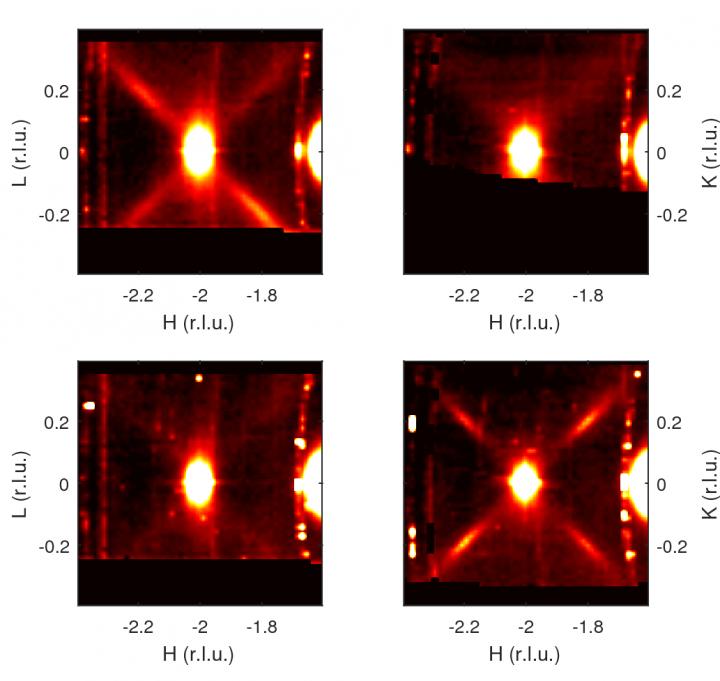
To analyze the functional properties, it is essential to understand how the structure of the material reacts to changing of the external parameters, such as temperature, pressure, field. During the experiment, the research group examined the influence of simultaneous change of temperature and pressure to the material properties. The measurements were performed at the ESRF (European Synchrotron Radiation Facility). The synchrotron x-ray source is required to provide the photon flux, which is sufficiently strong not only for ordinary Bragg scattering, but also diffuse scattering. The diffuse scattering became the key to finding new properties in the crystal lattice. Researches have determined that the symmetry of the crystal phases, which exists at high pressures and temperatures, is not the same as it was long time assumed.
The conditions at which the experiment was carried out are similar to those that can be created in future energy storage device (accumulators), where energy storage and release takes place due to switching between the crystal phases of different structures. Such structural switching will contribute to release of significant energy in a very short period of time, and lack of electrolytes has obvious advantages in terms of integration and miniaturization of energy storage elements.
In the research, the scientists managed to find the formation of the incommensurate phase, the phenomenon rarely occurring in crystal structures. This object is quite difficult to describe theoretically. Scientists of SPbPU and colleagues found that lead zirconate is the functional material, where the incommensurate phases could be located. "Based on the macroscopic measurements, researchers have suspected that the existing theories describing the crystal lattice are not fully correct. The contradictions arise on considering the evolution of the system in pressure-temperature space, and therefore we wanted to find out what processes occur on micro levels. Thus, during the experiment, we identified the incommensurate phase in substitution-free antiferroelectric for the first time," says Dr. Roman Burkovsky, associate professor at the "Physical electronics" department of the Institute of Physics, Nanotechnology and Telecommunications SPbPU, the first author of the paper.
Now the scientific community is faced with the task of construction of the theoretical models consistently describing energy states, and its reaction to external influence. "We have proved that such conditions exist in the in model antiferroelectric, thus highlighting the new challenge to the scientific community. By solving this problem, a big step in the description of functional materials will be taken," added Dr. Roman Burkovsky.
###
Media Contact
Raisa Bestugina
[email protected]
7-812-591-6675
@pgpuspb
http://english.spbstu.ru/
############
Story Source: Materials provided by Scienmag