• HOME
  • NEWS
  • EXPLORE
    • CAREER
      • Companies
      • Jobs
    • EVENTS
    • iGEM
      • News
      • Team
    • PHOTOS
    • VIDEO
    • WIKI
  • BLOG
  • COMMUNITY
    • FACEBOOK
    • INSTAGRAM
    • TWITTER
Monday, October 5, 2026
BIOENGINEER.ORG
No Result
View All Result
  • Login
  • HOME
  • NEWS
  • EXPLORE
    • CAREER
      • Companies
      • Jobs
        • Lecturer
        • PhD Studentship
        • Postdoc
        • Research Assistant
    • EVENTS
    • iGEM
      • News
      • Team
    • PHOTOS
    • VIDEO
    • WIKI
  • BLOG
  • COMMUNITY
    • FACEBOOK
    • INSTAGRAM
    • TWITTER
  • HOME
  • NEWS
  • EXPLORE
    • CAREER
      • Companies
      • Jobs
        • Lecturer
        • PhD Studentship
        • Postdoc
        • Research Assistant
    • EVENTS
    • iGEM
      • News
      • Team
    • PHOTOS
    • VIDEO
    • WIKI
  • BLOG
  • COMMUNITY
    • FACEBOOK
    • INSTAGRAM
    • TWITTER
No Result
View All Result
Bioengineer.org
No Result
View All Result
Home NEWS Science News

Scientists take step towards quantum supremacy

Bioengineer by Bioengineer
March 18, 2021
in Science News
Reading Time: 2 mins read
0
IMAGE
Share on FacebookShare on TwitterShare on LinkedinShare on RedditShare on Telegram

IMAGE

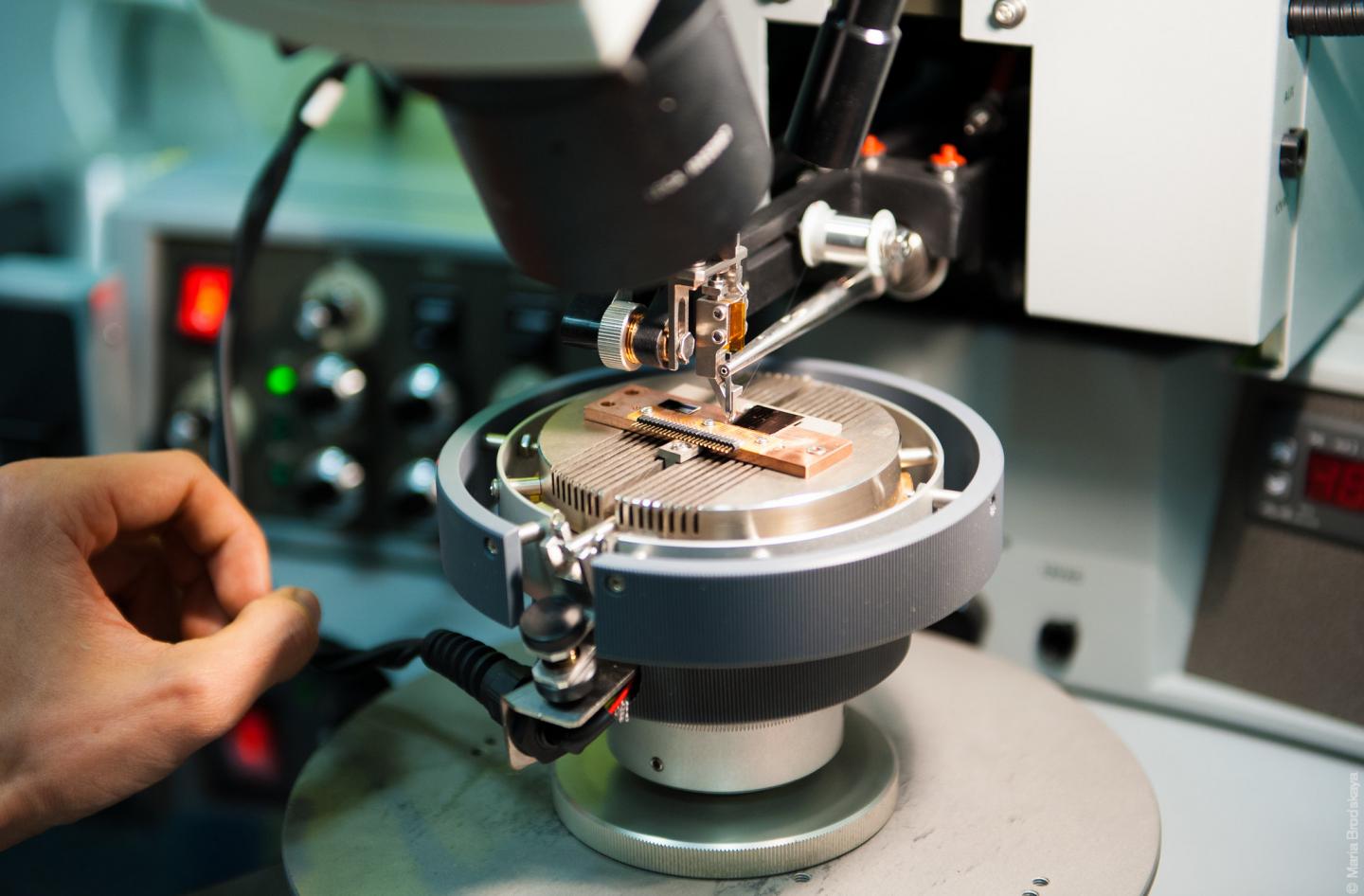
Credit: Sergey Gnuskov/NUST MISIS

A Russian-German research team has created a quantum sensor that grants access to measurement and manipulation of individual two-level defects in qubits. The study by NUST MISIS, Russian Quantum Center and the Karlsruhe Institute of Technology, published in npj Quantum Information, may pave the way for quantum computing.

In quantum computing the information is encoded in qubits. Qubits (or quantum bits), the quantum mechanical analogue of a classical bit, are coherent two-level systems. A leading qubit modality today superconducting qubits based on the Josephson junction. That is the kind of qubit IBM and Google used in their quantum processors. However, scientists are still searching for the perfect qubit — the one that can be precisely measured and controlled, while remaining unaffected by its environment.

The key element of a superconducting qubit is the nanoscale superconductor–insulator–superconductor Josephson junction. A Josephson junction is a tunnel junction made of two pieces of superconducting metal separated by a very thin insulating barrier. The most commonly used insulator is aluminum oxide.

Modern techniques do not allow to build a qubit with 100% precision, resulting in so-called tunneling two-level defects that limit the performance of superconducting quantum devices and cause computational errors. Those defects contribute to a qubit’s extremely short life span, or decoherence.

Tunneling defects in aluminum oxide and at surfaces of superconductors are an important source of fluctuations and energy losses in superconducting qubits, ultimately limiting the computer run-time. The more material defects occur, the more they affect the cubit’s performance, causing more computational errors, the researchers noted.

The new quantum sensor grants access to measurement and manipulation of individual two-level defects in quantum systems. According to Prof. Alexey Ustinov, Head of the Laboratory for Superconducting Metamaterials at NUST MISIS and Group Head at Russian Quantum Center, who co-authored the study, the sensor itself is a superconducting qubit, and it allows the detection and manipulation of individual defects. Traditional techniques for studying material structure, such as small-angle X-ray scattering (SAXS), are not sensitive enough to spot small individual defects, therefore using those techniques won’t help to build the best qubit. The study may open avenues for quantum material spectroscopy to investigate the structure of tunneling defects and to develop low-loss dielectrics that are urgently required for the advancement of superconducting quantum computers, the researchers believe.

###

Media Contact
Lyudmila Dozhdikova
[email protected]

Original Source

https://en.misis.ru/university/news/science/2021-03/7259/

Related Journal Article

http://dx.doi.org/10.1038/s41534-020-00359-x

Tags: Chemistry/Physics/Materials SciencesComputer ScienceMaterialsResearch/DevelopmentSuperconductors/SemiconductorsTechnology/Engineering/Computer Science
Share12Tweet8Share2ShareShareShare2

Related Posts

Endothelial Angptl2 Emerges as Central Driver of Influenza-Linked Lung Fibrosis

Endothelial Angptl2 Emerges as Central Driver of Influenza-Linked Lung Fibrosis

October 5, 2026
Clay-Based Fertilizer Loaded With Microbes Cuts Nitrous Oxide and Boosts Crop Nutrients

Clay-Based Fertilizer Loaded With Microbes Cuts Nitrous Oxide and Boosts Crop Nutrients

October 5, 2026

Calcium Signals Reveal How Seeds Decide to Germinate in Salty Soil

October 5, 2026

AI Scoring of Stomach Lining Visibility Boosts Early Cancer Detection in Landmark Trial

October 5, 2026
Please login to join discussion

POPULAR NEWS

  • Alloys That Shrink Their Own Grains: New PIX Mechanism Refines Metals With Heat Alone

    Alloys That Shrink Their Own Grains: New PIX Mechanism Refines Metals With Heat Alone

    29 shares
    Share 12 Tweet 7
  • Endurance Exercise Reshapes the Liver in Males and Females Through Distinct Molecular Routes

    29 shares
    Share 12 Tweet 7
  • Single Transcription Factor PU.1 Rapidly Converts Fibroblasts into Macrophage-Lineage Cells

    29 shares
    Share 12 Tweet 7
  • New Scale Measures How Ready Nurse Educators Really Are for the AI Era

    29 shares
    Share 12 Tweet 7

About

We bring you the latest biotechnology news from best research centers and universities around the world. Check our website.

Follow us

Recent News

Alloys That Shrink Their Own Grains: New PIX Mechanism Refines Metals With Heat Alone

Endurance Exercise Reshapes the Liver in Males and Females Through Distinct Molecular Routes

Single Transcription Factor PU.1 Rapidly Converts Fibroblasts into Macrophage-Lineage Cells

Subscribe to Blog via Email

Success! An email was just sent to confirm your subscription. Please find the email now and click 'Confirm' to start subscribing.

Join 85 other subscribers
  • Contact Us

Bioengineer.org © Copyright 2023 All Rights Reserved.

Welcome Back!

Login to your account below

Forgotten Password?

Retrieve your password

Please enter your username or email address to reset your password.

Log In
No Result
View All Result
  • Homepages
    • Home Page 1
    • Home Page 2
  • News
  • National
  • Business
  • Health
  • Lifestyle
  • Science

Bioengineer.org © Copyright 2023 All Rights Reserved.