• HOME
  • NEWS
  • EXPLORE
    • CAREER
      • Companies
      • Jobs
    • EVENTS
    • iGEM
      • News
      • Team
    • PHOTOS
    • VIDEO
    • WIKI
  • BLOG
  • COMMUNITY
    • FACEBOOK
    • INSTAGRAM
    • TWITTER
Friday, January 2, 2026
BIOENGINEER.ORG
No Result
View All Result
  • Login
  • HOME
  • NEWS
  • EXPLORE
    • CAREER
      • Companies
      • Jobs
        • Lecturer
        • PhD Studentship
        • Postdoc
        • Research Assistant
    • EVENTS
    • iGEM
      • News
      • Team
    • PHOTOS
    • VIDEO
    • WIKI
  • BLOG
  • COMMUNITY
    • FACEBOOK
    • INSTAGRAM
    • TWITTER
  • HOME
  • NEWS
  • EXPLORE
    • CAREER
      • Companies
      • Jobs
        • Lecturer
        • PhD Studentship
        • Postdoc
        • Research Assistant
    • EVENTS
    • iGEM
      • News
      • Team
    • PHOTOS
    • VIDEO
    • WIKI
  • BLOG
  • COMMUNITY
    • FACEBOOK
    • INSTAGRAM
    • TWITTER
No Result
View All Result
Bioengineer.org
No Result
View All Result
Home NEWS Science News Biology

Scientists take first snapshots of a molecular propeller that runs at 100 degrees Celsius

Bioengineer by Bioengineer
August 24, 2017
in Biology
Reading Time: 2 mins read
0
Share on FacebookShare on TwitterShare on LinkedinShare on RedditShare on Telegram
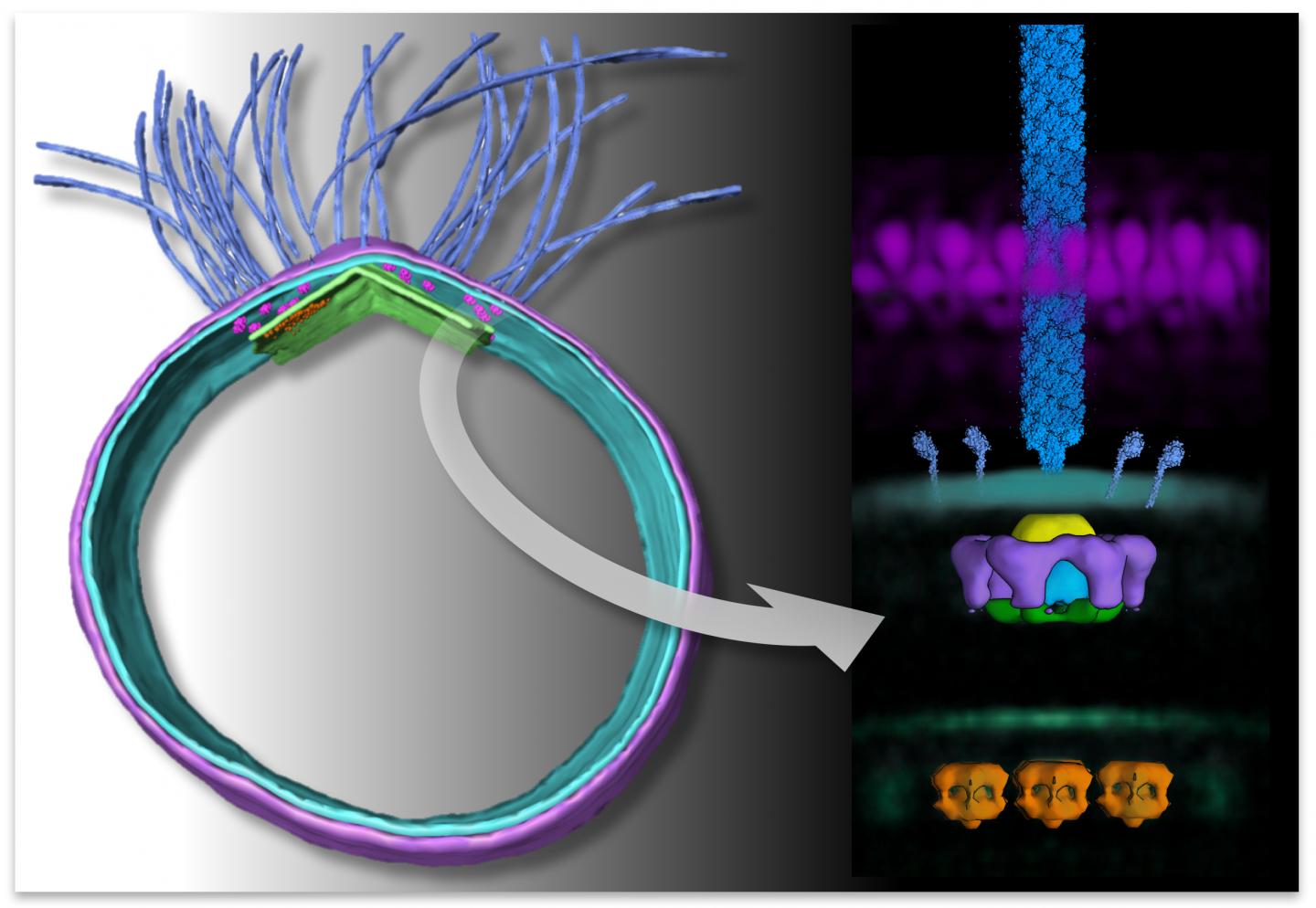
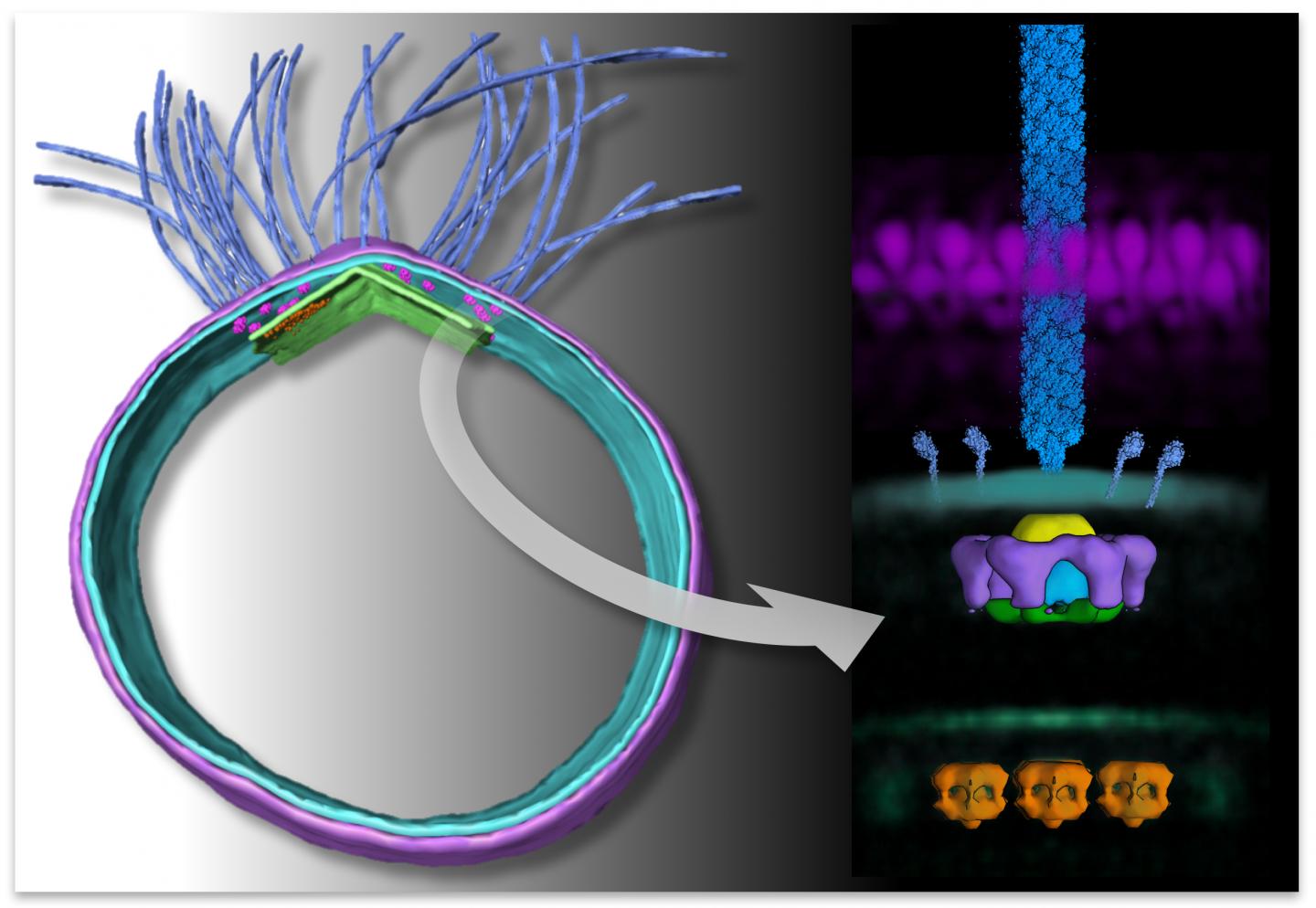
IMAGE

Credit: Bertram Daum / University of Exeter

Scientists have made a crucial new discovery into how a group of ancient microbes that can survive in some of the world's harshest environments, propel themselves forward.

An international team of experts, led by Dr Bertram Daum of the University of Exeter's Living System Institute, have revealed the structure of the unique whip-like appendage found on archaea, which rotates like a propeller to enable these cells to swim.

The structure, called the archaellum, is used for movement and also to allow the microbes to adhere themselves to surfaces, helping them flourish in their current environments and also to colonise new ones.

The researchers studied a particular type of archaea called Pyrococcus furious, which thrive without needing oxygen and at a temperature of 100° C – the boiling point of water.

Using state-of-the-art electron cryo-microscopy at the Max Planck Institute of Biophysics in Frankfurt (Germany), the research team have visualised this vital, yet previously poorly understood propelling motor in 3D and at so-far unachieved resolution. They say that the new research will pave the way for a deeper, molecular understanding of the swimming motion of the archaea.

The study is published in scientific journal eLife.

Dr Daum, a Research Fellow from the University of Exeter's College of Engineering, Mathematics and Physical Sciences said: "the machinery that drives these microorganisms can appear strikingly simple but it is extremely difficult to study in depth. This new research has allowed us to create, for the first time, a detailed model of the structure that propels the archaea, and as such helps them to thrive and survive in places that so much of life would perish.

"More than that, this could have an incredible impact on synthetic biology and by understanding how archaea move, we are able to provide a new idea for future medical practices. Understanding the molecular propeller in detail could help scientists create motors for minute artificial capsules, small enough to explore inside the human body and help combat infectious diseases or cancer."

As well as thriving in diverse and often harsh habitats across the world, such as boiling hot springs, salt lakes or deep sea vents, archaea are also found in the human digestive system and have been implicated as playing a role in obesity.

Dr Daum added: "We are really excited about our structure of the archaellum machinery because it has many downstream implications. Not only does it teach us about how life can exist at extreme conditions here on earth and potentially elsewhere in the universe, but it also provides us with a powerful and versatile tool to create revolutionary technology that works at the level of molecules."

Structure and in situ organisation of the Pyrococcus furiosus archaellum machinery is published in eLife.

###

Media Contact

Duncan Sandes
[email protected]
44-013-927-22391
@uniofexeter

http://www.exeter.ac.uk

Related Journal Article

http://dx.doi.org/10.7554/eLife.27470.001

Share14Tweet8Share2ShareShareShare2

Related Posts

Foreign Bodies in Sheep and Goats: Prevalence and Risks

Foreign Bodies in Sheep and Goats: Prevalence and Risks

December 31, 2025
Rethinking Gender Inference from Health Record Algorithms

Rethinking Gender Inference from Health Record Algorithms

December 31, 2025

Mapping RNA Editome Development in Ningxiang Pig Fat

December 31, 2025

Revealing Chloroplast Genomes: Insights on Plant Evolution

December 31, 2025
Please login to join discussion

POPULAR NEWS

  • blank

    PTSD, Depression, Anxiety in Childhood Cancer Survivors, Parents

    112 shares
    Share 45 Tweet 28
  • NSF funds machine-learning research at UNO and UNL to study energy requirements of walking in older adults

    71 shares
    Share 28 Tweet 18
  • Exploring Audiology Accessibility in Johannesburg, South Africa

    52 shares
    Share 21 Tweet 13
  • SARS-CoV-2 Subvariants Affect Outcomes in Elderly Hip Fractures

    44 shares
    Share 18 Tweet 11

About

We bring you the latest biotechnology news from best research centers and universities around the world. Check our website.

Follow us

Recent News

AI Innovations in Non-Small Cell Lung Cancer Care

Asthma Medicine Costs and Access in Nigeria

OBP-801 Reduces Fibrosis and Eye Pressure in Rabbits

Subscribe to Blog via Email

Success! An email was just sent to confirm your subscription. Please find the email now and click 'Confirm' to start subscribing.

Join 71 other subscribers
  • Contact Us

Bioengineer.org © Copyright 2023 All Rights Reserved.

Welcome Back!

Login to your account below

Forgotten Password?

Retrieve your password

Please enter your username or email address to reset your password.

Log In
No Result
View All Result
  • Homepages
    • Home Page 1
    • Home Page 2
  • News
  • National
  • Business
  • Health
  • Lifestyle
  • Science

Bioengineer.org © Copyright 2023 All Rights Reserved.