• HOME
  • NEWS
  • EXPLORE
    • CAREER
      • Companies
      • Jobs
    • EVENTS
    • iGEM
      • News
      • Team
    • PHOTOS
    • VIDEO
    • WIKI
  • BLOG
  • COMMUNITY
    • FACEBOOK
    • INSTAGRAM
    • TWITTER
Friday, September 4, 2026
BIOENGINEER.ORG
No Result
View All Result
  • Login
  • HOME
  • NEWS
  • EXPLORE
    • CAREER
      • Companies
      • Jobs
        • Lecturer
        • PhD Studentship
        • Postdoc
        • Research Assistant
    • EVENTS
    • iGEM
      • News
      • Team
    • PHOTOS
    • VIDEO
    • WIKI
  • BLOG
  • COMMUNITY
    • FACEBOOK
    • INSTAGRAM
    • TWITTER
  • HOME
  • NEWS
  • EXPLORE
    • CAREER
      • Companies
      • Jobs
        • Lecturer
        • PhD Studentship
        • Postdoc
        • Research Assistant
    • EVENTS
    • iGEM
      • News
      • Team
    • PHOTOS
    • VIDEO
    • WIKI
  • BLOG
  • COMMUNITY
    • FACEBOOK
    • INSTAGRAM
    • TWITTER
No Result
View All Result
Bioengineer.org
No Result
View All Result
Home NEWS Science News Chemistry

Scientists tackle difficult-to-recycle thermoset polymers

Bioengineer by Bioengineer
December 19, 2023
in Chemistry
Reading Time: 3 mins read
0
Polymer breakdown diagram
Share on FacebookShare on TwitterShare on LinkedinShare on RedditShare on Telegram

A team of UK scientists has got a step closer to making several different types of plastic much easier to recycle, using a method that could be applied to a whole range of difficult-to-recycle polymers, including rubbers, gels and adhesives.
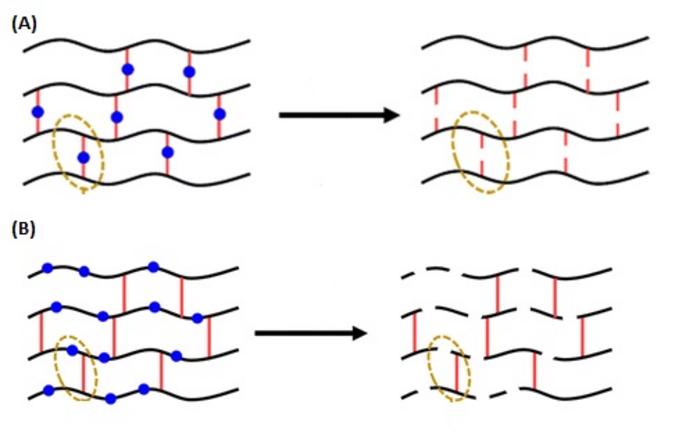
Polymer breakdown diagram

Credit: Maciek Kopec

A team of UK scientists has got a step closer to making several different types of plastic much easier to recycle, using a method that could be applied to a whole range of difficult-to-recycle polymers, including rubbers, gels and adhesives.

Thermoplastics and thermosets are two types of plastics that both consist of long chains of molecules called polymers but behave differently when heated.

Thermoplastics can be heated to high temperatures, poured into a mould then cooled to make the desired shape. They can subsequently be melted and reformed into other shapes when they are recycled, however they can break when stretched or stressed.

In contrast, the polymer chains in thermoset plastics are crosslinked to form a network which makes them incredibly strong and flexible. They are often used in composite materials, paints, coatings, rubbers and gels. Unfortunately, however, the crosslinks mean that the materials burn rather than melt when heated, making them much harder to break down and recycle.

Now, researchers at the University of Bath and University of Surrey have developed a way of introducing degradable bonds into thermoset polymers to make them more easily recyclable.

Publishing in Polymer Chemistry, they made a series of polymer gels with breakable bonds incorporated into different parts of the structure, and tested whether the properties changed after the gel was degraded and reformed.


They found that whilst all the gels could be degraded to some extent, gels with breakable bonds in the polymer chains (B in the attached diagram) retained their properties much better when reformed, compared with the polymers that were broken down via the cross-linked bonds (A).

The researchers hope this model system can be applied to other types of polymers, including adhesives, sealants and elastomers.

Dr Maciek Kopeć, from the University of Bath’s Department of Chemistry, said: “Thermosets are used widely in the commercial sector, in materials like resins and adhesives.

“Being able to make bonds reversible in these materials will increase their applications as well as making them more recyclable.”

The researchers aim to create a general road map of the best locations for these breakable bonds, to understand better why some bonds break more easily than others, and plan to optimise the system using other commercially used polymers.

The researchers are also looking at other applications of the work, including using crosslinked polymers as vehicles for controlled drug delivery systems.

The work was funded by the Engineering and Physical Sciences Research Council (EPSRC).


Journal

Polymer Chemistry

DOI

10.1039/D3PY01008B

Method of Research

Experimental study

Subject of Research

Not applicable

Article Title

Strands vs. crosslinks: topology-dependent degradation and regelation of polyacrylate networks synthesised by RAFT polymerisation

Article Publication Date

6-Nov-2023

Share12Tweet8Share2ShareShareShare2

Related Posts

Partially covalent desolvated cations boost electrochemical CO2 conversion

Partially covalent desolvated cations boost electrochemical CO2 conversion

September 4, 2026

Ferricyanide enables peptide hydrazide ligation in neutral water

September 4, 2026

How microplastics may weaken the human immune system

September 4, 2026

Antimicrobial PVA silver nanoparticle zeolite nanofibers developed for wound dressings

September 4, 2026

POPULAR NEWS

  • Study Explores Moral Choices, Machiavellianism, and Social Cognition in Autism

    29 shares
    Share 12 Tweet 7
  • Adolescent male and female mice show distinct social stress responses

    29 shares
    Share 12 Tweet 7
  • 3D modeling guides surgery and care in hypertrophic obstructive cardiomyopathy case

    29 shares
    Share 12 Tweet 7
  • Family members take on many roles supporting patients with alcohol-related liver disease

    29 shares
    Share 12 Tweet 7

About

We bring you the latest biotechnology news from best research centers and universities around the world. Check our website.

Follow us

Recent News

Study Explores Moral Choices, Machiavellianism, and Social Cognition in Autism

Adolescent male and female mice show distinct social stress responses

3D modeling guides surgery and care in hypertrophic obstructive cardiomyopathy case

Subscribe to Blog via Email

Enter your email address to subscribe to this blog and receive notifications of new posts by email.

Join 85 other subscribers
  • Contact Us

Bioengineer.org © Copyright 2023 All Rights Reserved.

Welcome Back!

Login to your account below

Forgotten Password?

Retrieve your password

Please enter your username or email address to reset your password.

Log In
No Result
View All Result
  • Homepages
    • Home Page 1
    • Home Page 2
  • News
  • National
  • Business
  • Health
  • Lifestyle
  • Science

Bioengineer.org © Copyright 2023 All Rights Reserved.