


Credit: NITech
Scientists at Nagoya Institute of Technology (NITech) and collaborating universities in Japan have gained new insights into the mechanisms behind degradation of a semiconductor material that is used in electronic devices. By highlighting the specific science behind how the material degrades, they are making way for potential discoveries that may prevent the performance degradation of the material.
The study was published in the Journal of Applied Physics in September of 2018. The scientists used Silicon Carbide (SiC) material for the experiment. SiC is becoming a more popular alternative to standard semiconductor materials for electronic devices. The study is based on a specific type of SiC material that is characteristic for its structure, or 4H-SiC. This material was exposed to both photoluminescence as well as various temperatures as a means to create specific kinds of deformations that lead to the degradation of SiC-based devices. The scientists were able to observe how these deformations actually take place on an atomic level.
"We quantified the speed at which electric charge particles move in regions of 4H-SiC material where the atomic structure has been defected. This will usher discoveries of ways to suppress degradation of SiC-based devices such as power electronic systems," states Dr. Masashi Kato, an associate professor at the Frontier Research Institute for Materials Science in NITech.
In order to better understand the actual mechanism behind atomic deformation that lead to degradations, the researchers used photoluminescence to induce movement of electric charge particles and measured the speeds at which that took place. They looked for specific factors that may limit particle movement, including the material that was used.
They also tested the effects of increasing temperature, specifically looking to see if higher temperatures will increase or decrease rate of deformation.
According to Dr. Kato, the presence of a particular kind of atomic deformation that causes the material degrade is particularly problematic for SiC-based power devices. "While a particular SiC-based device is in operation, the atoms of the material deform, which leads to degradation. The process by which these atoms deform is not clear yet. What is known, however, is that movement of electric charge within the material as well as areas where the material has become defect already contribute to the aforementioned atomic deformation," he states.
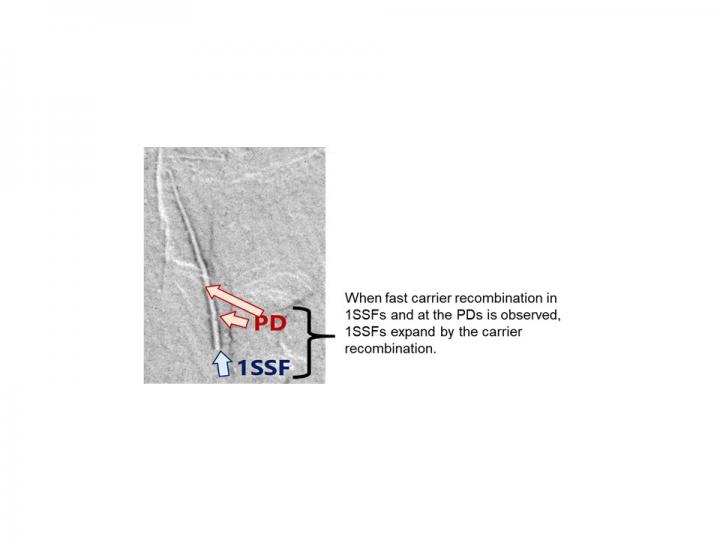
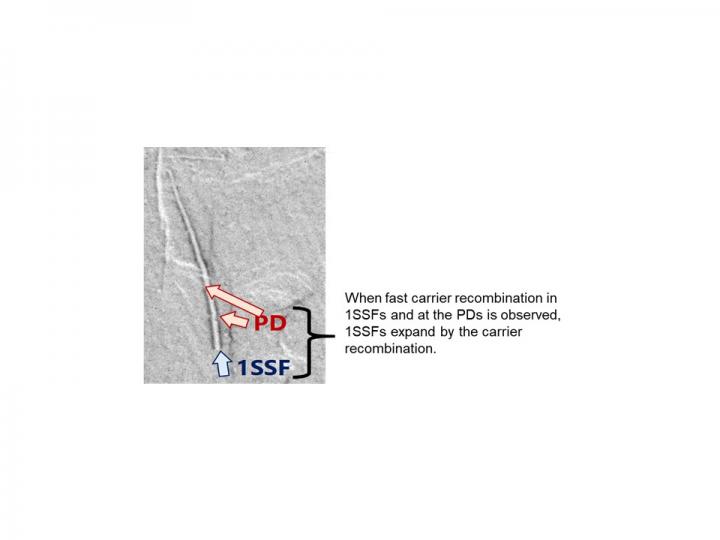
So far similar experiments have been conducted in the past by other researchers, the results that have been reported are not consistent. Here, the result of experiments with photoluminescence indicates that the carrier recombination in single Shockley stacking faults (1SSFs) and at partial dislocations (PDs) is faster than that in regions without 1SSFs in 4H-SiC. Such fast recombination will induce the degradation of the device with 1SSFs. In addition, 1SSF expansion velocity also increases with temperature increase.
As such, they pave the way for research that will revolve around the slowing of SiC-based devices degradation. This, in turn, could potentially result in higher quality and more durable devices.
Along those lines, the authors state that their future research endeavors will focus on finding out ways to prevent SiC-based devices from degrading as well as creating devices that will not wear down over time.
###
The article "Observation of carrier recombination in single Shockley stacking faults and at partial dislocations in 4H-SiC" was published in Journal of Applied Physics in DOI: 10.1063/1.5042561.
Media Contact
Kuniaki Shiraki
[email protected]
81-527-355-126
@nitechofficial
http://www.nitech.ac.jp/eng/index.html
Related Journal Article
http://dx.doi.org/10.1063/1.5042561

