Rutgers geneticists, working with an international team of scientists, have conducted the most comprehensive sequencing yet of the complete DNA sequence of the little skate – which, like its better-known cousin, the stingray, has long been viewed as enigmatic because of its shape.
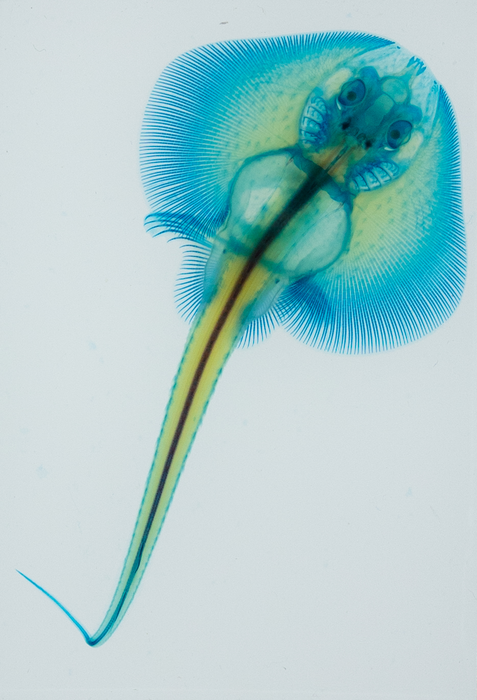
Credit: Tetsuya Nakamura/Rutgers University
Rutgers geneticists, working with an international team of scientists, have conducted the most comprehensive sequencing yet of the complete DNA sequence of the little skate – which, like its better-known cousin, the stingray, has long been viewed as enigmatic because of its shape.
The scientists, writing in Nature, reported that by studying the intricacies of Leucoraja erinacea’s genome, they have gained a far better understanding of how the fish evolved from its ancestor – which possessed a much narrower body – over a period of 300 million years to become a flat, winged bottom-dweller.
“We know that animals with a backbone and a skeleton – known as vertebrates – including fish, possess myriad body shapes, but we understand little about the underlying processes controlled by genes,” said Tetsuya Nakamura, an assistant professor in the Department of Genetics in the Rutgers School of Arts and Sciences (SAS) and an author on the study. “In this research, we have identified the genetic mechanisms that create the unique characteristics of the skate body.”
Little skates are an Atlantic Ocean species of skate that are about 16 to 20 inches long. Their flat bodies feature enlarged, wing-like pectoral fins that allow the fish to thrive in sea-floor environments. Their unique shape creates power for rapid forward propulsion. They also use their flat fins to scoop and flip sand over them to hide from predators, covering everything but their eyes.
“We wondered how this unique body evolved during their evolution,” said Nakamura, an expert in evolutionary developmental biology who generally is seeking to understand how humans evolved from fish. “If we came to understand how a skate evolved, perhaps it might give us clues to how other vertebrates developed their shapes.”
In conducting their analysis, the researchers connected the skates’ genotype – their unique sequence of DNA – with their phenotype – their physical properties, from body shape to biochemistry. They also compared the little skate genome with various shark genomes, including that of the bamboo shark, with whom it shares a common ancestor.
The researchers found similarities between the genomes and gene orders of the little skate and the bamboo sharks, which retain ancestral characters of chromosomes, the essential structures compactly packing DNA in the nucleus of every cell.
In the region of the little skate genome that controls for fin development, the researchers found extensive rearrangements in the order of genes, akin to a shuffling of cards. This gene shuffling occurred in the region of fin formation genes in skates when compared to sharks.
In the little skate genomes, researchers also found what they described as a “fin-specific enhancer” for what are known as “Hox” genes, which have been identified in other research to be involved in patterning an animal’s body from head to tail. In vertebrates, Hox genes determine the position of segmentation for areas of the body including the head. In the case of the little skate, the researchers found Hox genes were indispensable for the evolution of its wide fins.
This “extensive conservation of chromosomal identity and gene order, despite 300 million years of divergence,” indicates that most cartilaginous fish like skates, rays and sharks likely share this genetic organization, Nakamura said.
“Overall, we found that genetic recombination and genome sequence changes are critical for skate-wide fin evolution,” he said.
Other Rutgers geneticists involved with the study include Dina Navon, a postdoctoral researcher, and Ali Andrescavage, a lab technician.
Journal
Nature
DOI
10.1038/s41586-023-05868-1
Method of Research
Data/statistical analysis
Subject of Research
Animal tissue samples
Article Title
‘The little skate genome and the evolutionary emergence of wing-like fins
Article Publication Date
12-Apr-2023