• HOME
  • NEWS
  • EXPLORE
    • CAREER
      • Companies
      • Jobs
    • EVENTS
    • iGEM
      • News
      • Team
    • PHOTOS
    • VIDEO
    • WIKI
  • BLOG
  • COMMUNITY
    • FACEBOOK
    • INSTAGRAM
    • TWITTER
Friday, July 10, 2026
BIOENGINEER.ORG
No Result
View All Result
  • Login
  • HOME
  • NEWS
  • EXPLORE
    • CAREER
      • Companies
      • Jobs
        • Lecturer
        • PhD Studentship
        • Postdoc
        • Research Assistant
    • EVENTS
    • iGEM
      • News
      • Team
    • PHOTOS
    • VIDEO
    • WIKI
  • BLOG
  • COMMUNITY
    • FACEBOOK
    • INSTAGRAM
    • TWITTER
  • HOME
  • NEWS
  • EXPLORE
    • CAREER
      • Companies
      • Jobs
        • Lecturer
        • PhD Studentship
        • Postdoc
        • Research Assistant
    • EVENTS
    • iGEM
      • News
      • Team
    • PHOTOS
    • VIDEO
    • WIKI
  • BLOG
  • COMMUNITY
    • FACEBOOK
    • INSTAGRAM
    • TWITTER
No Result
View All Result
Bioengineer.org
No Result
View All Result
Home NEWS Science News Chemistry

Scientists reveal the effect of Cu(I) structure on quantum sieving for hydrogen isotope separation

Bioengineer by Bioengineer
February 9, 2023
in Chemistry
Reading Time: 3 mins read
0
Scientists Reveal the Effect of Cu(I) Structure on Quantum Sieving for Hydrogen Isotope Separation
Share on FacebookShare on TwitterShare on LinkedinShare on RedditShare on Telegram

Recently, a research team led by Prof. CHEN Changlun from Institute of Plasma Physics, Hefei Institutes of Physical Science of Chinese Academy of Sciences, studied Cu(I)Cu(II)-BTC, a kind of hydrogen isotope separation material and proved its crucial role in tuning quantum sieving without a complex structural design, which provided a new strategy for the intelligent design of highly efficient isotope systems.
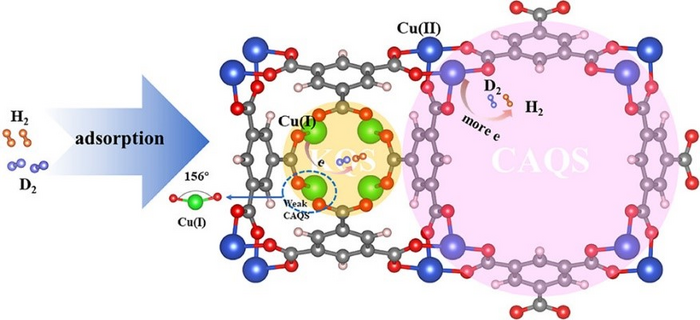
Scientists Reveal the Effect of Cu(I) Structure on Quantum Sieving for Hydrogen Isotope Separation

Credit: HU Xiaoyu

Recently, a research team led by Prof. CHEN Changlun from Institute of Plasma Physics, Hefei Institutes of Physical Science of Chinese Academy of Sciences, studied Cu(I)Cu(II)-BTC, a kind of hydrogen isotope separation material and proved its crucial role in tuning quantum sieving without a complex structural design, which provided a new strategy for the intelligent design of highly efficient isotope systems.

The result was published in ACS Applied Materials & Interfaces.

High pure deuterium (D2) is an important industrial and scientific gas, which has been widely used as an irreplaceable raw material, neutron moderator, isotopic tracer, and in other fields. Despite the huge demand for it, the mole fraction of natural deuterium is only up to 0.0156% of natural hydrogen in the oceans. Moreover, D2 and its isotope (H2 or T2) molecules have almost identical classical dimensions, associated with very similar physicochemical properties, and the separation of hydrogen isotope mixtures in high purity has been considered as one of the greatest difficulties and challenges in modern separation technology.

In this study, HKUST-1 crystals in the presence of hydroquinone were reduced to construct Cu(I)Cu(II)-BTC, featured by dual micropore size distribution and mixed-valence of Cu metal, and had been chosen to study H2/D2 separation in detail.

The study showed that unique Cu(I) and Cu(II) coordination network of Cu(I)Cu(II)-BTC could significantly facilitate D2/H2 isotope separation. Density functional theory (DFT) calculations indicated that the introduction of Cu(I) macrocycles in the framework decreased the pore size and further led to relatively enhanced interaction of H2/D2 molecules on Cu(II) sites. The significantly enhanced selectivity of Cu(I)Cu(II)-BTC at 30 K was mainly attributed to the synergistic effect of kinetic quantum sieving (KQS) and chemical affinity quantum sieving (CAQS).

In addition, a large angle of 156° for the O-Cu(I)-O configuration in Cu(I)Cu(II)-BTC exhibited weak binding strength of hydrogen adsorption since the dz2 orbital and small positive of Cu(I) couldn’t effectively participate in the hydrogen interaction, and didn’t show a strong CAQS effect at above liquid nitrogen temperature.

This research verified the effect of Cu(I) structure in D2/H2 separation. “We believe that this study will provide a new strategy for reasonable design of porous materials with OMSs at highly efficient isotope and gas separation systems,” said HU Xiaoyu, first author of the paper.


Journal

ACS Applied Materials & Interfaces

DOI

10.1021/acsami.2c18221

Article Title

Highly Effective H2/D2 Separation within the Stable Cu(I)Cu(II)-BTC: The Effect of Cu(I) Structure on Quantum Sieving

Article Publication Date

9-Jan-2023

Share12Tweet8Share2ShareShareShare2

Related Posts

Scientists Capture Cosmic Drift Preceding Star Birth

Scientists Capture Cosmic Drift Preceding Star Birth

July 10, 2026
Artificial Intelligence Transforms Material Synthesis Methods

Artificial Intelligence Transforms Material Synthesis Methods

July 10, 2026

Computer Chip Uses Vibrations for Memory Storage

July 10, 2026

Rapid Screening Advances Discovery of Nanocrystals

July 10, 2026

POPULAR NEWS

  • Detection of EDCs in Breast Milk and Infant Urine Up to Six Months Highlights Early Exposure Risks

    77 shares
    Share 31 Tweet 19
  • New Drug Candidate Developed at McMaster Shows Potential for Treating Brain Cancer

    58 shares
    Share 23 Tweet 15
  • KTU Researchers Explore Ultrasound’s Role in Enhancing Blood Flow Beyond Diagnostics

    53 shares
    Share 21 Tweet 13
  • 高齢者の骨粗鬆症治療の持続性比較

    51 shares
    Share 20 Tweet 13

About

We bring you the latest biotechnology news from best research centers and universities around the world. Check our website.

Follow us

Recent News

Scientists Capture Cosmic Drift Preceding Star Birth

Genetic Mapping Reveals New Treatments for Bone Diseases

Delirium Rates in German Nursing Homes Revealed in New Study

Subscribe to Blog via Email

Enter your email address to subscribe to this blog and receive notifications of new posts by email.

Join 84 other subscribers
  • Contact Us

Bioengineer.org © Copyright 2023 All Rights Reserved.

Welcome Back!

Login to your account below

Forgotten Password?

Retrieve your password

Please enter your username or email address to reset your password.

Log In
No Result
View All Result
  • Homepages
    • Home Page 1
    • Home Page 2
  • News
  • National
  • Business
  • Health
  • Lifestyle
  • Science

Bioengineer.org © Copyright 2023 All Rights Reserved.