What species live in this coral reef, and are they healthy? Chemical clues emitted by marine organisms might hold that information. But in underwater environments, invisible compounds create a complex “soup” that is hard for scientists to decipher. Now, researchers in ACS’ Journal of Proteome Research have demonstrated a way to extract and identify these indicator compounds in seawater. They found metabolites previously undetected on reefs, including three that may represent different reef organisms.
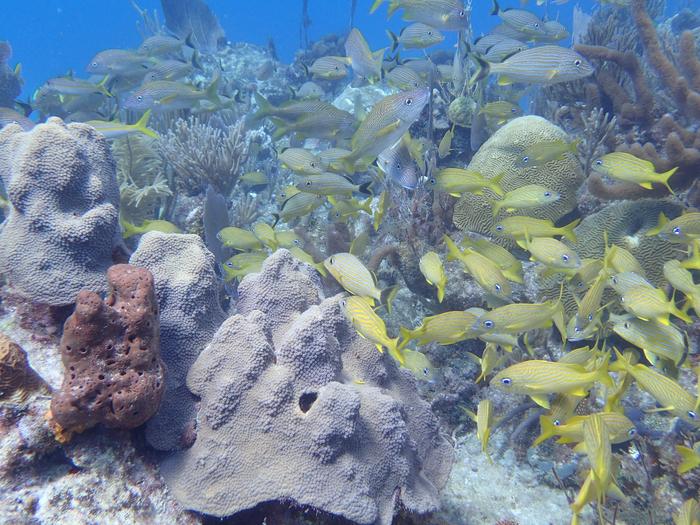
Credit: Amy Apprill
What species live in this coral reef, and are they healthy? Chemical clues emitted by marine organisms might hold that information. But in underwater environments, invisible compounds create a complex “soup” that is hard for scientists to decipher. Now, researchers in ACS’ Journal of Proteome Research have demonstrated a way to extract and identify these indicator compounds in seawater. They found metabolites previously undetected on reefs, including three that may represent different reef organisms.
Plants and animals living in coral reefs release various substances, from complex macromolecules to individual amino acids, into the surrounding water. To determine which ones could identify the ecosystems’ inhabitants and be used to measure a coral reef’s health, scientists need to prepare water samples for analysis by concentrating the compounds and separating them from the salty broth. They primarily concentrate and collect these dissolved compounds from seawater on sticky membranes. However, this method misses many important nitrogen-, oxygen- and sulfur-containing compounds produced by marine organisms. These metabolites don’t attach well to the membrane materials and are present at extremely low levels in seawater. To overcome these challenges, Brianna Garcia, Amy Apprill, Elizabeth Kujawinski and colleagues at Woods Hole Oceanographic Institution tested a technique that modified the dissolved metabolites before they were extracted from seawater into a form that’s compatible with membrane materials allowing them to be concentrated and analyzed.
First, the researchers collected and filtered water samples from five coral reefs around the U.S. Virgin Islands. They then used a series of reactions to attach a benzoyl functional group to dissolved amine- and alcohol-containing metabolites. Next, the team extracted the modified metabolites from the samples and assessed their composition and concentrations with liquid chromatography-mass spectrometry. From applying this new technique, the researchers identified 23 metabolites that hadn’t been identified near coral reefs by previous studies, including amino acids, amines, pyrimidine nucleosides and organosulfonic acids, which are involved in photosynthesis and organismal growth. When the researchers analyzed their data, they found that:
- The presence of diseased coral, macroalgae and crustose coralline algae had the greatest influence on the metabolite compositions.
- Some compounds, such as the organosulfonic acid called DHPS, were consistently at high levels in all locations, which suggests the presence of coral and associated organisms.
- Three metabolites (homoserine betaine, tryptophan and γ-aminobutryic acid) had significantly different levels among the five reefs, and the researchers attribute those differences to variations in marine environments and organisms.
The researchers say this study successfully demonstrates how to collect previously overlooked, ecologically relevant compounds in coral reef ecosystems that could be used to monitor them for effects from climate change, natural disturbances and disease activity.
The authors acknowledge funding from the National Science Foundation and the National Oceanic & Atmospheric Administration’s Oceanic and Atmospheric Research Cooperative Institutes.
###
The American Chemical Society (ACS) is a nonprofit organization chartered by the U.S. Congress. ACS’ mission is to advance the broader chemistry enterprise and its practitioners for the benefit of Earth and all its people. The Society is a global leader in promoting excellence in science education and providing access to chemistry-related information and research through its multiple research solutions, peer-reviewed journals, scientific conferences, eBooks and weekly news periodical Chemical & Engineering News. ACS journals are among the most cited, most trusted and most read within the scientific literature; however, ACS itself does not conduct chemical research. As a leader in scientific information solutions, its CAS division partners with global innovators to accelerate breakthroughs by curating, connecting and analyzing the world’s scientific knowledge. ACS’ main offices are in Washington, D.C., and Columbus, Ohio.
To automatically receive news releases from the American Chemical Society, contact [email protected].
Note: ACS does not conduct research, but publishes and publicizes peer-reviewed scientific studies.
Follow us: X, formerly Twitter | Facebook | LinkedIn | Instagram
Journal
Journal of Proteome Research
DOI
10.1021/acs.jproteome.4c00049
Article Title
“Benzoyl Chloride Derivatization Advances the Quantification of Dissolved Polar Metabolites on Coral Reefs”
Article Publication Date
23-May-2024