• HOME
  • NEWS
  • EXPLORE
    • CAREER
      • Companies
      • Jobs
    • EVENTS
    • iGEM
      • News
      • Team
    • PHOTOS
    • VIDEO
    • WIKI
  • BLOG
  • COMMUNITY
    • FACEBOOK
    • INSTAGRAM
    • TWITTER
Thursday, June 25, 2026
BIOENGINEER.ORG
No Result
View All Result
  • Login
  • HOME
  • NEWS
  • EXPLORE
    • CAREER
      • Companies
      • Jobs
        • Lecturer
        • PhD Studentship
        • Postdoc
        • Research Assistant
    • EVENTS
    • iGEM
      • News
      • Team
    • PHOTOS
    • VIDEO
    • WIKI
  • BLOG
  • COMMUNITY
    • FACEBOOK
    • INSTAGRAM
    • TWITTER
  • HOME
  • NEWS
  • EXPLORE
    • CAREER
      • Companies
      • Jobs
        • Lecturer
        • PhD Studentship
        • Postdoc
        • Research Assistant
    • EVENTS
    • iGEM
      • News
      • Team
    • PHOTOS
    • VIDEO
    • WIKI
  • BLOG
  • COMMUNITY
    • FACEBOOK
    • INSTAGRAM
    • TWITTER
No Result
View All Result
Bioengineer.org
No Result
View All Result
Home NEWS Science News Chemistry

Scientists proposed a novel configuration of nanoscopes

Bioengineer by Bioengineer
May 23, 2019
in Chemistry
Reading Time: 3 mins read
0
IMAGE
Share on FacebookShare on TwitterShare on LinkedinShare on RedditShare on Telegram

Special diffraction gratings with gold plates instead of microlenses can accelerate the generation of images in nanoscopes
IMAGE

Credit: Tomsk Polytechnic University

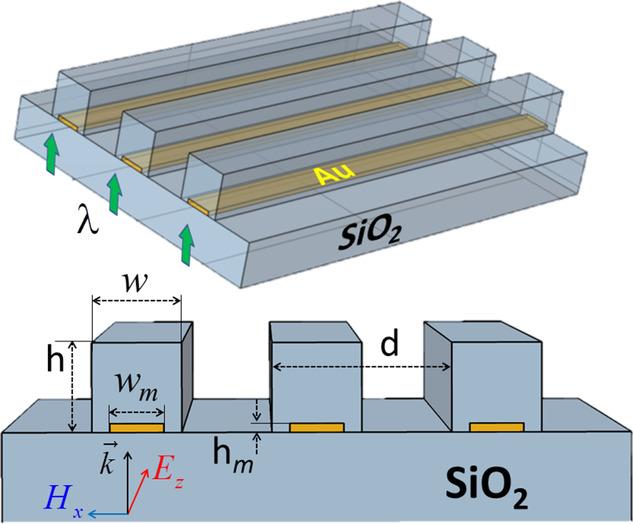
Scientists from Tomsk Polytechnic University together with colleagues proposed using special diffraction gratings with gold plates instead of microlenses used in the classic configuration to obtain images in nanoscopes. Microlenses transmit images by small pieces (pixels), whereas diffraction gratings allow you to see the whole object. Such innovation can help to accelerate the generation of images from nanoscopes without losing any magnification power. The results of the study are presented in the journal Annalen der Physik.

Optical microscopes are considered the simplest. However, for a long time it was believed that they are not powerful enough compared to, for example, electronic microscopes. Everything changed with the advent of nanoscopes in 2011. Images are obtained using small spheres or rectangular particles of quartz glass and enlarged further with a conventional microscope lens. Through nanoscopes it is possible to see objects the size of which is 50 nm, which exceeds the capabilities of a conventional optical microscope by 20 times. They can also be used to study living viruses, as compared to electronic microscopes lacking this function because the flow of electrons just kills them, and the inside of cells. This feature makes nanoscopes extremely promising for biological research. Therefore, scientists around the world are working to improve their resolution and design.

However, images in nanoscopes is formed by ‘pieces’, i.e. each microsphere detects its part of an object at a particular point. Therefore, it is necessary to make a whole matrix of a large number of microspheres or to move a microsphere, which takes some time.

As a solution, TPU scientists proposed using a rectangular mesoscale phase diffraction grating (a grating with a period comparable to the wavelength of the radiation used). This is an optical device that is a surface with a large number of parallel microscopic strokes or protrusions.

The project supervisor, Igor Minin, DSc in technical sciences, SRF at the TPU Division of Electronic Engineering says:

‘A conventional diffraction grating out of dielectric ensures poor resolution in nanoscopes. Therefore, we propose to add a small gold plate to each of the strokes. In fact, a paradox emerges: metal does not transmit light but the resolution nevertheless increases. Why? Here several effects work simultaneously.

These are the effect of abnormal amplitude apodization, the Fabry-Perot resonance, and the Fano resonance. Together they help to improve resolution compared to a conventional diffraction grating up to 0.3 λ. This is about the same solution as that of nanoscopes with spherical particles.’

Now, the researchers are tasked to verify the simulation data during experiments.

###

The article was published in Annalen der Physik in collaboration with the scientists from Tomsk State University and V.E. Zuev Institute of Atmospheric Optics SB RAS.

Media Contact
Kristina Nabokova
[email protected]

Original Source

https://news.tpu.ru/en/news/2019/05/20/34804/

Related Journal Article

http://dx.doi.org/10.1002/andp.201900033

Tags: Cell BiologyOpticsTechnology/Engineering/Computer ScienceVirology
Share12Tweet8Share2ShareShareShare2

Related Posts

AI and Physics Collaborate to Design Advanced Hydrogen Storage Materials

June 25, 2026

International Team Including Dresden Scientists Develops Novel Designer Proteins for Advanced Study of Living Tissue

June 25, 2026

New Study Uncovers Key Factors Driving Water Chemistry in Nanoscale Environments

June 25, 2026

Plasma Technology Extends Catalyst Lifespan in Hydrogen Production

June 24, 2026
Please login to join discussion

POPULAR NEWS

  • Saying Goodbye to PGY-6: Pediatric Fellowship Realities

    103 shares
    Share 41 Tweet 26
  • Multi-Hospital Study Reveals Long Covid Burden Is Twice as High as Current Estimates

    92 shares
    Share 36 Tweet 23
  • Detection of EDCs in Breast Milk and Infant Urine Up to Six Months Highlights Early Exposure Risks

    77 shares
    Share 31 Tweet 19
  • New Drug Candidate Developed at McMaster Shows Potential for Treating Brain Cancer

    58 shares
    Share 23 Tweet 15

About

We bring you the latest biotechnology news from best research centers and universities around the world. Check our website.

Follow us

Recent News

Tracking Lanthanide-Labeled Microplastics in Plants

POSTECH Researchers Slash Cost of Reconstituted Cell-Free Systems by 95%

AI and Physics Collaborate to Design Advanced Hydrogen Storage Materials

Subscribe to Blog via Email

Success! An email was just sent to confirm your subscription. Please find the email now and click 'Confirm' to start subscribing.

Join 82 other subscribers
  • Contact Us

Bioengineer.org © Copyright 2023 All Rights Reserved.

Welcome Back!

Login to your account below

Forgotten Password?

Retrieve your password

Please enter your username or email address to reset your password.

Log In
No Result
View All Result
  • Homepages
    • Home Page 1
    • Home Page 2
  • News
  • National
  • Business
  • Health
  • Lifestyle
  • Science

Bioengineer.org © Copyright 2023 All Rights Reserved.