• HOME
  • NEWS
  • EXPLORE
    • CAREER
      • Companies
      • Jobs
    • EVENTS
    • iGEM
      • News
      • Team
    • PHOTOS
    • VIDEO
    • WIKI
  • BLOG
  • COMMUNITY
    • FACEBOOK
    • INSTAGRAM
    • TWITTER
Sunday, May 3, 2026
BIOENGINEER.ORG
No Result
View All Result
  • Login
  • HOME
  • NEWS
  • EXPLORE
    • CAREER
      • Companies
      • Jobs
        • Lecturer
        • PhD Studentship
        • Postdoc
        • Research Assistant
    • EVENTS
    • iGEM
      • News
      • Team
    • PHOTOS
    • VIDEO
    • WIKI
  • BLOG
  • COMMUNITY
    • FACEBOOK
    • INSTAGRAM
    • TWITTER
  • HOME
  • NEWS
  • EXPLORE
    • CAREER
      • Companies
      • Jobs
        • Lecturer
        • PhD Studentship
        • Postdoc
        • Research Assistant
    • EVENTS
    • iGEM
      • News
      • Team
    • PHOTOS
    • VIDEO
    • WIKI
  • BLOG
  • COMMUNITY
    • FACEBOOK
    • INSTAGRAM
    • TWITTER
No Result
View All Result
Bioengineer.org
No Result
View All Result
Home NEWS Science News Chemistry

Scientists propose a novel NO2 sensor based on static magnetic field faraday rotation spectroscopy

Bioengineer by Bioengineer
February 9, 2023
in Chemistry
Reading Time: 2 mins read
0
Scientists Propose a Novel NO2 Sensor Based on Static Magnetic Field Faraday Rotation Spectroscopy
Share on FacebookShare on TwitterShare on LinkedinShare on RedditShare on Telegram

Low-power FRS nitrogen dioxide sensor basing on ring array permanent was proposed by a research team led by Prof. GAO Xiaoming from Hefei Institutes of Physical Science of Chinese Academy of Sciences, according to a paper published in Analytical Chemistry.
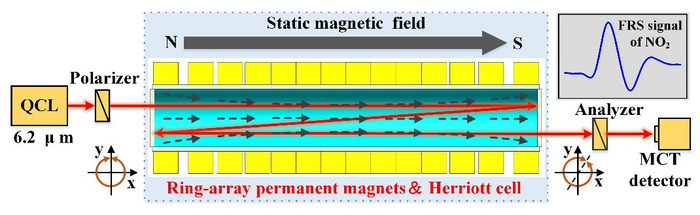
Scientists Propose a Novel NO2 Sensor Based on Static Magnetic Field Faraday Rotation Spectroscopy

Credit: CAO Yuan

Low-power FRS nitrogen dioxide sensor basing on ring array permanent was proposed by a research team led by Prof. GAO Xiaoming from Hefei Institutes of Physical Science of Chinese Academy of Sciences, according to a paper published in Analytical Chemistry.

Faraday rotation spectroscopy (FRS) enables the detection of paramagnetic molecules by detecting changes in the polarization state of the linearly polarized light caused by a gaseous medium immersed in an external longitudinal magnetic field.

The advantage is that FRS is not disturbed by diamagnetic molecules such as CO2 and H2O, so it exhibits a high species specificity. In addition, the FRS has a very high detection sensitivity due to the use of a pair of nearly-crossed polarizers that greatly suppress the laser intensity noise.

The current FRS signal is mainly generated by modulating the Zeeman splitting of the sample absorption lines by an alternating magnetic field which is generated by a solenoid coil. The drawback is that when exciting the magneto-optical effect, this sinusoidal electromagnetic field suffers from high power consumption, generation of large amounts of Joule heat, electromagnetic interference and other defects.

To solve these problems, the research team proposed a static magnetic field FRS sensing device based on rare-earth permanent magnets.

Based on the magnetic field distribution characteristics of neodymium-iron-boron (NdFeB) permanent magnet rings, 14 identical NdFeB magnet rings were combined in a non-equidistant form, resulting in a static magnetic field with an average magnetic field strength of 346 Gauss over a length of 380 mm. By fitting the Herriott cell coaxially to the permanent magnet array, the interaction between the linearly polarized light and the sample was thus greatly enhanced.

A Q-branch spectral feature in the ν3 fundamental band of NO2 at 1613.25 cm-1 was probed using a mid-infrared quantum cascade laser. The NO2 detection limit of 0.4 ppb was achieved at an optical length of 23.7 m.

“We expect it to be developed into a robust field-deployable environment monitoring system,” said CAO Yuan, first author of the paper.


Journal

Analytical Chemistry

DOI

10.1021/acs.analchem.2c04821

Article Title

NO2 Sensor Based on Faraday Rotation Spectroscopy Using Ring Array Permanent Magnets

Article Publication Date

5-Jan-2023

Share12Tweet8Share2ShareShareShare2

Related Posts

Using Epigenetics to Monitor Environmental Arsenic Exposure — Chemistry

Using Epigenetics to Monitor Environmental Arsenic Exposure

May 1, 2026
Innovative Nanoreactor Design Enhances Catalysis by Optimizing Transport and Reaction Kinetics — Chemistry

Innovative Nanoreactor Design Enhances Catalysis by Optimizing Transport and Reaction Kinetics

May 1, 2026

Swift Creation of Conductive Organic Compounds via Mechanochemistry

May 1, 2026

Scientists Reveal Atomic Mechanism Behind Water-Induced Hydroxylation in CoOx Nanostructures

May 1, 2026

POPULAR NEWS

  • Research Indicates Potential Connection Between Prenatal Medication Exposure and Elevated Autism Risk

    832 shares
    Share 333 Tweet 208
  • New Study Reveals Plants Can Detect the Sound of Rain

    714 shares
    Share 285 Tweet 178
  • Scientists Investigate Possible Connection Between COVID-19 and Increased Lung Cancer Risk

    67 shares
    Share 27 Tweet 17
  • Salmonella Haem Blocks Macrophages, Boosts Infection

    61 shares
    Share 24 Tweet 15

About

We bring you the latest biotechnology news from best research centers and universities around the world. Check our website.

Follow us

Recent News

Family Health Needs of Disabled Elders Explored

Mcu Controls Bone Growth Through Mitochondrial Calcium

Physical Disorders, ADLs, Cognition, Depression in Nursing Homes

Subscribe to Blog via Email

Success! An email was just sent to confirm your subscription. Please find the email now and click 'Confirm' to start subscribing.

Join 82 other subscribers
  • Contact Us

Bioengineer.org © Copyright 2023 All Rights Reserved.

Welcome Back!

Login to your account below

Forgotten Password?

Retrieve your password

Please enter your username or email address to reset your password.

Log In
No Result
View All Result
  • Homepages
    • Home Page 1
    • Home Page 2
  • News
  • National
  • Business
  • Health
  • Lifestyle
  • Science

Bioengineer.org © Copyright 2023 All Rights Reserved.