• HOME
  • NEWS
  • EXPLORE
    • CAREER
      • Companies
      • Jobs
    • EVENTS
    • iGEM
      • News
      • Team
    • PHOTOS
    • VIDEO
    • WIKI
  • BLOG
  • COMMUNITY
    • FACEBOOK
    • INSTAGRAM
    • TWITTER
Sunday, June 28, 2026
BIOENGINEER.ORG
No Result
View All Result
  • Login
  • HOME
  • NEWS
  • EXPLORE
    • CAREER
      • Companies
      • Jobs
        • Lecturer
        • PhD Studentship
        • Postdoc
        • Research Assistant
    • EVENTS
    • iGEM
      • News
      • Team
    • PHOTOS
    • VIDEO
    • WIKI
  • BLOG
  • COMMUNITY
    • FACEBOOK
    • INSTAGRAM
    • TWITTER
  • HOME
  • NEWS
  • EXPLORE
    • CAREER
      • Companies
      • Jobs
        • Lecturer
        • PhD Studentship
        • Postdoc
        • Research Assistant
    • EVENTS
    • iGEM
      • News
      • Team
    • PHOTOS
    • VIDEO
    • WIKI
  • BLOG
  • COMMUNITY
    • FACEBOOK
    • INSTAGRAM
    • TWITTER
No Result
View All Result
Bioengineer.org
No Result
View All Result
Home NEWS Science News Chemistry

Scientists propose a flexible interface design for silicon-graphite dual-ion battery

Bioengineer by Bioengineer
March 10, 2020
in Chemistry
Reading Time: 2 mins read
0
IMAGE
Share on FacebookShare on TwitterShare on LinkedinShare on RedditShare on Telegram

IMAGE

Credit: SIAT


Silicon is abundant in nature with high theoretical capacity (4200 mAh g-1), making it an ideal anode material for improving the energy density of dual-ion batteries (DIBs). However, its application in DIBs has been restricted by the large volume expansion problem (>300%).

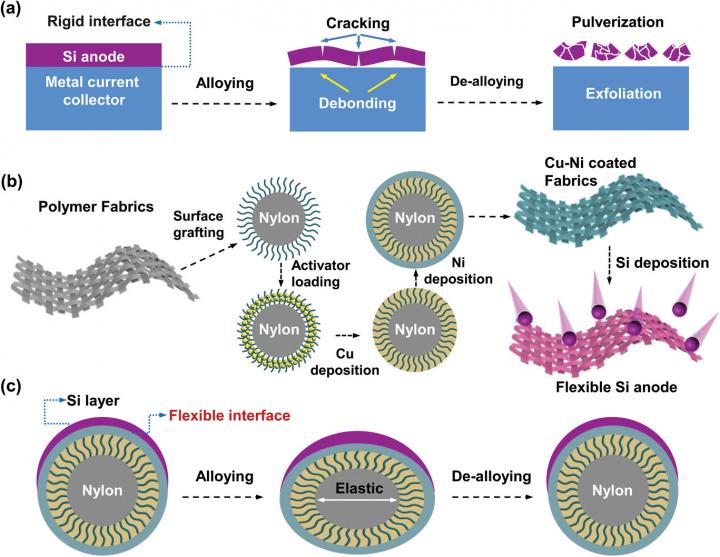
Rigid contacts between silicon and current collectors, commonly made with metal foils, lead to significant interfacial stress. As a consequence, interface cracking and even exfoliation of active materials occur resulting in suboptima cycling performance.

A research group led by Prof. TANG Yongbing and his team members (Dr. JIANG Chunlei, XIANG Lei, MIAO Shijie etc.) from the Shenzhen Institutes of Advanced Technology (SIAT) of the Chinese Academy of Sciences, along with Prof. ZHENG Zijian from the Hong Kong Polytechnic University, have proposed a flexible interface design to reduce alloying stress on silicon anodes in silicon-graphite DIBs.

This flexible interface design modulates stress distribution via the construction of a silicon anode on a soft nylon fabric modified with a conductive Cu-Ni transition layer, thus endowing the silicon electrode with remarkable flexibility and stability over 50,000 bends.

Assembly of the flexible silicon anode with an expanded graphite cathode yielded a silicon-graphite DIB (SGDIB) having record-breaking rate performance (up to 150 C) and cycling stability over 2000 cycles at 10 C with capacity retention of 97%.

Moreover, the SGDIB showed high capacity retention of about 84% after 1500 bends and a low self-discharging voltage loss of 0.0015% per bend after 10,000 bends, indicating strong potential for high-performance, flexible energy-storage applications.

###

The study, entitled “Flexible Interface Design for Stress Regulation of a Silicon Anode toward Highly Stable Dual-Ion Batteries,” was published online in Advanced Materials.

Media Contact
ZHANG Xiaomin
[email protected]

Original Source

http://english.cas.cn/

Related Journal Article

http://dx.doi.org/10.1002/adma.201908470

Tags: Chemistry/Physics/Materials SciencesEnergy/Fuel (non-petroleum)
Share12Tweet8Share2ShareShareShare2

Related Posts

AI and Physics Collaborate to Design Advanced Hydrogen Storage Materials

June 25, 2026

International Team Including Dresden Scientists Develops Novel Designer Proteins for Advanced Study of Living Tissue

June 25, 2026

New Study Uncovers Key Factors Driving Water Chemistry in Nanoscale Environments

June 25, 2026

Plasma Technology Extends Catalyst Lifespan in Hydrogen Production

June 24, 2026
Please login to join discussion

POPULAR NEWS

  • Saying Goodbye to PGY-6: Pediatric Fellowship Realities

    103 shares
    Share 41 Tweet 26
  • Multi-Hospital Study Reveals Long Covid Burden Is Twice as High as Current Estimates

    92 shares
    Share 36 Tweet 23
  • Detection of EDCs in Breast Milk and Infant Urine Up to Six Months Highlights Early Exposure Risks

    77 shares
    Share 31 Tweet 19
  • New Drug Candidate Developed at McMaster Shows Potential for Treating Brain Cancer

    58 shares
    Share 23 Tweet 15

About

We bring you the latest biotechnology news from best research centers and universities around the world. Check our website.

Follow us

Recent News

Tracking Lanthanide-Labeled Microplastics in Plants

POSTECH Researchers Slash Cost of Reconstituted Cell-Free Systems by 95%

AI and Physics Collaborate to Design Advanced Hydrogen Storage Materials

Subscribe to Blog via Email

Success! An email was just sent to confirm your subscription. Please find the email now and click 'Confirm' to start subscribing.

Join 82 other subscribers
  • Contact Us

Bioengineer.org © Copyright 2023 All Rights Reserved.

Welcome Back!

Login to your account below

Forgotten Password?

Retrieve your password

Please enter your username or email address to reset your password.

Log In
No Result
View All Result
  • Homepages
    • Home Page 1
    • Home Page 2
  • News
  • National
  • Business
  • Health
  • Lifestyle
  • Science

Bioengineer.org © Copyright 2023 All Rights Reserved.