• HOME
  • NEWS
  • EXPLORE
    • CAREER
      • Companies
      • Jobs
    • EVENTS
    • iGEM
      • News
      • Team
    • PHOTOS
    • VIDEO
    • WIKI
  • BLOG
  • COMMUNITY
    • FACEBOOK
    • INSTAGRAM
    • TWITTER
Monday, October 5, 2026
BIOENGINEER.ORG
No Result
View All Result
  • Login
  • HOME
  • NEWS
  • EXPLORE
    • CAREER
      • Companies
      • Jobs
        • Lecturer
        • PhD Studentship
        • Postdoc
        • Research Assistant
    • EVENTS
    • iGEM
      • News
      • Team
    • PHOTOS
    • VIDEO
    • WIKI
  • BLOG
  • COMMUNITY
    • FACEBOOK
    • INSTAGRAM
    • TWITTER
  • HOME
  • NEWS
  • EXPLORE
    • CAREER
      • Companies
      • Jobs
        • Lecturer
        • PhD Studentship
        • Postdoc
        • Research Assistant
    • EVENTS
    • iGEM
      • News
      • Team
    • PHOTOS
    • VIDEO
    • WIKI
  • BLOG
  • COMMUNITY
    • FACEBOOK
    • INSTAGRAM
    • TWITTER
No Result
View All Result
Bioengineer.org
No Result
View All Result
Home NEWS Science News Chemistry

Scientists precisely predict intricate evolutions of multiple-period patterns in bilayers

Bioengineer by Bioengineer
December 16, 2020
in Chemistry
Reading Time: 2 mins read
0
IMAGE
Share on FacebookShare on TwitterShare on LinkedinShare on RedditShare on Telegram

IMAGE

Credit: @Science China Press

Surface instability of compliant film/substrate bilayers has raised considerable interests due to its broad applications such as wrinkle-driven surface renewal and antifouling, shape-morphing for camouflaging skins, and micro/nano-scale surface patterning control. However, it is still a challenge to precisely predict and continuously trace secondary bifurcation transitions in the nonlinear post-buckling region. Fundamental understanding and quantitative prediction of morphological evolution and pattern selection are, in fact, crucial for the effective use of wrinkling as a tool for morphological design.

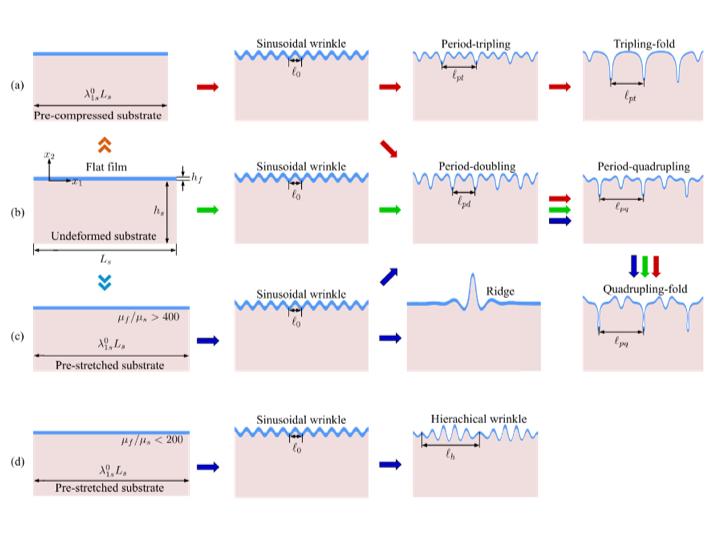
Lately, an article entitled “Intricate evolutions of multiple-period post-buckling patterns in bilayers”, published in SCIENCE CHINA Physics, Mechanics & Astronomy by a soft matter mechanics group at Fudan University, has reported rich successive post-buckling phenomena involving multiple-period pattern transitions (see Fig. 1), based on their lattice models of hyperelastic bilayers.

Researchers have developed lattice models to quantitatively predict the nonlinear surface morphology evolution with multiple mode transitions in hyperelasric bilayers. Based on these models, they have revealed an intricate post-buckling phenomenon involving successive bifurcations: flat-wrinkle-doubling-quadrupling-fold. They have examined effects of modulus ratio, dimension and loading types on pattern formation and evolution. With high substrate pre-tension, hierarchical wrinkles in the form of alternating packets of large and small undulations appear in the bilayer with a low modulus ratio at the secondary bifurcation, while a wrinkle-to-ridge mode transition occurs with a relatively high modulus ratio. While with a moderate substrate pre-compression and modulus ratio, the bilayer tends to evolve into a period-tripling mode. Lastly, they have provided phase diagrams based on neo-Hookean and Arruda-Boyce constitutive laws to characterize the influence of pre-stretch and modulus ratio on pattern selection (see Fig. 2). Both hyperelastic models demonstrate the same trend of mode transition and similar deformation shapes in film/substrate bilayers.

This work not only advances the fundamental understanding of nonlinear morphological transitions of soft bilayer materials, but also gives a way to quantitatively predict and design multiple-period or localized surfaces, which is promising to guide smart surface regulation in broad applications.

###

This work was supported by the National Natural Science Foundation of China (Grant Nos. 11872150, 11772094, and 11890673), the Shanghai Rising-Star Program (Grant No. 19QA1400500), and the Shanghai Chenguang Program (Grant No. 16CG01).

See the article:

Z. Cheng, and F. Xu, Intricate evolutions of multiple-period post-buckling patterns in bilayers, Sci. China-Phys. Mech. Astron. 64, 214611 (2021).

https://doi.org/10.1007/s11433-020-1620-0

Media Contact
Xu Fan
[email protected]

Related Journal Article

http://dx.doi.org/10.1007/s11433-020-1620-0

Tags: Chemistry/Physics/Materials Sciences
Share12Tweet8Share2ShareShareShare2

Related Posts

Sound Waves and a Plant-Made Catalyst Turn Water Into a Drug-Making Machine

Sound Waves and a Plant-Made Catalyst Turn Water Into a Drug-Making Machine

October 5, 2026
Earth-Abundant CFTS Solar Cells Simulated to Reach 25.52% Efficiency

Earth-Abundant CFTS Solar Cells Simulated to Reach 25.52% Efficiency

October 5, 2026

Waste Polyamide Becomes Tunable Light-Emitting Carbon Dots, Saitama Team Reports

October 5, 2026

Cigarette Filters Reborn as Green Sorbents to Catch Pesticides in Vegetables

October 5, 2026
Please login to join discussion

POPULAR NEWS

  • Alloys That Shrink Their Own Grains: New PIX Mechanism Refines Metals With Heat Alone

    Alloys That Shrink Their Own Grains: New PIX Mechanism Refines Metals With Heat Alone

    29 shares
    Share 12 Tweet 7
  • Endurance Exercise Reshapes the Liver in Males and Females Through Distinct Molecular Routes

    29 shares
    Share 12 Tweet 7
  • Single Transcription Factor PU.1 Rapidly Converts Fibroblasts into Macrophage-Lineage Cells

    29 shares
    Share 12 Tweet 7
  • New Scale Measures How Ready Nurse Educators Really Are for the AI Era

    29 shares
    Share 12 Tweet 7

About

We bring you the latest biotechnology news from best research centers and universities around the world. Check our website.

Follow us

Recent News

Alloys That Shrink Their Own Grains: New PIX Mechanism Refines Metals With Heat Alone

Endurance Exercise Reshapes the Liver in Males and Females Through Distinct Molecular Routes

Single Transcription Factor PU.1 Rapidly Converts Fibroblasts into Macrophage-Lineage Cells

Subscribe to Blog via Email

Success! An email was just sent to confirm your subscription. Please find the email now and click 'Confirm' to start subscribing.

Join 85 other subscribers
  • Contact Us

Bioengineer.org © Copyright 2023 All Rights Reserved.

Welcome Back!

Login to your account below

Forgotten Password?

Retrieve your password

Please enter your username or email address to reset your password.

Log In
No Result
View All Result
  • Homepages
    • Home Page 1
    • Home Page 2
  • News
  • National
  • Business
  • Health
  • Lifestyle
  • Science

Bioengineer.org © Copyright 2023 All Rights Reserved.