• HOME
  • NEWS
  • EXPLORE
    • CAREER
      • Companies
      • Jobs
    • EVENTS
    • iGEM
      • News
      • Team
    • PHOTOS
    • VIDEO
    • WIKI
  • BLOG
  • COMMUNITY
    • FACEBOOK
    • INSTAGRAM
    • TWITTER
Saturday, February 7, 2026
BIOENGINEER.ORG
No Result
View All Result
  • Login
  • HOME
  • NEWS
  • EXPLORE
    • CAREER
      • Companies
      • Jobs
        • Lecturer
        • PhD Studentship
        • Postdoc
        • Research Assistant
    • EVENTS
    • iGEM
      • News
      • Team
    • PHOTOS
    • VIDEO
    • WIKI
  • BLOG
  • COMMUNITY
    • FACEBOOK
    • INSTAGRAM
    • TWITTER
  • HOME
  • NEWS
  • EXPLORE
    • CAREER
      • Companies
      • Jobs
        • Lecturer
        • PhD Studentship
        • Postdoc
        • Research Assistant
    • EVENTS
    • iGEM
      • News
      • Team
    • PHOTOS
    • VIDEO
    • WIKI
  • BLOG
  • COMMUNITY
    • FACEBOOK
    • INSTAGRAM
    • TWITTER
No Result
View All Result
Bioengineer.org
No Result
View All Result
Home NEWS Science News Chemistry

Scientists make breakthrough in ion-conducting composite membranes

Bioengineer by Bioengineer
January 7, 2020
in Chemistry
Reading Time: 2 mins read
0
IMAGE
Share on FacebookShare on TwitterShare on LinkedinShare on RedditShare on Telegram

IMAGE

Credit: DAI Qing


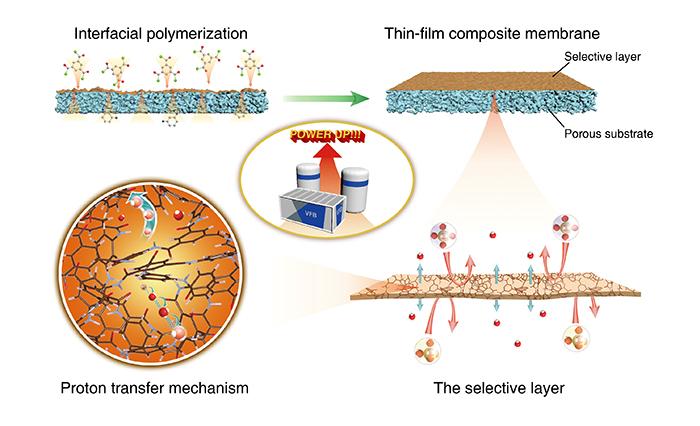
Chinese researchers under the direction of Profs. LI Xianfeng and ZHANG Huamin from the Dalian Institute of Chemical Physics (DICP) of the Chinese Academy of Sciences recently developed an ultrathin ion-conducting membrane with high selectivity and conductivity that can boost the power of flow batteries. The study was published in Nature Communications.

Membranes are key components of flow batteries. They separate reactive materials in the negative and positive chambers while permitting the transfer of ions across the membrane at the same time. The efficiency of flow batteries greatly depends on the ion selectivity and conductivity of these membranes.

Based on their previous study (Environ.Sci., 2011, 4, 1676), LI’s group found that the key challenge for ion-conducting membranes is the “trade-off” between ion selectivity and conductivity. Porous membranes using the traditional phase inversion method of construction had tortuous and poorly connected pores, resulting in low ion conductivity.

In contrast, composite membranes possess separately tuned selective layers supported on substrates. “A composite membrane with a very thin selective layer and a highly conductive substrate hopefully overcomes the trade-off between ion selectivity and conductivity and further improves flow battery performance,” said Prof. LI.

To this end, the researchers utilized interfacial polymerization to fabricate a thin-film composite membrane. This membrane has an ultra-thin cross-linked polyamide selective layer and a highly conductive support layer. The ultrathin selective layer is only 180 nm thick. It offers a very short ion-transfer pathway and has very low area resistance.

The cross-linked polyamide has free volume between the size of hydronium and hydrated vanadium ions. Vanadium ions, due to their size, are highly resistant to crossover, thus endowing the membrane with high ion selectivity.

Flow batteries with a thin-film composite membrane could work at higher current density. This would allow the use of a smaller battery stack to generate higher power and reduction in the cost of battery stacks.

The proton transfer mechanism in polyamide selective layers can be further understood by utilizing the Grotthuss mechanism to make theoretical calculations of proton transfers along water chains and carboxyl groups. Results provide new ideas for designing advanced ion-selective membranes that can also be applied to flow batteries.

###

Media Contact
CHEN Si
[email protected]

Related Journal Article

http://dx.doi.org/10.1038/s41467-019-13704-2

Tags: Atomic/Molecular/Particle PhysicsChemistry/Physics/Materials SciencesEnergy/Fuel (non-petroleum)
Share12Tweet8Share2ShareShareShare2

Related Posts

blank

Breakthrough in Environmental Cleanup: Scientists Develop Solar-Activated Biochar for Faster Remediation

February 7, 2026
blank

Cutting Costs: Making Hydrogen Fuel Cells More Affordable

February 6, 2026

Scientists Develop Hand-Held “Levitating” Time Crystals

February 6, 2026

Observing a Key Green-Energy Catalyst Dissolve Atom by Atom

February 6, 2026
Please login to join discussion

POPULAR NEWS

  • Robotic Ureteral Reconstruction: A Novel Approach

    Robotic Ureteral Reconstruction: A Novel Approach

    82 shares
    Share 33 Tweet 21
  • Digital Privacy: Health Data Control in Incarceration

    63 shares
    Share 25 Tweet 16
  • Study Reveals Lipid Accumulation in ME/CFS Cells

    57 shares
    Share 23 Tweet 14
  • Breakthrough in RNA Research Accelerates Medical Innovations Timeline

    53 shares
    Share 21 Tweet 13

About

We bring you the latest biotechnology news from best research centers and universities around the world. Check our website.

Follow us

Recent News

Palmitoylation of Tfr1 Drives Platelet Ferroptosis and Exacerbates Liver Damage in Heat Stroke

Oxygen-Enhanced Dual-Section Microneedle Patch Improves Drug Delivery and Boosts Photodynamic and Anti-Inflammatory Treatment for Psoriasis

Scientists Identify SARS-CoV-2 PLpro and RIPK1 Inhibitors Showing Potent Synergistic Antiviral Effects in Mouse COVID-19 Model

Subscribe to Blog via Email

Enter your email address to subscribe to this blog and receive notifications of new posts by email.

Join 73 other subscribers
  • Contact Us

Bioengineer.org © Copyright 2023 All Rights Reserved.

Welcome Back!

Login to your account below

Forgotten Password?

Retrieve your password

Please enter your username or email address to reset your password.

Log In
No Result
View All Result
  • Homepages
    • Home Page 1
    • Home Page 2
  • News
  • National
  • Business
  • Health
  • Lifestyle
  • Science

Bioengineer.org © Copyright 2023 All Rights Reserved.