Physicists at Ural Federal University (UrFU) and their colleagues from the Institute of Electrophysics, Ural Branch of the Russian Academy of Sciences, and the Institute of Ion Plasma and Laser Technologies, Academy of Sciences of Uzbekistan have developed a technology for the growth of nonspherical nanoparticles that are synthesized in the process of ion implantation. The new technique makes it possible to grow nanoparticles of different shapes and thus obtain the necessary properties and control these properties. The technology is applicable to various metals, both noble metals such as gold, silver and platinum, as well as “ordinary” metals, the scientists assure. A description of the technology and the results of the first experiments – copper implantation in ceramics – published in the Journal of Physics and Chemistry of Solids.
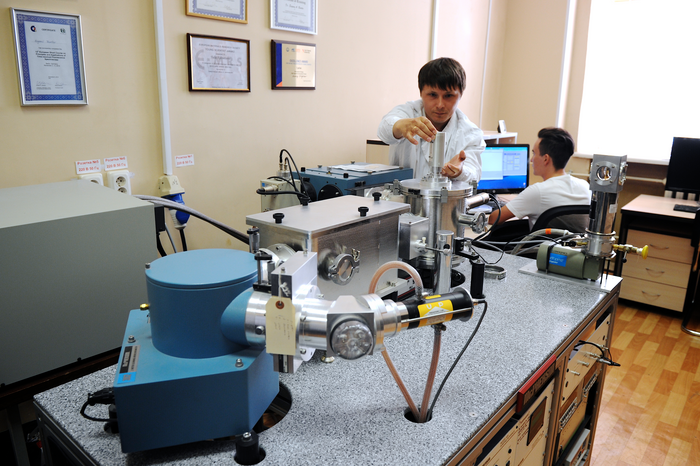
Credit: UrFU / Vladimir Petrov
Physicists at Ural Federal University (UrFU) and their colleagues from the Institute of Electrophysics, Ural Branch of the Russian Academy of Sciences, and the Institute of Ion Plasma and Laser Technologies, Academy of Sciences of Uzbekistan have developed a technology for the growth of nonspherical nanoparticles that are synthesized in the process of ion implantation. The new technique makes it possible to grow nanoparticles of different shapes and thus obtain the necessary properties and control these properties. The technology is applicable to various metals, both noble metals such as gold, silver and platinum, as well as “ordinary” metals, the scientists assure. A description of the technology and the results of the first experiments – copper implantation in ceramics – published in the Journal of Physics and Chemistry of Solids.
“By changing the shape of the nanoparticles from spherical to non-spherical, we were able to increase the range of optical absorption. This, in turn, is the basis for further conversion of absorbed energy into electricity, heat. As a result, we can get more functional sensors and increase their sensitivity range,” explains the co-author of the study Arseny Kiryakov, associate professor at UrFU Department of Physical Methods and Quality Control Devices. “If such nanoparticles are embedded in lasers, lasers power will increase. If we talk about sensors, their sensitivity will increase. As for the sensors, their response time will change. This is all due to the peculiarity of plasmon resonance, which causes an amplified electric field to appear around the nanoparticles.”
Metal nanoparticles are used to solve a variety of problems: from biological (sensors for determining the composition of proteins, DNA analysis, etc.) to physical (creating amplified lasers, photoluminescent sensors, etc.). Thus, in contact with biobjects – DNA, viruses, antibodies – plasmonic nanostructures allow more than an order of magnitude increase the intensity of fluorescence signals, i.e. significantly expand the capabilities of detection, identification and diagnosis. And changing the shape of nanoparticles will allow to control these properties, to improve them.
The first experiments with copper particles allowed scientists to create a metamaterial that has no analogues.
“The new material consists of nonspherical plasmonic nanoparticles in a matrix of optically transparent radiation-resistant ceramics. The controlled morphology of plasmonic nanoparticles provides improved spectral characteristics and increases the energy conversion efficiency of absorbed photons,” says Anatoly Zatsepin, professor at the Department of Physical Methods and Quality Control Devices at the UrFU. “We found that the unique physical properties of the obtained material are appeared by a special phenomenon – the effect of surface plasmon resonance.”
In addition, co-researcher from Uzbekistan proposed a universal mathematical model describing this process. According to the physicists, the model is important to describe and understand what happens to nanoparticles in different materials, and it is the first model that describes the growth of nonspherical nanoparticles. Previous models do not take into account the unusual shape of the particles.
Physicists plan to expand their understanding of the nature and laws of physical phenomena occurring in the material under external energy influences, which, in turn, will provide information about new possibilities for the functional application of this type of materials.
Journal
Journal of Physics and Chemistry of Solids
DOI
10.1016/j.jpcs.2022.110966
Article Publication Date
19-Aug-2022