Physicists and mathematicians from the Ural Federal University (UrFU) have created a complex mathematical model that calculates the distribution of nanoparticles (in particular, viruses) in living cells. The mathematical model helps finding how the nanoparticles cluster (merge into a single particle) inside cells, namely in cellular endosomes, which are responsible for sorting and transporting proteins and lipids. These calculations will be useful for medical purposes because, on the one hand, they show the behaviour of viruses when they enter cells and seek to replicate. And on the other hand, the model allows to accurately calculate the amount of medication needed for therapy, so that the treatment is as effective as possible and with minimal side effects. The model description and the results of calculations, the scientists published in the journal Crystals.
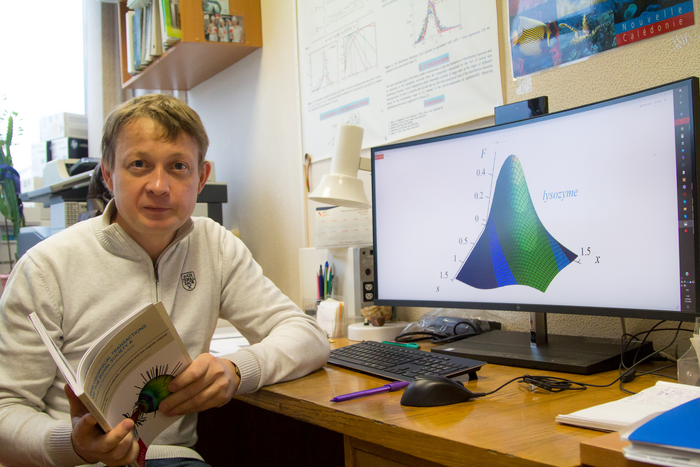
Credit: UrFU
Physicists and mathematicians from the Ural Federal University (UrFU) have created a complex mathematical model that calculates the distribution of nanoparticles (in particular, viruses) in living cells. The mathematical model helps finding how the nanoparticles cluster (merge into a single particle) inside cells, namely in cellular endosomes, which are responsible for sorting and transporting proteins and lipids. These calculations will be useful for medical purposes because, on the one hand, they show the behaviour of viruses when they enter cells and seek to replicate. And on the other hand, the model allows to accurately calculate the amount of medication needed for therapy, so that the treatment is as effective as possible and with minimal side effects. The model description and the results of calculations, the scientists published in the journal Crystals.
“The processes in cells are extremely complex, but in simple words, the viruses use different variants to reproduce. Some of them deliver the genetic material directly to the cytoplasm. Others use the endocytosis pathway: they deliver the viral genome by releasing it from the endosomes. If viruses linger in the endosomes, the acidity increases and they die in the lysosomes,” says Dmitri Alexandrov, Head of the Laboratory of Multiscale Mathematical Modeling at UrFU. “So, our model has allowed to find out, first, when and which viruses “escape” from endosomes in order to survive. For example, some influenza viruses are low pH-dependent viruses; they fuse with the endosome membrane and release their genome into the cytoplasm. Secondly, we found that it is easier for viruses to survive in endosomes during clustering, when two particles merge and tend to form a single particle.”
As the scientists explain, the mathematical model will also be useful in tumor targeting therapy: many cancer therapies depend on when and how nanoparticles of a drug saturate cancer cells. And the model will help to calculate this parameter.
In addition, understanding the behavior of viruses in cells is important for the development of vaccines and drugs, as well as for gene therapy, which treats diseases that conventional medicine cannot cope with. For example, various adenovirus-based vectors and lipid particles are used as a platform for gene delivery to treat the disease. But their limited ability to “slip out” of the endosomes also limits their use as deliverers.
“Nanoparticles smaller than 100 nanometers are becoming increasingly important tools in the modern medicine. Its applications range from nanodiagnostics to radiation therapy for cancer. For example, pH-sensitive nanoparticles mimicking viruses are used for targeted delivery of antitumor drugs. This is how drugs are delivered from whole organs to individual cells,” says Head of the Laboratory of Stochastic Transport of Nanoparticles in Living Systems (UrFU) Eugenya Makoveeva.
Reference
Endosome is a membrane intracellular organelle. It is responsible for sorting and transporting proteins and lipids; occur during the fusion and development of endocytic vesicles. In the process of maturation, the endosome goes through several stages, as a result of which it turns into a lysosome. Mature endosomes reach sizes of 300-400 nanometers.
Journal
Crystals
DOI
10.3390/cryst12081159
Article Title
Analysis of Smoluchowski’s Coagulation Equation with Injection
Article Publication Date
17-Aug-2022