• HOME
  • NEWS
  • EXPLORE
    • CAREER
      • Companies
      • Jobs
    • EVENTS
    • iGEM
      • News
      • Team
    • PHOTOS
    • VIDEO
    • WIKI
  • BLOG
  • COMMUNITY
    • FACEBOOK
    • INSTAGRAM
    • TWITTER
Sunday, May 10, 2026
BIOENGINEER.ORG
No Result
View All Result
  • Login
  • HOME
  • NEWS
  • EXPLORE
    • CAREER
      • Companies
      • Jobs
        • Lecturer
        • PhD Studentship
        • Postdoc
        • Research Assistant
    • EVENTS
    • iGEM
      • News
      • Team
    • PHOTOS
    • VIDEO
    • WIKI
  • BLOG
  • COMMUNITY
    • FACEBOOK
    • INSTAGRAM
    • TWITTER
  • HOME
  • NEWS
  • EXPLORE
    • CAREER
      • Companies
      • Jobs
        • Lecturer
        • PhD Studentship
        • Postdoc
        • Research Assistant
    • EVENTS
    • iGEM
      • News
      • Team
    • PHOTOS
    • VIDEO
    • WIKI
  • BLOG
  • COMMUNITY
    • FACEBOOK
    • INSTAGRAM
    • TWITTER
No Result
View All Result
Bioengineer.org
No Result
View All Result
Home NEWS Science News Health

Scientists from Russia and Germany measured how the brain learn new words

Bioengineer by Bioengineer
March 31, 2021
in Health
Reading Time: 2 mins read
0
IMAGE
Share on FacebookShare on TwitterShare on LinkedinShare on RedditShare on Telegram

IMAGE

Credit: Urfu / Nadezhda Pavlova.

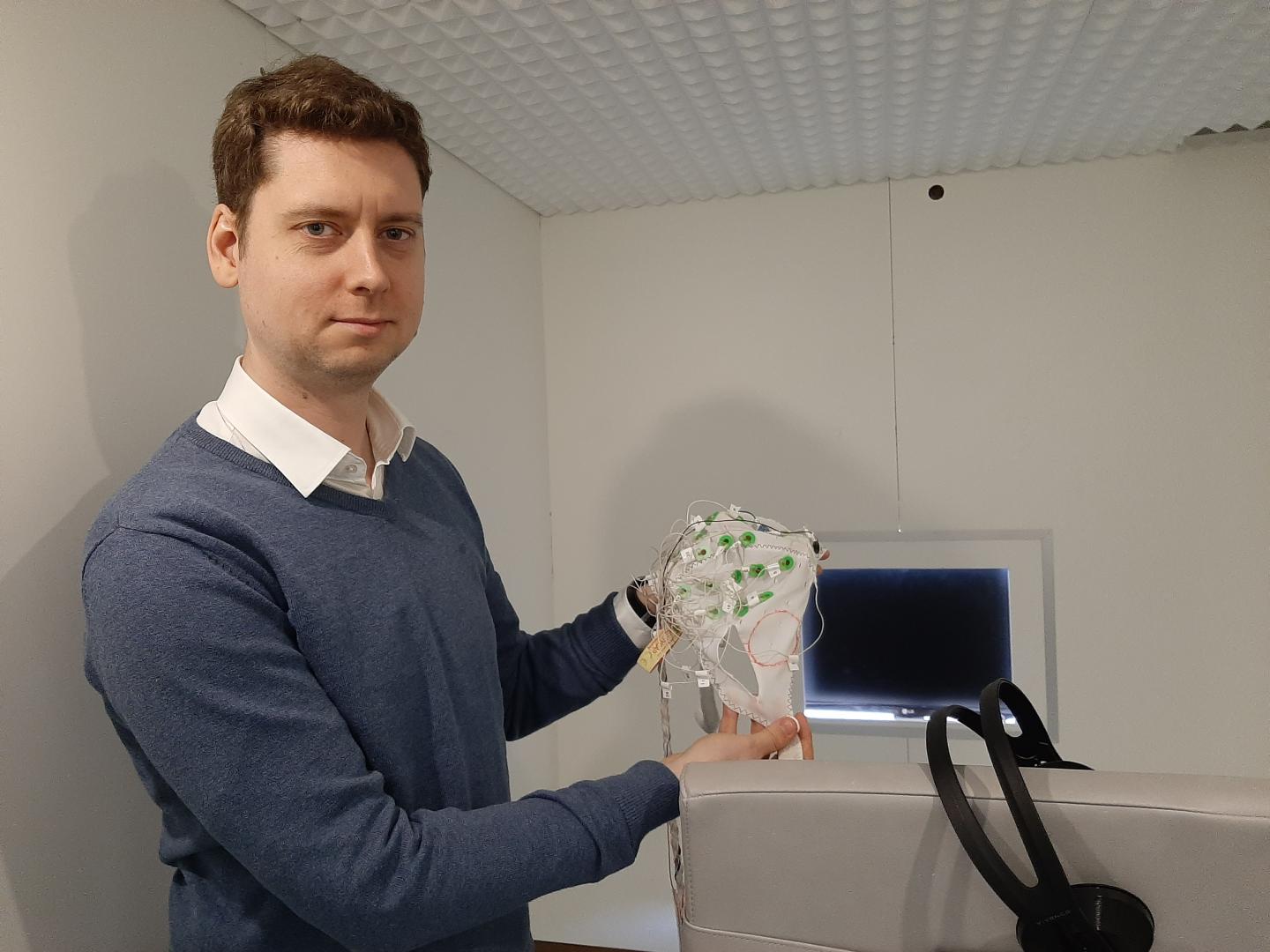
Researchers from University of Tübingen (Tübingen, Germany) and Ural Federal University (Ekaterinburg, Russia) have developed and experimentally tested new method to understand how the brain builds associations between previously unrelated words. The findings are published in Journal of Neurolinguistics.

The scientists conducted used electroencephalography to measure how the brain responds to the incongruent sentence endings. So, the brain responses to the last word in the phrase “I like my coffee with cream and sugar” have much smaller magnitude as compared to the phrase “I like my coffee with cream and socks”. The brain reacts in a similar way to words in pairs such as cat-dog and cat-sky.

“We get a neural index of how people learn new associations between words, in fact – a language,” said researcher of Department of Psychology at Ural Federal University and Institute of Medical Psychology and Behavioral Neurobiology at University of Tübingen Yuri Pavlov. “At the same time, this index is completely independent from behavioral responses. The brain itself informs us what it has learnt.”

At first stage of the experiment the participants listened to five pairs of semantically unrelated words, each pair repeated twenty times. To give an example, the participants could hear such word pairs as carriage-text, death-fruit, seriousness-cow. Then, to the freshly learnt pairs, new similarly weird but new pairs were added. The experiment showed that the brain responses to the learnt word pairs rapidly attenuated and, after twenty repetitions, did not differ from the responses to familiar word pairs such as coffee-cream.

In the future, the scientists plan to apply the developed experimental paradigm to patients in disorders of consciousness.

“Perhaps those patients whose brains preserve the ability to learn new semantic associations have a chance to regain consciousness,” said Yuri Pavlov. “Indeed, such an ability depends on a multiverse of cognitive functions such as long-term and working memory, speech perceptionThis means that we can suspect that the underlying anatomical and functional connections within the brain are not entirely destroyed. It is even possible that the patient is conscious, but cannot inform us about this by speech or gestures.”

###

Media Contact
Anna Marinovich
[email protected]

Related Journal Article

http://dx.doi.org/10.1016/j.jneuroling.2021.101001

Tags: Clinical TrialsDiagnosticsHearing/SpeechIntelligenceMemory/Cognitive ProcessesSocial/Behavioral ScienceTrauma/Injury
Share12Tweet8Share2ShareShareShare2

Related Posts

Urdu Fall Risk Questionnaire Adapted for Elderly

May 10, 2026

Key Pharmacological Markers for HIV Prevention in MSM

May 10, 2026

Taking 8,500 Steps Daily May Aid Long-Term Weight Management, Study Finds

May 10, 2026

Group Exercise Boosts Cognition, Fitness in Dementia

May 10, 2026
Please login to join discussion

POPULAR NEWS

  • Research Indicates Potential Connection Between Prenatal Medication Exposure and Elevated Autism Risk

    840 shares
    Share 336 Tweet 210
  • New Study Reveals Plants Can Detect the Sound of Rain

    727 shares
    Share 290 Tweet 181
  • Scientists Investigate Possible Connection Between COVID-19 and Increased Lung Cancer Risk

    68 shares
    Share 27 Tweet 17
  • Salmonella Haem Blocks Macrophages, Boosts Infection

    61 shares
    Share 24 Tweet 15

About

We bring you the latest biotechnology news from best research centers and universities around the world. Check our website.

Follow us

Recent News

Urdu Fall Risk Questionnaire Adapted for Elderly

Key Pharmacological Markers for HIV Prevention in MSM

Taking 8,500 Steps Daily May Aid Long-Term Weight Management, Study Finds

Subscribe to Blog via Email

Success! An email was just sent to confirm your subscription. Please find the email now and click 'Confirm' to start subscribing.

Join 82 other subscribers
  • Contact Us

Bioengineer.org © Copyright 2023 All Rights Reserved.

Welcome Back!

Login to your account below

Forgotten Password?

Retrieve your password

Please enter your username or email address to reset your password.

Log In
No Result
View All Result
  • Homepages
    • Home Page 1
    • Home Page 2
  • News
  • National
  • Business
  • Health
  • Lifestyle
  • Science

Bioengineer.org © Copyright 2023 All Rights Reserved.