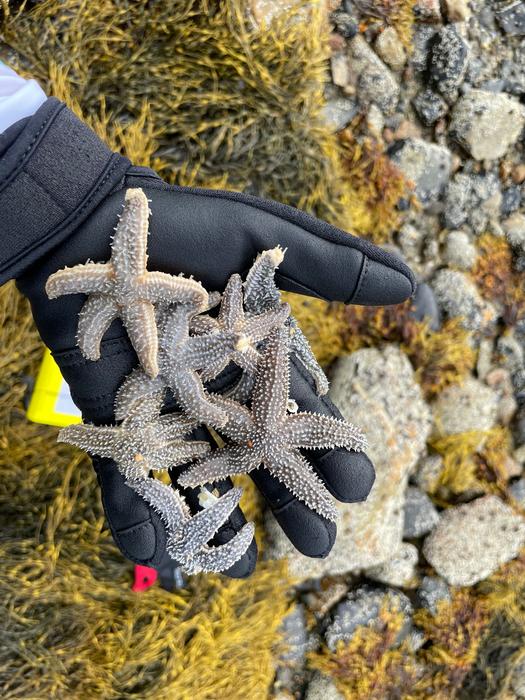
New York, September 11, 2023 – Scientists have long suspected two species of sea stars—commonly referred to as starfish—along rocky European and North American coastlines of crossbreeding in the cool waters of the North Atlantic Ocean. Now, according to recently analyzed genomic data, hybrid starfish are living and thriving, from the shores of New England to the Canadian Maritimes.
Credit: Melina Giakoumis
New York, September 11, 2023 – Scientists have long suspected two species of sea stars—commonly referred to as starfish—along rocky European and North American coastlines of crossbreeding in the cool waters of the North Atlantic Ocean. Now, according to recently analyzed genomic data, hybrid starfish are living and thriving, from the shores of New England to the Canadian Maritimes.
A new study, published in the journal Molecular Ecology, presents genomic evidence of hybridization between two closely related species of sea stars– Asterias rubens, the common starfish, and Asterias forbesi, known as Forbes’ sea star.
“It is the first genome-wide evidence of extensive hybridization in an ecologically important coastal species,” said corresponding author Melina Giakoumis, who is a Ph.D. candidate with the Graduate Center’s Biology program and associate director of the Institute for Comparative Genomics at the American Museum of Natural History.
The biologists set out to find whether the sea stars were crossbreeding in the wild, and if so, what environmental factors influenced its occurrence. The researchers took DNA samples from both species at 33 sites in the North Atlantic, and then conducted DNA sequencing that included samples from Asterias amurensis, the Northern Pacific sea star, used as a control group.
Through the genomic data, the scientists found that widespread hybridization had occurred between the two species of sea stars from Cape Cod to Nova Scotia.
The sea stars were shown to have different environmental preferences: A. forbesi has a limited geographic range with adaption to local environments, and A. rubens has a wider range that extends all the way to western Europe. These preferences are also apparent in their genomes, the researchers said.
The study’s species distribution models accurately predicted hybrid zones to occur where these ranges overlapped — the Gulf of Maine being at the center of hybridization — suggesting that environmental selection played an important role in the preservation of hybrid zones. Additionally, the results indicate that A. forbesi has a higher tolerance for warmer temperatures, while A. rubens prefers colder habitats, and hybrids are found in areas with temperatures that are tolerable by both species.
The study highlights the ecological importance of both sea stars, considered to be “keystone species” with significant impacts on surrounding marine communities. When they’re removed from their intertidal communities—the coastal zones between high and low tide—diversity among those entire ecosystems has been shown to collapse, Giakoumis said.
“Two questions arise from this study,” said Michael Hickerson, a biology professor with the CUNY Graduate Center and City College of New York, and Giakoumis’ advisor. “Will the hybrids’ move to follow the changes in sea surface temperatures accelerate to the point of one species replacing the other? Or will they rescue the two species by being a source of gene combinations that allow greater resilience to climatic changes due to increased adaptive variation.
“Since sea stars preferentially eat dominant competitors, they provide stability to the ecosystem,” the biologist explained. “These species are therefore crucial to study for marine conservation, as they have rippling effects throughout the rest of the community.”
Giakoumis notes that the Gulf of Maine is warming faster than 99% of the global ocean. “Our results imply that the distribution of genomic variation in North Atlantic sea stars is influenced by the environment, which will be crucial to consider as the climate changes,” she adds.
Hybridization is believed to be common in nature, Giakoumis points out, and it has been observed more often as genomic data expands. As the first study to offer genome-wide proof of hybridization in these sea star species, the research supports the work of evolutionary biologists and other scientists who study intertidal ecology, the authors said, with possible implications for wildlife management and protection of intertidal zones in the North Atlantic.
This research was funded by the National Science Foundation.
The paper’s DOI is 10.1111/mec.17118
About the Graduate Center of The City University of New York
The CUNY Graduate Center is a leader in public graduate education devoted to enhancing the public good through pioneering research, serious learning, and reasoned debate. The Graduate Center offers ambitious students nearly 50 doctoral and master’s programs of the highest caliber, taught by top faculty from throughout CUNY — the nation’s largest urban public university. Through its nearly 40 centers, institutes, initiatives, and the Advanced Science Research Center, the Graduate Center influences public policy and discourse and shapes innovation. The Graduate Center’s extensive public programs make it a home for culture and conversation.
Journal
Molecular Ecology
DOI
10.1111/mec.17118
Method of Research
Experimental study
Subject of Research
Animals
Article Title
Evidence of introgression, ecological divergence and adaptation in Asterias sea stars
Article Publication Date
11-Sep-2023