• HOME
  • NEWS
  • EXPLORE
    • CAREER
      • Companies
      • Jobs
    • EVENTS
    • iGEM
      • News
      • Team
    • PHOTOS
    • VIDEO
    • WIKI
  • BLOG
  • COMMUNITY
    • FACEBOOK
    • INSTAGRAM
    • TWITTER
Saturday, December 20, 2025
BIOENGINEER.ORG
No Result
View All Result
  • Login
  • HOME
  • NEWS
  • EXPLORE
    • CAREER
      • Companies
      • Jobs
        • Lecturer
        • PhD Studentship
        • Postdoc
        • Research Assistant
    • EVENTS
    • iGEM
      • News
      • Team
    • PHOTOS
    • VIDEO
    • WIKI
  • BLOG
  • COMMUNITY
    • FACEBOOK
    • INSTAGRAM
    • TWITTER
  • HOME
  • NEWS
  • EXPLORE
    • CAREER
      • Companies
      • Jobs
        • Lecturer
        • PhD Studentship
        • Postdoc
        • Research Assistant
    • EVENTS
    • iGEM
      • News
      • Team
    • PHOTOS
    • VIDEO
    • WIKI
  • BLOG
  • COMMUNITY
    • FACEBOOK
    • INSTAGRAM
    • TWITTER
No Result
View All Result
Bioengineer.org
No Result
View All Result
Home NEWS Science News

Scientists establish NanDeSyn Database to support international cooperation on industrial microalgae

Bioengineer by Bioengineer
October 26, 2020
in Science News
Reading Time: 2 mins read
0
IMAGE
Share on FacebookShare on TwitterShare on LinkedinShare on RedditShare on Telegram

IMAGE

Credit: QIBEBT

Industrial oil-producing microalgae can use light energy to convert carbon dioxide and water into oils on a large scale. Therefore, it is a potential solution for the sustainable supply of food, nutrition and fuel for human society.

To promote resource sharing and research cooperation for the synthetic biology and molecular breeding of industrial oil-producing microalgae, an international team led by Single-Cell Center (SCC), Qingdao Institute of Bioenergy and Bioprocess Technology (QIBEBT) of the Chinese Academy of Sciences (CAS), has released the “NanDeSyn Database” (http://www.nandesyn.org). This work was published in The Plant Journal on Oct. 25.

Nannochloropsis spp. is industrial microalgae that can be grown outdoors in a large scale for producing oils. They have highly attractive features as “photosynthetic yeast”, such as a haploid nuclear genome of ~30M base pairs, simple and reliable DNA transformation, high genome-editing efficiency, and flexible gene expression regulation techniques.

The global Nannochloropsis research community has accumulated a large amount of functional genomics data, as well as genetic resources such as plasmids and mutant strains.

The “NanDeSyn Database”, developed by GONG Yanhai, et al., from SCC, and Nam Kyu Kang, et al., from Korea Advanced Institute of Science and Technology (KAIST), systematically collects and integrates functional genomics and epigenetics data including the latest genome sequences, gene annotations, transcriptomes, proteomes, and small RNAs of all Nannochloropsis species.

At the same time, online data mining tools such as gene search, genome comparison, collinearity analysis, gene enrichment analysis, metabolic pathway analysis, and genome browser are provided through the website.
In addition, combined with literature research, the present research status of each gene, as well as the corresponding vectors and mutant strains, are displayed, so as to promote the free sharing of these research materials.

###

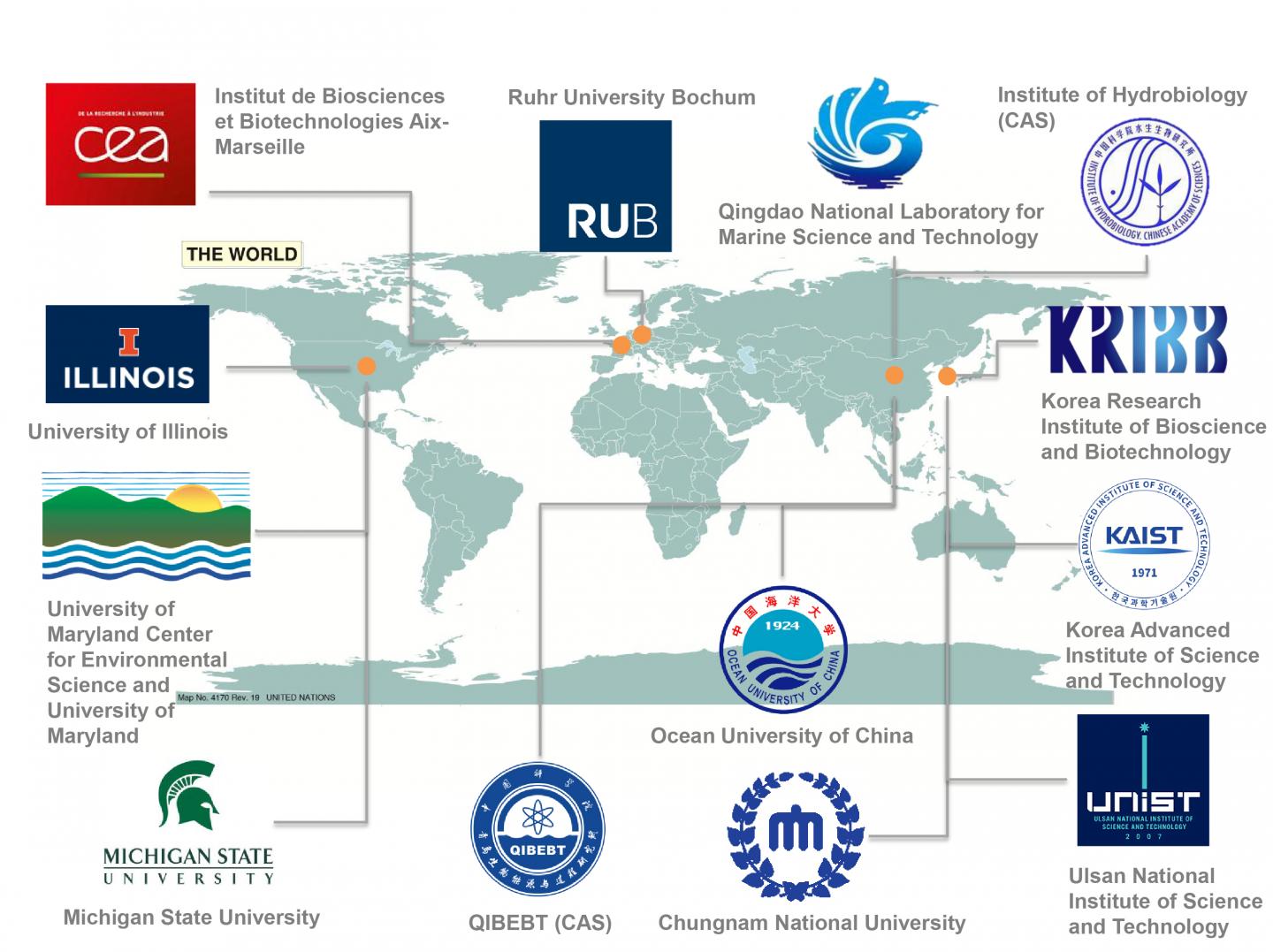
Behind the NanDeSyn database is an open international collaborative research network (Fig. 1). In addition to QIBEBT, the network also includes KAIST, Ulsan National Institute of Science and Technology (UNIST, Korea), Korea Research Institute of Bioscience and Biotechnology (KRIBB, Korea), Chungnam National University (CNU, Korea), MSU-DOE Plant Research Laboratory, Michigan State University (PRL, USA), French Alternative Energies and Atomic Energy Commission (CEA, France), Ruhr University Bochum (RUB, Germany), Qingdao National Laboratory for Marine Science and Technology (QNLM, China), Ocean University of China (OUC, China), University of Maryland (UMD, USA), Institute of Hydrobiology, CAS (IHB, China), University of Illinois (UI, USA), etc.

On the basis of the NanDeSyn database, this international collaborative research network will jointly develop Nannochloropsis into a chassis for photosynthetic production of oils from carbon dioxide.
This work was supported by the National Natural Science Foundation of China, the National Key Research and Development Program, the Natural Science Foundation of Shandong Province, and the Ministry of Science, Technology, Information and Communication of Korea.

Media Contact
CHENG Jing
[email protected]

Original Source

http://english.cas.cn/

Related Journal Article

http://dx.doi.org/10.1111/tpj.15025

Tags: BioinformaticsBiologyBiotechnologyMicrobiologyPlant Sciences
Share12Tweet8Share2ShareShareShare2

Related Posts

Assessing the K-NHSPSC: Korean Patient Safety Culture Insights

December 20, 2025

Spot Urine CA 19-9: New Insights in Pediatric Hydronephrosis

December 20, 2025

Discharge Choices for Elderly Surgical Patients Explored

December 20, 2025

Health Needs Influence Care Utilization in Women Veterans

December 20, 2025
Please login to join discussion

POPULAR NEWS

  • Nurses’ Views on Online Learning: Effects on Performance

    Nurses’ Views on Online Learning: Effects on Performance

    70 shares
    Share 28 Tweet 18
  • NSF funds machine-learning research at UNO and UNL to study energy requirements of walking in older adults

    70 shares
    Share 28 Tweet 18
  • Unraveling Levofloxacin’s Impact on Brain Function

    53 shares
    Share 21 Tweet 13
  • Exploring Audiology Accessibility in Johannesburg, South Africa

    51 shares
    Share 20 Tweet 13

About

We bring you the latest biotechnology news from best research centers and universities around the world. Check our website.

Follow us

Recent News

Assessing the K-NHSPSC: Korean Patient Safety Culture Insights

Spot Urine CA 19-9: New Insights in Pediatric Hydronephrosis

Discharge Choices for Elderly Surgical Patients Explored

Subscribe to Blog via Email

Enter your email address to subscribe to this blog and receive notifications of new posts by email.

Join 70 other subscribers
  • Contact Us

Bioengineer.org © Copyright 2023 All Rights Reserved.

Welcome Back!

Login to your account below

Forgotten Password?

Retrieve your password

Please enter your username or email address to reset your password.

Log In
No Result
View All Result
  • Homepages
    • Home Page 1
    • Home Page 2
  • News
  • National
  • Business
  • Health
  • Lifestyle
  • Science

Bioengineer.org © Copyright 2023 All Rights Reserved.