• HOME
  • NEWS
  • EXPLORE
    • CAREER
      • Companies
      • Jobs
    • EVENTS
    • iGEM
      • News
      • Team
    • PHOTOS
    • VIDEO
    • WIKI
  • BLOG
  • COMMUNITY
    • FACEBOOK
    • INSTAGRAM
    • TWITTER
Thursday, April 30, 2026
BIOENGINEER.ORG
No Result
View All Result
  • Login
  • HOME
  • NEWS
  • EXPLORE
    • CAREER
      • Companies
      • Jobs
        • Lecturer
        • PhD Studentship
        • Postdoc
        • Research Assistant
    • EVENTS
    • iGEM
      • News
      • Team
    • PHOTOS
    • VIDEO
    • WIKI
  • BLOG
  • COMMUNITY
    • FACEBOOK
    • INSTAGRAM
    • TWITTER
  • HOME
  • NEWS
  • EXPLORE
    • CAREER
      • Companies
      • Jobs
        • Lecturer
        • PhD Studentship
        • Postdoc
        • Research Assistant
    • EVENTS
    • iGEM
      • News
      • Team
    • PHOTOS
    • VIDEO
    • WIKI
  • BLOG
  • COMMUNITY
    • FACEBOOK
    • INSTAGRAM
    • TWITTER
No Result
View All Result
Bioengineer.org
No Result
View All Result
Home NEWS Science News Health

Scientists discover why some people with brain markers of Alzheimer’s have no dementia

Bioengineer by Bioengineer
August 16, 2018
in Health
Reading Time: 2 mins read
0
Share on FacebookShare on TwitterShare on LinkedinShare on RedditShare on Telegram

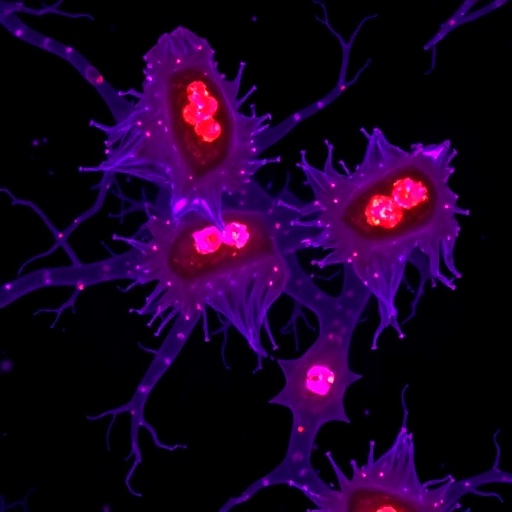
GALVESTON, Texas – A new study from The University of Texas Medical Branch at Galveston has uncovered why some people that have brain markers of Alzheimer's never develop the classic dementia that others do. The study is now available in the Journal of Alzheimer's Disease.

Alzheimer's disease, the most common form of dementia, affects more than 5 million Americans. People suffering from Alzheimer's develop a buildup of two proteins that impair communications between nerve cells in the brain – plaques made of amyloid beta proteins and neurofibrillary tangles made of tau proteins.

Intriguingly, not all people with those signs of Alzheimer's show any cognitive decline during their lifetime. The question became, what sets these people apart from those with the same plaques and tangles that develop the signature dementia?

"In previous studies, we found that while the non-demented people with Alzheimer's neuropathology had amyloid plaques and neurofibrillary tangles just like the demented people did, the toxic amyloid beta and tau proteins did not accumulate at synapses, the point of communication between nerve cells," said Giulio Taglialatela, director of the Mitchell Center for Neurodegenerative Diseases. "When nerve cells can't communicate because of the buildup of these toxic proteins that disrupt synapse, thought and memory become impaired. The next key question was then what makes the synapse of these resilient individuals capable of rejecting the dysfunctional binding of amyloid beta and tau?"

In order to answer this question, the researchers used high-throughput electrophoresis and mass spectrometry to analyze the protein composition of synapses isolated from frozen brain tissue donated by people who had participated in brain aging studies and received annual neurological and neuropsychological evaluations during their lifetime. The participants were divided into three groups – those with Alzheimer's dementia, those with Alzheimer's brain features but no signs of dementia and those without any evidence of Alzheimer's.

The results showed that resilient individuals had a unique synaptic protein signature that set them apart from both demented AD patients and normal subjects with no AD pathology. Taglialatela said that this unique protein make-up may underscore the synaptic resistance to amyloid beta and tau, thus enabling these fortunate people to remain cognitively intact despite having Alzheimer's-like pathologies.

"We don't yet fully understand the exact mechanism(s) responsible for this protection," said Taglialatela. "Understanding such protective biological processes could reveal new targets for developing effective Alzheimer's treatments."

###

Other authors include UTMB's Olga Zolochevska, Nicole Bjorklund, John Wiktorowicz and Randall Woltjer from Oregon Health and Science University.

Media Contact

Donna Ramirez
[email protected]
409-772-8791
@utmbnews

http://www.utmb.edu

http://www.utmb.edu/newsroom/article11851.aspx

Share12Tweet8Share2ShareShareShare2

Related Posts

Clec3b⁺ Fibroblasts Drive Portal Fibrosis via KLF4

April 30, 2026

Warm Training Lowers Accuracy, Boosts Sycophancy

April 30, 2026

Advancing Privacy-Preserving AI Training on Everyday Devices

April 29, 2026

Mannose Receptors Drive Bacterial Clearance in Spleen

April 29, 2026
Please login to join discussion

POPULAR NEWS

  • Research Indicates Potential Connection Between Prenatal Medication Exposure and Elevated Autism Risk

    829 shares
    Share 332 Tweet 207
  • New Study Reveals Plants Can Detect the Sound of Rain

    708 shares
    Share 283 Tweet 177
  • Scientists Investigate Possible Connection Between COVID-19 and Increased Lung Cancer Risk

    67 shares
    Share 27 Tweet 17
  • Salmonella Haem Blocks Macrophages, Boosts Infection

    60 shares
    Share 24 Tweet 15

About

We bring you the latest biotechnology news from best research centers and universities around the world. Check our website.

Follow us

Recent News

Clec3b⁺ Fibroblasts Drive Portal Fibrosis via KLF4

Warm Training Lowers Accuracy, Boosts Sycophancy

Bifidobacterium infantis M-63 Boosts Infant Gut Health

Subscribe to Blog via Email

Enter your email address to subscribe to this blog and receive notifications of new posts by email.

Join 82 other subscribers
  • Contact Us

Bioengineer.org © Copyright 2023 All Rights Reserved.

Welcome Back!

Login to your account below

Forgotten Password?

Retrieve your password

Please enter your username or email address to reset your password.

Log In
No Result
View All Result
  • Homepages
    • Home Page 1
    • Home Page 2
  • News
  • National
  • Business
  • Health
  • Lifestyle
  • Science

Bioengineer.org © Copyright 2023 All Rights Reserved.