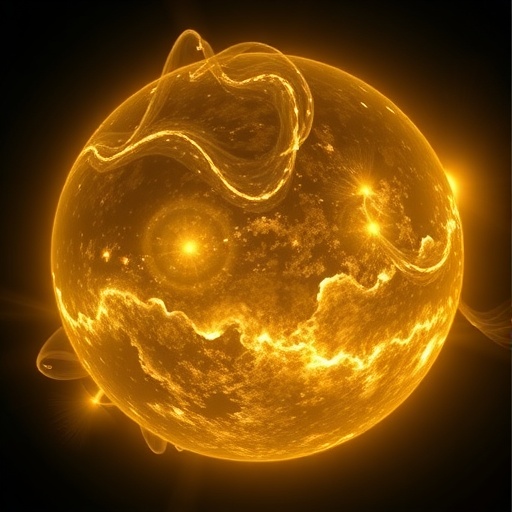
Scientists have captured the smallest solar surface vortices ever directly observed, revealing previously invisible plasma motions that may help explain how the Sun twists its magnetic field, mixes magnetized material and releases energy into its atmosphere. The structures were detected in exceptionally sharp images from the U.S. National Science Foundation’s Daniel K. Inouye Solar Telescope in Hawaii, the largest solar telescope in the world. Combined with advanced computer simulations, the observations expose turbulent activity occurring at scales of roughly 20 kilometers—tiny by solar standards, but potentially significant for the behavior of the entire star.
The discovery was made by researchers from the NSF National Solar Observatory, Germany’s Max Planck Institute for Solar System Research and the High Altitude Observatory in the United States. Their study, published in Nature, describes swirling plasma features positioned along the boundaries of solar granules. These granules are constantly shifting cellular patterns that cover the Sun’s visible surface, or photosphere. Each granule is typically between 500 and 2,000 kilometers across and forms as hot plasma rises from deeper layers, cools near the surface and sinks again.
The new images reveal delicate, fringed structures lining the edges of these granules. Some are less than 20 kilometers wide, placing them at the limit of what current solar imaging technology can resolve. The researchers compare the challenge to seeing a one-euro coin from a distance of 180 kilometers. To reach this level of detail, the team used a broad-band imaging camera supplied by the Max Planck Institute for Solar System Research, together with sophisticated image-restoration techniques that compensate for atmospheric distortion and instrumental effects.
Over time, the fringes were seen to develop swirling motions that resemble breaking ocean waves. The researchers interpret these motions as Kelvin–Helmholtz instabilities, a fluid-dynamic process generated when adjacent layers of fluid or plasma move at different speeds. The velocity difference creates shear at their interface. Small disturbances can then amplify into rolling waves and vortices, much as wind passing over water produces ripples that eventually curl and break.
Kelvin–Helmholtz instabilities are not unique to the Sun. They appear in terrestrial oceans and lakes, in cloud systems, in the atmospheres of Jupiter and Saturn, and where the solar wind encounters planetary magnetic fields. On the Sun, however, the process unfolds in electrically charged plasma governed by both fluid motion and magnetic forces. At the borders of granules, neighboring plasma streams can move in different directions or at different velocities, creating the conditions required for the instability to grow.
The discovery could alter scientists’ understanding of how solar magnetic fields become energized. Magnetic field lines emerging through the photosphere can be stretched, twisted and coiled by moving plasma. In this state, the field stores magnetic energy, much like a tightly wound spring. When the configuration becomes unstable, magnetic reconnection can abruptly rearrange the field lines and convert stored energy into heat, particle acceleration and radiation.
One possible consequence is the production of nanoflares, extremely small bursts of energy that are individually far weaker than major solar flares but may occur in enormous numbers. Nanoflares have long been considered a possible contributor to the Sun’s extraordinarily hot corona, yet the physical processes that supply and release their energy remain debated. If the newly observed vortices continually twist magnetic field lines, they could provide a persistent mechanism for loading energy into the solar atmosphere and initiating small-scale reconnection events.
The vortices may also solve part of a long-standing problem involving the transport of magnetic flux. The observations and simulations indicate that these miniature whirlpools efficiently mix magnetized and non-magnetized plasma at the solar surface. Such mixing could help magnetic fields spread upward into the atmosphere more rapidly than existing models predict. This matters because the Sun’s magnetic activity rises and falls over an approximately 11-year cycle, a remarkably fast transformation that requires magnetic flux to be redistributed efficiently through the solar surface and atmosphere.
Researchers caution that the images represent only a narrow window into a highly dynamic environment, and further observations will be needed to determine how often the vortices occur, how strongly they are shaped by magnetic fields and how much energy they transport. Nevertheless, their apparent ubiquity wherever the magnetic field is sufficiently strong suggests that they may be a fundamental part of solar surface physics rather than an unusual phenomenon. The result demonstrates how processes occurring across just a few dozen kilometers can influence the evolution of the Sun’s magnetic architecture—and potentially the bursts of radiation that affect the space environment around Earth.
Subject of Research: Not applicable
Article Title: Ubiquitous Kelvin–Helmholtz instabilities driving plasma mixing on the Sun
News Publication Date: 5-Aug-2026
Web References: https://doi.org/10.1038/s41586-026-10871-3
References: Nature, DOI: 10.1038/s41586-026-10871-3
Image Credits: NSF/NSO/AURA/MPS
Keywords
Sun, solar physics, plasma vortices, Kelvin–Helmholtz instability, solar granulation, magnetic reconnection, nanoflares, solar magnetic fields, Daniel K. Inouye Solar Telescope, space weather
Tags: advanced computer simulations of solar activityDaniel K. Inouye Solar Telescope observationshigh-resolution solar imagingmagnetic field twisting on the Sunplasma motions in the Sun’s atmospheresolar energy release mechanismssolar granulation and vortex formationsolar magnetic field dynamicssolar surface turbulencesolar surface vorticestiny plasma vortices on the Sunturbulence at small solar scales